location-recall-location-2ca5b4ac110f
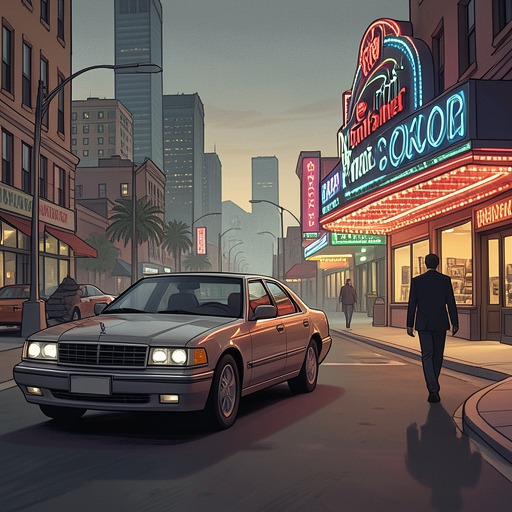
The GodfatherLas Vegas is the western setting in which the Corleone Family’s future is imagined, tested, and finally established. It first appears as a refuge and working environment for people damaged by the New York family’s violence, then as the foundation of a casino empire, and ultimately as the permanent home of Michael Corleone and his household. Its decisive significance lies in this doubleness: Las Vegas offers distance from the old New York order while preserving the same network of favors, secrecy, security, and controlled power in a new commercial form.
A Western Refuge and Working World
Las Vegas initially provides a changed life for Lucy Mancini after her departure from New York. Nearly eighteen months into her stay, she is surprised to find herself almost happy. She swims in hotel pools, sails on Lake Mead, drives through the desert on her days off, and works as a receptionist in the public-relations section of the hotel. The landscape and routine do not erase her memories of Santino Corleone, but they give her a life not organized entirely around grief. She remains isolated from Fredo Corleone in practical terms, although he stops to talk when they meet, and she observes that he has become thinner, carefully dressed, socially confident, and capable of running the hotel side of a gambling resort.
Las Vegas also becomes a place where the Corleone network can protect people through arrangements that appear legal and administrative. Tom Hagen visits Lucy after six months and explains the structure behind her regular support: she receives six hundred dollars a month in addition to her salary, signs powers of attorney so the money can be channeled properly, and is formally listed as the owner of five points in the hotel where she works. The arrangement requires Nevada legal formalities and secrecy, but it promises legal protection and assured income. In Las Vegas, personal obligation is translated into ownership documents, payroll, and regulated business forms without ceasing to be an obligation enforced by the family.
The city’s social life is equally shaped by the entertainment industry’s mixture of pleasure and management. The Hollywood Movie Star Lonely Hearts Club meets every Friday at a studio-owned house in Las Vegas, officially under the cover of viewing a new film. Jack Woltz devised the parties because aging stars needed help finding lovers and because young male actors on the studio payroll could be drawn into a system of sexual opportunity and professional advancement. When parties produced brawls or sexual excess, the public-relations counselor was present to pay off newsmen and police officers and keep the incidents quiet. Las Vegas therefore appears not simply as a resort but as a controlled marketplace in which desire, publicity, labor, and reputation are managed together.
The Casino Foundation
Michael Corleone eventually identifies Las Vegas as the place where the family’s future lies. He tells Johnny Fontane, Fredo Corleone, and others that the Corleone Family plans to sell its interests in the olive-oil business and settle in the West. The move may take two, three, or even four years, but the intended foundation already exists: friends of the family own a substantial percentage of the hotel and casino, and Moe Greene is expected to sell his interest so the property can become wholly controlled by family allies. Las Vegas thus marks a shift from an older enterprise rooted in trucking and olive oil toward casinos, hotels, and a more openly corporate form of wealth.
The plan immediately exposes a conflict between personal affection and business control. Fredo Corleone doubts that Moe Greene will sell because Greene loves the business and has never mentioned such an intention. Michael answers with the family’s familiar language of compelled agreement, declaring that Greene will be made an offer he cannot refuse. The sentence carries the old power into the new setting: Las Vegas may represent modern commerce, but its transactions remain backed by the Corleone Family’s authority rather than by ordinary negotiation alone.
When Michael reports to the family leadership after his trip, he says Greene refused the offer to buy him out, but he still presents the western expansion as the settled direction. The Corleone Family will have four hotel casinos on the Strip, though not immediately. Michael asks Peter Clemenza and Salvatore Tessio to follow his lead for one year without questioning or reservation; afterward, each may split off and become the head of his own family while preserving the friendship owed to Michael’s father. Las Vegas therefore reorganizes not only the family’s business but also its internal loyalties, turning an uncertain relocation into a test of obedience, patience, and succession.
Networks of Protection and Control
The city’s power does not stand alone. It is connected to the older structure through friendships, debts, and information. Don Vito Corleone’s influence had long depended on helping labor leaders, and those earlier relationships remain useful beyond New York. Tom Hagen can reach the most powerful man in the movie labor unions and arrange a meeting with Jack Woltz by suggesting that failure to satisfy the Corleone side could bring a labor strike. The threat works through a network rather than through a formal command: labor, entertainment, organized crime, and personal obligation overlap, making geographical distance less important than remembered debt.
The same principle appears in the family’s protection of its commercial interests. Vito Corleone once told a lawyer to place every potentially useful official on the organization’s monthly payoff list, even those who could not help immediately, because he believed in showing friendship first. That policy explains how Las Vegas can become a credible destination before the move is complete. The family carries westward not merely money but a stored network of obligations, contacts, and reciprocal services. Its wealth is accumulated through relationships as much as through visible property.
The Las Vegas operation also reveals the continuing importance of hidden organization beneath respectable surfaces. Tom Hagen notices that Rocco Lampone is building a secret regime: recruits are placed on the payroll at salaries higher than their apparent jobs warrant, and everyone formally hired by Lampone is supposed to be reported. Michael has given Lampone independent living and considerable freedom, allowing him to build an empire within the larger empire. The western business therefore requires both public legitimacy and covert personnel structures. Hotels, casinos, ownership points, construction interests, and security operations may look like ordinary enterprises, while the family’s real capacity depends on information withheld from most participants.
Permanent Home and New Order
After the family’s bloody victory and a year of political maneuvering, Michael Corleone becomes the most powerful Family chief in the United States. During that year he divides his time between headquarters at the Long Beach mall and his new home in Las Vegas. Once he decides to close the New York operation, he brings the entire family East for a final month to sell the houses and mall property and complete the remaining business. The movement is no longer exploratory. New York is being dismantled so that Las Vegas can become the family’s permanent center.
The completed western order is carefully distributed. Clemenza has his own Family, Rocco Lampone is a Corleone caporegime, Albert Neri heads security for the family-controlled hotels in Nevada, and Tom Hagen remains part of Michael’s Western Family. Las Vegas is consequently not just a private residence or a casino address; it is the geographic center of a reorganized hierarchy. Authority has been relocated, delegated, and embedded in distinct offices and territories, even as the family’s underlying discipline persists.
For Kay Adams Corleone, the move changes the emotional meaning of the family’s power. She comes to love Nevada’s red-rock hills and canyons, burning deserts, refreshing lakes, and intense heat. Her two boys ride their own ponies, she has real servants rather than bodyguards, and Michael lives a more normal public life through a construction business, businessmen’s clubs, civic committees, and an interest in local politics. She is happy that the New York house is closing and that Las Vegas will truly be home; returning to New York feels like returning to a place from which she wants to be discharged.
That final departure gives Las Vegas its strongest narrative function. At dawn on the last day, Kay hears the trucks outside the mall emptying the houses of furniture while the family prepares to fly back to Nevada. The sound joins the city’s machinery of relocation to the private act of beginning again. Las Vegas promises normality, permanence, and civic respectability, but it is built from the liquidation of the old headquarters and the survival of the old methods. Its apparent openness is therefore also a form of concealment: the Corleone Family has not abandoned power; it has found a setting in which power can be made to look like ownership, hospitality, security, and ordinary American success.