organization-recall-organization-875627e9d8e7
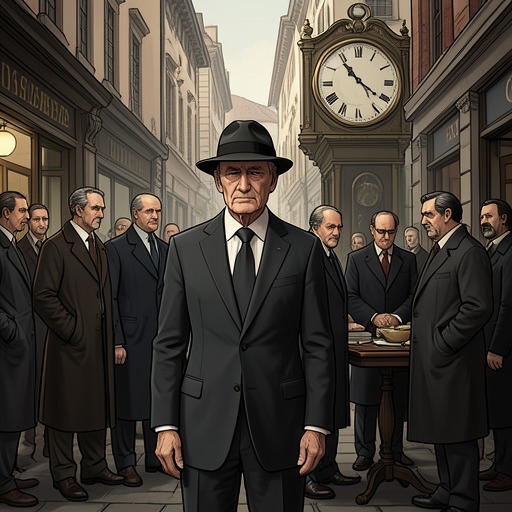
The GodfatherThe Five Families are the five dominant New York Mafia organizations whose combined power governs the central political and commercial conflicts of the underworld. They function not as a single state but as rival sovereign powers: each preserves authority over its own organization and territory, yet all are capable of mobilizing against a common enemy or negotiating rules that bind the whole system. Their history with the Corleone Family moves from uneasy coexistence to war, and then to a peace settlement that reveals how organized violence can harden into a form of government.
Structure and Balance of Power
The Five Families operate through layered organizations in which authority is separated from the men who carry out orders. The Corleone Family, whose structure provides the clearest example, places a Don above a Consigliere and caporegimes, with soldiers and lower-level operators beneath them. Orders pass through insulating links so that an operational act cannot easily be traced to the head of the Family. This arrangement allows a chief to exercise extensive power while limiting his direct exposure, and it gives the broader New York system a bureaucratic quality even though its authority rests on loyalty, secrecy, and violence.
The Families are sustained by more than gunmen. Their power depends on gambling, prostitution, bookmaking, numbers operations, labor influence, political contacts, police payoffs, and reciprocal favors. Don Vito Corleone builds his own organization by protecting Italian families, maintaining a list of officials receiving monthly payments, helping residents obtain work or avoid jail, and advising voters about political candidates. Such networks make the Families competitors in both commerce and public authority. They offer protection and assistance where courts, banks, employers, and government offices appear indifferent, while expecting loyalty and future service in return.
The balance among the Families is never permanent. Before the war, Don Vito Corleone works to preserve peace among powerful underworld organizations throughout the United States, respecting each member's internal authority while establishing spheres of influence and a general obligation to prevent violence. The arrangement resembles a federation of criminal powers: independence is preserved, but disorder is limited when it threatens common interests.
War with the Corleone Family
The modern conflict begins after Michael Corleone kills Virgil Sollozzo and Captain McCluskey. New York City police respond with sweeping raids, suspending gambling, prostitution, and other illegal activities until the captain's killer is found. When an emissary asks whether the Corleone Family will surrender Michael, the response is that the affair does not concern them. A bomb is then thrown at the Corleone Family's Long Beach mall, and two Corleone button men are killed while eating in a Greenwich Village restaurant. The Five Families War has begun.
The war of 1947 damages both sides, but police pressure makes the conflict especially costly. The Corleone Family's numbers and policy operations are disrupted, runners are arrested, gambling banks are raided, and the organization loses substantial income. The Five Families then strike at the Corleones' wider network. Two powerful garment-union officials belonging to the Corleone Family are murdered; Corleone shylocks and bookmakers are driven from the waterfront; longshoremen's locals shift allegiance; bookmakers throughout the city are threatened; and an important Harlem numbers banker allied with the Corleones is brutally killed.
The attacks force Santino Corleone to abandon the hope of limited retaliation. He orders the organization to enter a full defensive war, establishing two furnished apartments in New York as temporary bases, stocking them with mattresses, food, guns, and ammunition. Clemenza and Tessio each command one base, while Corleone bookmakers receive bodyguard teams. Yet the organization is overmatched. Don Vito Corleone is too weak to restore his former political influence, years of peace have diminished the fighting strength of the caporegimes, and Tom Hagen's non-Sicilian background is treated as a liability for a wartime Consigliere.
The Five Families' advantage is therefore not merely numerical. Their pressure exposes the dependence of Mafia power on political protection, information systems, loyal labor networks, and disciplined command. When those supports are disrupted, the language of honor and family cannot by itself replace lost revenue or weakened institutions.
Peace Conference and Collective Rule
Santino Corleone's death creates the expectation of a massive Corleone counterattack. Instead, Don Vito Corleone rises from his sickbed and sends emissaries to propose peace and a meeting involving the New York Families as well as Families from across the United States. The proposal initially appears suspicious: it might be a trap, a diversion, or preparation for a massacre. Its credibility is established when the Don takes no steps to place his own forces on a war footing and invokes the Bocchicchio Family, whose tightly bound blood relations have become an instrument of peace.
The conference is held in a private executive suite of a bank under the protection of handpicked guards wearing bank uniforms. Representatives of the Five Families of New York are joined by ten other Families from around the country, with Chicago excluded because the others have abandoned attempts to discipline it. Each representative may bring one aide. Most Dons bring Sicilian Consiglieres, while Tom Hagen is the only non-Sicilian young man in the room and is treated as an object of curiosity. He remains silent, serving Don Vito Corleone with formal respect by bringing him a drink, lighting his cigar, and arranging his ashtray.
The council converts wartime antagonism into a negotiated order. The Families agree that narcotics trafficking will be permitted, with the Barzini and Tattaglia Families handling much of the large-scale business and Don Vito Corleone providing legal protection in the East. They also designate Las Vegas and Miami as open cities in which any Family may operate, while prohibiting violence there and discouraging petty criminals. Executions likely to provoke public outrage require council approval, and soldiers are to be restrained from personal acts of vengeance against one another. The Families further promise mutual services, including executioners, technical assistance, and help with bribing jurors when necessary.
This settlement does not abolish conflict; it regulates the conditions under which conflict may occur. The council acts as a substitute court, diplomatic congress, and security compact. Its rules protect collective profitability by limiting uncontrolled violence, while preserving each Family's internal authority. The result is a criminal version of legal pluralism: state law remains officially valid, but the Families establish their own rules, judges, punishments, and channels of cooperation.
Ideology and Historical Significance
Don Vito Corleone presents the settlement as a sacrifice of private vengeance for the common good. He argues that the Families must manage their own affairs rather than submit to powerful outsiders who make laws for their own benefit. His appeal to shared identity and mutual defense gives the council an ideological foundation: the Families are not merely gangs competing for revenue but a community resisting external control.
At the same time, the rhetoric of protection conceals coercion. Don Vito Corleone helps the poor, intervenes with landlords, finds jobs, and assists people facing courts or jail, but these favors create debts. His organization supports the families of imprisoned employees so that silence is rewarded and betrayal is made materially unthinkable. The same pattern operates among the Five Families. Protection, friendship, territory, and commercial access are exchanged through personal allegiance rather than impartial law.
The council therefore marks both the height of the Five Families' influence and the beginning of a structural transition. Their authority depends on older forms of personal loyalty, yet it increasingly resembles a modern system of offices, records, intermediaries, banks, labor organizations, police contacts, and negotiated jurisdictions. The old order remains violent, but it is no longer disorganized. It has learned to institutionalize violence by deciding when it is profitable, when it is forbidden, and when it must be collectively authorized.
Decline of the Corleone Position
After the peace, the Corleone Family's relative strength declines. By the time Michael Corleone takes control, the Barzini Family is indisputably the most powerful in the New York area, allied with the Tattaglia Family and steadily moving into Corleone gambling territory. The strain is visible even inside the Corleone leadership. At a meeting attended by Don Vito Corleone, Michael Corleone, Tom Hagen, Carlo Rizzi, Clemenza, and Tessio, succession is treated as a political problem rather than an automatic hereditary right. Powerful caporegimes could, under other circumstances, become Dons or split away to establish their own Families.
Michael Corleone's later victory reverses that decline. It takes a year of delicate political maneuvering after the bloody campaign to establish him as the most powerful Family chief in the United States. Once the Corleone Family becomes unchallengeable, Clemenza has his own Family, Rocco Lampone serves as Michael's caporegime, Albert Neri controls security for the Family's Nevada hotels, and Tom Hagen belongs to Michael's Western organization. The Five Families remain the framework against which this achievement is measured, but their former balance has been replaced by Corleone dominance and a new center of power in Las Vegas.