Alcohol Dependence and Escaping Reality
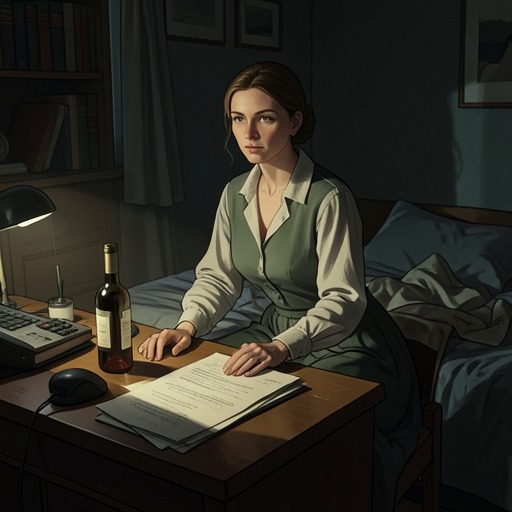
The GodmotherAlcohol Dependence and Escaping Reality is presented through Anita Cavanagh’s repeated use of drinking to soften distress and postpone confrontation. The relief is immediate but temporary: it dulls her anger and disappointment, while contributing to strained friendships, conflict with Giles Cavanagh, and a growing sense that familiar ways of recovering from a bad patch no longer work.
Relief and Avoidance
At the agency bar, Anita has already begun drinking early in the day. She experiences the resulting placidity as a welcome reprieve, but the scene also shows what that reprieve costs. Rachel Elliot notices signs of Anita’s drinking and arrives intending to offer help; faced with Anita’s mood and the noisy, crowded setting, however, she cannot bring herself to raise the subject. The conversation they might have had is displaced by the bar’s distractions and by Rachel’s reluctance to press her friend.
Anita’s intoxication also alters what she says. When Rachel jokes about the possibility of having a baby, Anita responds with an offer involving her husband, a remark that turns marital frustration into provocative humour. The exchange is not a direct discussion of her drinking or her relationship with Giles. Instead, intoxication loosens her speech while keeping the underlying distress at a distance. The more candid remarks do not necessarily bring greater intimacy: Rachel feels weary and lets the difficult subject go.
The Strain on Friendship
The bar encounter has consequences beyond that evening. Rachel and Anita do not speak for a week, despite Rachel leaving messages. Rachel is caught in a familiar dilemma: she wants to support Anita without intruding, but avoidance leaves her with little sense of how her friend is faring. When she contacts Giles, he describes Anita as going through a downward swing and says his parents have been brought in to help at home. He promises to keep Rachel informed but does not do so. The account makes the limits of informal care plain: concern exists, yet communication remains guarded and unreliable.
Anita’s drinking is therefore not represented only as private relief. It affects the people around her, who must decide whether to intervene, wait, or manage the immediate consequences. At the agency, Will Raphael helps Anita walk out and into a taxi. Rachel follows, takes care of Anita’s coat, and says she will contact Giles to let him know Anita is on the way. Anita’s apology is brief, and she describes herself harshly as drunk again. The incident makes the practical burden visible: others are left to get her home and communicate with her husband, even as Anita seems aware that this is not an isolated occurrence.
A Recurring Marital Cycle
Later, Anita recalls a pattern in her marriage. Bad periods have previously reached a crisis, after which she and Giles turn toward each other with regret and promises to try again. A spell of cheerfulness follows, then calm gives way to renewed difficulty. The cycle has been painful, but its predictability has also offered reassurance: a bad period would end, just as a good one would. Anita now senses that this familiar rhythm has changed. Giles, she believes, is no longer taking part in the same process, and she is unsure whether her drinking alone accounts for the distance between them.
Her memories give the drinking a relational context without excusing its effects. Anita has sometimes believed that it makes Giles gentler and more conciliatory. At the same time, she resents his withdrawal. During Christmas week he is away from her emotionally, leaving conversation to his parents; the presents he gives her, a Smith’s token and a book about birds, strike her as poorly attuned to her. The accumulated disappointments feed the anger and loneliness she carries into the New Year’s Eve party. Her drinking sits within this larger marital impasse, serving as a way to manage feelings that neither spouse is resolving together.
The Party and the Return of the Pattern
Before the party, Anita has behaved herself for two weeks, but she is eager to drink without counting her glasses or worrying about whether anyone else is counting them. The occasion offers a temporary permission to suspend restraint. She has also arranged for Will to be invited, hoping to see him and to make the evening a way of punishing Giles. The combination of resentment, anticipation, and planned drinking shows how the party becomes more than a social outing: Anita enters it already using the occasion to escape the ordinary limits she has been trying to observe.
At the party, Anita presents herself to Rachel and Will with exaggerated cheerfulness. She jokes about flirting with Will and about her deteriorating closeness with Giles, while Rachel recognizes that much of the brightness comes from alcohol and asks to speak privately. Anita refuses the conversation, saying that talking never does any good, then draws Will away to dance. Her decision turns the evening’s apparent gaiety into another form of avoidance. The drink blunts her disappointment, but it also helps her evade Rachel’s attempt to reach her and sharpens the risk to their friendship. Rachel leaves the exchange smiling after them, yet worried that the friendship is being lost and that the situation cannot continue at its current pitch.
What Drinking Can and Cannot Do
A separate moment in Rachel’s car clarifies the wider emotional atmosphere surrounding the friendship. Already feeling isolated and troubled by her own life, Rachel turns on Radio 4 and hears a discussion of infertility. She then reaches for her work phone to try Anita, who has not been returning her calls. The passage does not make Rachel’s distress equivalent to Anita’s drinking; rather, it places Rachel’s private worry beside the silence between the friends. Their difficulties coexist, but alcohol has made it harder for them to meet each other openly.
Across these scenes, drinking repeatedly promises a pause: placidity at the agency, freedom from monitoring at the party, and temporary relief from marital disappointment. Yet each respite is bounded by consequences. Anita becomes difficult for Rachel to approach; Will and Rachel must help her leave the agency; and at the party her intoxicated performance pushes away the conversation that might have addressed the friendship’s strain. The book thus treats alcohol as both an escape from distress and a force that helps perpetuate it. The pattern offers no resolution in the supplied episodes: the desire to feel better recurs, while the underlying marriage and the increasingly fragile friendship remain unsettled.