Anita Cavanagh
The GodmotherAnita Cavanagh is a freelance journalist, mother of three, and a long-standing friend of Rachel Elliot. Her life is marked by the distance between the ambitious career she once imagined and the domestic responsibilities that have narrowed her opportunities. Her marriage to Giles Cavanagh and her escalating reliance on alcohol deepen that frustration, while her bond with Rachel provides both a refuge and a point of painful comparison.
Identity and Background
Anita first meets Rachel when she is writing for Campaign and Rachel is buying magazine advertising space. Their professional encounter begins with Anita interviewing Rachel for a small article about rising media costs, but becomes a long lunch and the start of a friendship. Anita speaks openly about hoping to use journalism as a step toward greater achievements; Rachel is more guarded about her own ambitions, but listens and encourages her. Anita admires Rachel’s composure and judgment, yet Rachel’s apparent success can also make Anita feel diminished by comparison.
Anita’s ambitions are redirected by her relationship with Giles, an ambitious political journalist. Even before they marry, she repeatedly chooses to accompany him abroad rather than take regular work in London. At first this choice reflects her infatuation; later, she fears that prioritizing her career might lead to his leaving her. The pattern secures their relationship at a cost: opportunities dwindle for a freelance writer who has no settled speciality and is often away. By the time she is raising three children, she is still writing, but her work is intermittent and frequently fitted around family life.
Work and Family Life
Anita’s domestic routine is busy and often isolating. While trying to write a witty feature about London leisure centres, she watches the twins paint the kitchen walls as well as their paper, then each other. Rain closes in on the garden, and the children’s clamour makes concentrated work difficult. She looks forward to their starting nursery, imagining five mornings in which she might have time to herself. The anticipation shows how little uninterrupted space she has, even as she continues to value her identity as a writer.
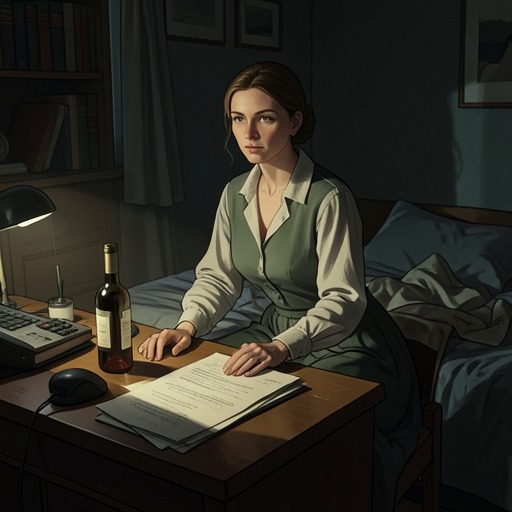
When the twins are absorbed in play, Anita slips away to the utility room for wine, taking several quick sips alone beside the washing machine. She returns to the kitchen, joins in their tiger game, and manages to write between looking after them. Later she refills her glass and calls Rachel. This sequence links her drinking to the search for a brief pause in an otherwise crowded day, without making it a solution to the conditions that exhaust her.
Her eldest child, Charlotte, wakes at night and comes into her parents’ bed; the twins, Laura and Eddie, are in a phase of starting their day at five. Anita also describes trying to finish a feature while keeping the children occupied and maintaining the household. She makes clear that these pressures coexist with her wish to work: her concerns are not simply that family life is demanding, but that the demands repeatedly restrict the career she once hoped to build.
Friendship and Motherhood
Anita regards Rachel as an unusually steady source of perspective: successful, self-possessed, and kind. When family life feels bleak, she calls to ask whether she can visit. She describes Giles returning from reporting among Russian rebels with an expectation of being treated as a hero, while he berates the children and criticizes her. She is also trying to write about leisure centres, a subject she considers less glamorous than war reporting but necessary to keep the family going. Her appeal to Rachel makes their friendship practical as well as intimate: Rachel is someone Anita trusts with an unvarnished account of her difficulties.
That trust is tested when Anita learns Rachel might be considering having a child. Anita warns her that motherhood can erode independence and pull a working mother in opposing directions: toward work and time alone, and toward staying with the children. She insists that money for a nanny would not remove those pressures. Her argument draws on the demands she knows firsthand, but it also turns her own ambivalence into a judgment about Rachel’s future. Rachel is angered by the assumption that she would not want a child and by Anita’s attempt to dissuade her. The exchange reveals an important asymmetry in their friendship: Anita can be a perceptive confidante, yet the strain of her own experience can make her less able to support a choice different from hers.
Anita later recognizes Rachel’s renewed relationship with Robbie Dexter and the possibility that Rachel may have the love and family life she wants. At a New Year’s Eve party, Anita links arms with Rachel and Will Raphael, joking that she wants to flirt with Will and hear about Robbie. Her levity carries envy and hurt: she sees Rachel as having found what Anita feels she has lost, while her own marriage has become emotionally distant. When Rachel tries to talk, Anita declines, saying conversation has not helped. Rachel, already concerned by the alcohol in Anita’s breath and her mood, finds herself too weary to offer the carefully considered support she had intended.
Alcohol and Marital Crisis
Anita’s drinking recurs in moments of stress and social exposure. After returning from a work trip, Rachel meets her at the McKenzie Cartwright bar intending to offer help. Anita has already begun drinking that morning and appears mellow; Rachel notices the signs and loses the energy to raise the subject. The setting is crowded and noisy, leaving little room for the serious conversation Rachel had hoped to have. Their friendship is not severed, but Anita’s drinking makes care difficult to offer and difficult to accept.
The marriage’s trouble has long followed a cycle. Anita tells friends, including Rachel, that the relationship seems to consist of one bad patch after another. At earlier low points, she and Giles have turned toward each other with regret and promises to try harder; a cheerful period follows, then calm, then renewed difficulty. The predictability has helped her endure the pattern because she assumes neither the good nor the bad can last. More recently, however, Giles no longer seems to participate in the familiar reconciliation. During Christmas week he stays away behind the steady conversation of his parents, and his gifts—a Smith’s token and a book about birds—show how little attention he has paid to her preferences. Anita’s anger and loneliness surface as she anticipates a party, hoping to drink without monitoring herself and to see Will again.
At another point, she tells Rachel that Giles seems like a different person and wonders whether he has fallen in love with someone else, despite his denials. The suspicion is not confirmed. More concretely, his withdrawal prevents Anita from concentrating on a substantial commission about balancing a career with early motherhood. The assignment is well paid and closely connected to her own experience, but she cannot focus while she believes Giles is deliberately making her miserable. Rachel suggests that he may be ill; Anita objects that he insists he is fine and will not see a doctor.
Illness, Work, and Change
Anita later calls Rachel with a changed understanding: Giles really is ill. Doctors suspect a post-traumatic condition connected to his time in war zones and keep him in hospital for tests. His lack of energy had looked to Anita like indifference or hostility; learning that illness may account for it brings relief, although it does not undo the strain of the preceding weeks. Rachel has tried to reach Anita for days, and their conversation returns to the practical burdens that surround the crisis.
The children respond warmly to their father’s illness, making get-well presents from toilet rolls and string. At the same time, Anita’s work begins to arrive more steadily. She reports that her piece on postnatal depression has struck a chord and that she has received assignments on wife-beating, with euthanasia planned next. This renewed demand contrasts with the earlier difficulty of concentrating on her career, but also creates another problem: she needs reliable childcare. When Rachel tentatively offers to help, Anita receives the offer as an extraordinary kindness. Their friendship thus moves beyond confidences and disagreements into material support, with Rachel offering time that may enable Anita to work.
Narrative Role
Anita’s story brings the conflict between professional identity, motherhood, and marriage into ordinary domestic detail: a feature written around children’s play, a hoped-for nursery schedule, a party approached as a rare escape, and work that cannot be completed while a partner’s condition remains unexplained. Her experience complicates her advice to Rachel. She knows the costs of parenting and fears for Rachel’s independence, yet her warning becomes unfair when it assumes Rachel’s desires can be settled by Anita’s own exhaustion.
Her relationship with Rachel is shaped by both affection and comparison. Rachel offers steadiness and, eventually, childcare; Anita offers candid accounts of marriage and motherhood, but can withdraw into alcohol or turn her hard-won knowledge into discouragement. The later recognition that Giles may be ill and the return of serious commissions do not erase the pressures she faces. Instead, they change their immediate shape: marital neglect becomes a medical uncertainty, career frustration gives way to the need for childcare, and friendship becomes a concrete means of making work possible.