Cats
The GodmotherThe cat in Rachel Elliot’s story is an unclaimed visitor rather than an established pet: it enters her home during a rainstorm, returns after she has let it outside, and appears again while Anita Cavanagh is visiting. Its brief, recurring presence unsettles Rachel’s reluctance to take responsibility for an animal and gives the narrative a concrete image through which to connect her domestic boundaries, her working habits, and a dream of a baby.
Appearance and uncertain status
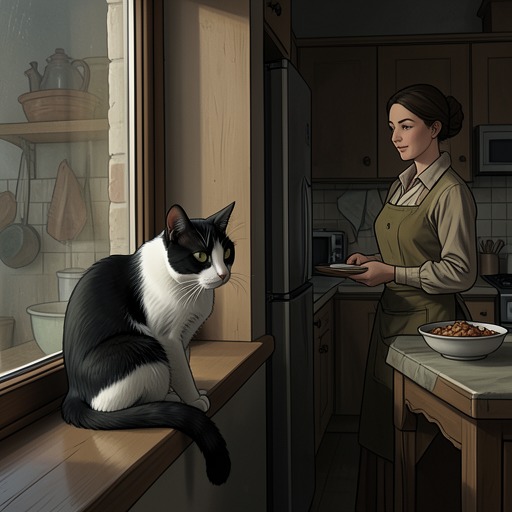
The cat is black, with white patches around its eyes and white tips to its ears. When Rachel first sees it waiting beside the glass door to the garden, it changes its loud call to a quieter mew. The contrast between its persistent attempts to attract attention and Rachel’s wish to stay indoors makes their first encounter a negotiation: it seeks entry, while she initially regards the animal as an unwelcome responsibility.
Rachel is not accustomed to keeping pets. She associates them with smells and fur that are difficult to remove, and she worries that feeding a wandering animal might discourage it from returning to its rightful owners. The text does not establish who owns the cat. Later, Rachel guesses that it may belong to a neighbor, but that remains an assumption rather than a confirmed explanation for its repeated appearances.
Arrival at Rachel’s home
The cat’s first arrival takes place on a wet, windy evening. After hearing a high-pitched sound outside, Rachel at first imagines that an animal is in distress and hesitates to investigate. When she finally lifts the curtain, she finds the cat waiting at the door. She tells it to go away, but its continued appeal prompts her to unlock the door. Although she makes clear that she does not want a pet, the cat slips inside and settles on the blue circle of a hand-woven rug.
Rachel limits the welcome in words to a single night. She puts on a Fauré piano quartet and returns to her briefcase, where she has work papers concerning the agency’s staffing and recruiting policies. The presentation is connected with a senior post expected to become vacant, and she believes her promotion is due. The cat’s arrival therefore interrupts, rather than replaces, a night organized around work and professional advancement. Its easy occupation of the room stands in contrast to Rachel’s effort to keep both her home and her ambitions under control.
That night, the animal also enters Rachel’s dream. As it settles across her stomach and thighs, her sleeping mind transforms its warmth and weight into the image of a baby rising from within her. The episode is a dream, not a literal change or a waking decision to keep the animal. Its importance lies in the association the narrative creates between the cat’s presence and an imagined baby: an unexpected domestic visitor becomes, for a moment, the shape of a different possibility.
A brief welcome, then another return
The next morning, Rachel finds the cat at the end of her bed. She wakes it and sends it out into the garden; when it remains nearby as though expecting breakfast, she refuses to feed it, wary of encouraging a pet that may have an owner. She then shuts the curtains and returns to her room. The sequence marks a boundary she tries to maintain: the cat has been allowed inside, but Rachel does not accept that one night as the beginning of an ongoing obligation.
That boundary does not settle the matter. Rachel goes into work despite having intended to take a day for herself, and later wonders whether the cat contributed to her early start. The account does not establish that the animal caused her change of plans; it shows instead that its presence has remained in her thoughts as she moves back into the demands of account management. Her reluctance to feed it and her awareness of it persist together, without resolving into adoption.
The cat during Anita’s visit
When Anita visits later, the cat appears again, leaping onto the arm of the sofa and startling her. Rachel is surprised too: she has not seen it since its one-night stay after her return from France. She says that it must have slipped in when she opened the front door and recalls that she once let it inside. Her explanation makes recurrence clear while leaving the practical question of how it has entered the house unanswered.
Anita responds differently from Rachel. She admires the cat’s appearance, speculates that it has Persian ancestry, and argues that it is doing no harm. She then connects the subject of cats to toxoplasmosis, an illness she remembers writing about, and describes possible risks during pregnancy. Rachel asks what might happen if someone were pregnant; Anita cannot recall the details precisely. The exchange introduces pregnancy as a subject through the visitor rather than as a confirmed condition or medical event in Rachel’s life. Against the earlier dream, the conversation gives the cat’s return a further narrative association with motherhood, while the text remains careful not to establish more than the characters actually say.
Across these scenes, the cat is less a pet with a known history than a recurring disturbance to Rachel’s attempts to define the limits of her home. It comes and goes without a settled explanation, and Rachel alternates between refusing it and letting it remain. Its narrative role gathers force through that repetition: first an unexpected animal at a rain-darkened door, then a dream image, and finally the occasion for a conversation about pregnancy. The cat does not resolve Rachel’s domestic or personal questions; its appearances bring them briefly into view.