Christmas
The GodmotherChristmas is both a recurring calendar event and a test of how far its characters’ lives have drifted from the arrangements they once expected. Its commercial demands, family rituals, and promises of companionship sharpen the conflict between work and care, while Rachel Elliot’s first prospect of a Christmas alone exposes how precarious the independence she has prized can feel.
Work and the December calendar
Christmas enters the story first as a demanding season for Rachel’s advertising work. For five years she has organized an annual two-day bonding weekend for sixteen representatives of Mallarmé and its client, Frank Alder. The event grew out of a strained relationship following a product launch that led to allergic rashes when the product was used too heavily on dry skin. Its successful first year turned it into a regular fixture in a crowded December schedule. When Alan Jarvis proposes involving Cliff Weybourne in the next Mallarmé Christmas weekend, Rachel is astonished; Alan argues that Mallarmé is expanding and that Cliff’s product-launch experience could help retain its business.
A week later, Rachel drives through Friday-night traffic toward a luxury hotel near Bristol, where the Mallarmé and McKenzie Cartwright Christmas event is to take place. The professional journey coincides with an inward crisis: she feels she has lost her confidence and no longer wants to be herself unless something fundamental changes. The thought of having a baby has become a recurring, exhausting preoccupation, one she cannot simply set aside. December therefore brings not only a work commitment but an occasion against which Rachel measures the life she has built and the life she now wants.
Anita’s domestic Christmas
The season’s pressure is visible in Anita Cavanagh’s everyday life well before the holiday itself. While trying to write a feature about London leisure centres, she is distracted by her young twins painting the kitchen walls and then each other. Rain turns the lawn to mud as she counts down the months until nursery school. The Christmas calendar sits against a wider routine of interrupted work and childcare: earlier, Anita had left the children briefly to get wine and then called Rachel, seeking the calm judgment she associates with her successful, dependable friend.
That dependence has a history. Anita’s career plans narrowed after she met Giles Cavanagh: she repeatedly chose accompanying him abroad over regular London work, first out of infatuation and later from fear that he might leave her. Her freelance opportunities dwindled. When Charlotte was born, motherhood offered some consolation for her stalled career but also brought exhausting demands; Anita felt confined while Giles could still travel at short notice. She chose to have a second child because she did not want Charlotte to grow up as an only child, and was then surprised by twins. Giles arranged a period of home-based work, but the change did not remove the resentment between them. A large mortgage on a dilapidated Camden maisonette left little room for paid help or other comforts.
In a later conversation during Rachel’s drive, Anita describes the approaching holiday as a performance of happy family life that she finds difficult to believe in. She expects the familiar meal and rituals, even though the children dislike some of the food, and worries that her drinking will be noticed. She attributes her strain to the amount happening at home and tells herself that things will improve after Christmas and when the twins start school. The seasonal promise of family togetherness thus meets the more ordinary realities of fatigue, unequal burdens, and Anita’s attempt to explain away her distress.
Rachel’s remembered and present holidays
Rachel’s recollection of the previous Christmas makes her current circumstances look especially stark. After the usual family visit to Gerrard’s Cross, she flew to New York to be with Nathan Kramer. They spent four days in his apartment near Times Square, going to films, sleeping late, eating brunch, shopping, and returning home together. Even the memory of his exacting domestic habits does little to dim the warmth of that holiday. The contrast is less about a perfect past than about how thoroughly her present has changed: the former closeness now seems to belong to someone else’s life.
This year, Rachel’s parents are going to Washington, D.C., to be with Duncan and Mary Beth. Rachel declines their invitation, unwilling to return near the scene of recent personal disappointment or to take part in family games. She has no invitation to join Ian and Clare in Scotland and is relieved not to face their large family gathering. Joy has moved to France, but Rachel does not ask to stay at the Daltons’ farmhouse; she has already agreed to visit them at Easter and cannot bring herself to request Christmas hospitality as well. Naomi Fullerton’s family Christmas, with its party clothes, mulled wine, and church, holds no greater appeal. For the first time, Rachel recognizes that she may spend the holiday alone, despite having thought of herself as too organized to let that happen.
The solitude becomes tangible in small absences. Rachel misses the postman’s brief doorstep conversations, and she misses a cat that has disappeared again after a short stay. Two tins of gourmet food remain unused. A Christmas card from Anita says she is with Giles’s parents until December 30 and asks whether Rachel will attend the usual New Year gathering. Its joking image of Santa dealing with a parking ticket cheers Rachel, but also makes her wish Anita were nearby. Rachel is unused to needing someone to talk to, and begins to recognize that independence and isolation are not opposites as neatly as she had assumed.
Ritual, doubt, and the season’s aftermath
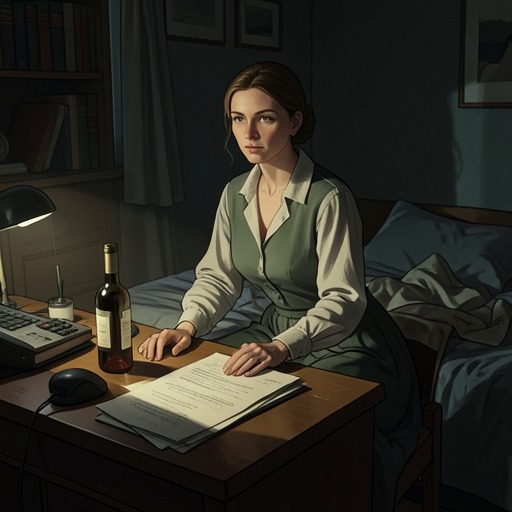
Trying to make the evening manageable, Rachel leaves work early and buys an extravagant meal for one: quail’s eggs, smoked eel, caviar, champagne, claret, pâté, warm bread, and additional delicacies. The purchases are an intentional attempt to be generous to herself, not evidence that she has resolved the loneliness behind them. At home she switches on the lights of a small artificial tree, runs a bath, and listens to a Christmas lesson and carol on the radio. When the batteries fail, she treats the holiday as something to endure until it passes. The ordinary malfunction punctures the ritual at the moment it briefly seems capable of offering comfort.
The bath also becomes a setting for Rachel’s uncertainty about the incident with Cliff. In the immediate aftermath, she had gone to Alan Jarvis’s office determined to use what happened to her advantage. By Christmas Eve, she is questioning her own assessment, wondering whether she had encouraged Cliff and whether the incident is serious enough to risk her job over. The narrative places that wavering beside the holiday’s familiar language of comfort and renewal, without allowing the season to settle her doubts. She counts the days until Anita returns and notices a bubble-bath advertisement in the calendar Melissa gave her, a small reminder that the promise of good things afterwards remains a slogan rather than a guarantee.
The book’s wider treatment of family life makes these Christmas pressures part of a continuing question about what care costs. Later, Naomi tells Rachel that Graham wants a divorce after fifteen years and four children. Naomi had given up a good degree and a media-planning job to help build the life Graham wanted; she now describes loving her children while also feeling financially trapped by the years before the youngest can finish university. Her story is not presented as a Christmas episode, but it echoes the season’s central contrast: family can be a source of attachment and a constraint on women’s work and independence. Across the holiday scenes, Christmas does not repair these conflicts. It makes them harder to ignore, revealing how companionship, domestic responsibility, professional ambition, and the desire for a different life can all press on the same few days.