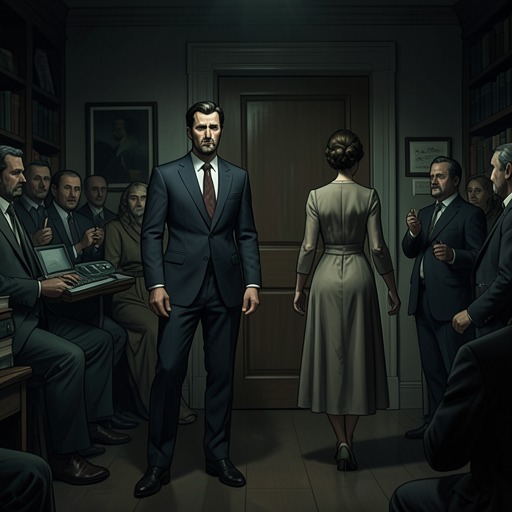
Giles Cavanagh’s unexplained illness
The GodmotherGiles Cavanagh’s unexplained illness turns what Anita has interpreted as marital rejection into a possible medical crisis. For months he has become nearly unreachable: he barely moves, does not speak, and offers no explanation that Anita can trust. When doctors eventually keep him in hospital for tests, the possibility of a trauma-related illness gives her a reason for his withdrawal without resolving its cause. The change in interpretation brings relief, but not certainty.
Withdrawal and uncertainty
When Anita describes Giles to Rachel, she struggles to say that he has gone, then clarifies that he has left her mentally: he has turned away and shut himself off, seemingly for good. This is more alarming to her than an ordinary disagreement or estrangement. He barely moves and does not speak, while denying that anything is wrong. Anita calls him like a zombie and compares living with him to living with a corpse. Her language conveys the severity of what she sees at home, but it remains the account of a distressed spouse, not a clinical description.
Anita wonders whether Giles has fallen in love with someone else, imagining a younger, less cynical woman who does not drink. She has asked him repeatedly whether there is someone else, and he denies it; she also says that he denies everything. The suspicion supplies a possible explanation for his distance, but the conversation gives no evidence of an affair. Rachel proposes that he may need a doctor and may genuinely be ill. Anita resists the suggestion that medical help is readily available: Giles says he is fine and will not go, and she says she cannot carry a thirteen-stone man to the car. Her anger and helplessness coexist with the fear that she cannot reach him.
A marriage and a life put on hold
Giles’s silence affects more than Anita’s sense of the marriage. She has just received her first serious commission in a long time, a well-paid article about balancing a career with early motherhood. The assignment appears particularly suited to her, yet she says she cannot concentrate while Giles is like this. His unexplained condition therefore interrupts a professional opportunity as well as their home life. The prospect of good work cannot become straightforwardly good news when the person closest to her seems absent and she does not know why.
The first conversation also presents Anita as having been drinking before she calls. Rachel suspects that she has had a considerable amount of liquid fortification, and Anita’s agitation gives the discussion an additional strain. This detail matters beside the later report of sobriety: her account of Giles’s illness emerges while she is struggling with her own drinking, but it is not thereby shown to be false. Rather, the later medical explanation changes the meaning of the conflict she has described without erasing the distress or impaired concentration she experienced.
Hospital tests and a changed explanation
Days later, Anita reaches Rachel again after coming from the hospital. Giles is being kept in for tests because doctors think his condition might be a kind of post-trauma response connected with war zones. The account presents this as a possibility, not a diagnosis: the tests are intended to establish what is happening, and the illness remains unexplained. Anita reports that Giles has zero energy, a concrete description consistent with the stillness and silence she had noticed at home.
The news makes Anita sound relieved. She says she had imagined all sorts of explanations and had feared that the marriage was over because Giles had become unreachable. Learning that he may have been ill for some time gives the preceding months a different frame: his withdrawal need not mean that he has rejected her or fallen in love with someone else. That reframing is emotionally important even while the cause is still being investigated. Rachel responds with sympathy, and her relief at hearing Anita speak differently registers how heavily the uncertainty has weighed on their exchange.
Anita’s response and the limits of resolution
Anita also tells Rachel that she has not had a drink since Monday and has finally signed up with Alcoholics Anonymous. She calls the early days ghastly, though not as bad as she had feared. Her decision is presented alongside the hospital news, not as a consequence doctors have prescribed or as a cure for the marital crisis. The two developments instead mark parallel attempts to face problems that had become difficult to manage: Giles is undergoing tests, while Anita has sought support to stop drinking.
The illness does not receive a confirmed explanation or outcome in these episodes. What changes is Anita’s understanding of the silence. Earlier, she reads it through betrayal, anger, and fear that the marriage has ended; after the hospital visit, she can recognize that Giles may have been unwell for months. That shift offers relief without closure. The narrative preserves the distinction between what Anita observes, what she fears, and what the doctors suspect, making uncertainty itself the condition that has shaped the couple’s domestic life.