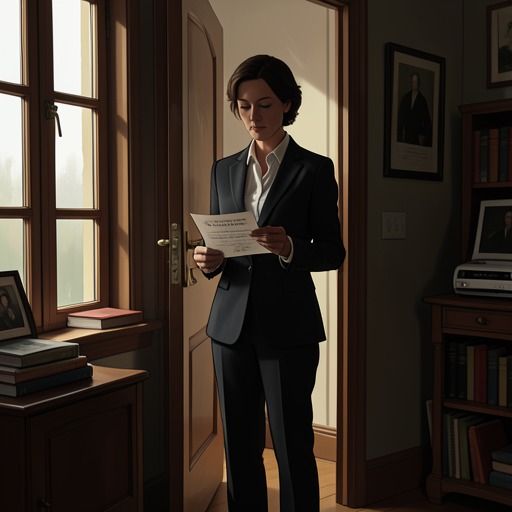
Naomi Fullerton and Graham's marriage
The GodmotherNaomi Fullerton and Graham’s marriage is presented at the moment its apparent permanence gives way to separation. After fifteen years together and four children, Graham asks for a divorce, having had an affair for two years. For Naomi, the rupture exposes not only a breach of trust but the cost of a life built around the future Graham wanted: she has left a media-planning career, is raising their children, and now expects to remain financially dependent on him for years. Their marriage becomes a sharp instance of how an intimate partnership can distribute opportunity and care unequally, leaving one spouse especially vulnerable when the other chooses to leave.
A shared life and its unequal terms
Naomi recalls that she earned a good degree and held a good job in media planning before giving them up to help build the life Graham said he wanted. The account does not specify a single turning point at which she abandoned her career; instead, it presents the sacrifice as the accumulated consequence of organizing her choices around their shared plan. By the time she describes the marriage to Rachel Elliot, she sees the lost work not as an incidental past detail but as a present constraint: she cannot readily return to earning a decent income.
The length of the relationship intensifies that reckoning. Graham has been her husband for fifteen years, and together they have four children. Naomi had understood their family and home as substantial grounds for a lasting partnership, even as their sex life diminished. She says she was not especially interested in sex and had felt grateful when Graham lost interest, interpreting the change as something that mattered less than the family life they had made. In retrospect, that interpretation appears to her as a form of not seeing what she did not want to see. Her account links the emotional assumptions of the marriage to its practical arrangements: she accepted the reduced intimacy while continuing to invest in a life whose security she believed rested on more than sex.
The disclosure and separation
The decisive news comes when Naomi visits Rachel Elliot at her office. She tells Rachel that Graham wants a divorce, then explains that he has been having an affair with a primary-school teacher for two years. He has moved into the other woman’s house, which Naomi describes as a small home on the edge of an estate. The affair has not remained private in Suffolk; Naomi says the county knows about it. That public knowledge helps explain why remaining there feels untenable to her. She leaves, insisting on her pride rather than continuing to live near Graham and the woman with whom he has been involved.
Graham’s promise that Naomi can have whatever she wants does not resolve the imbalance she describes. The offer comes after he has chosen another life, while she is left to consider how to support herself and their children. She and the children are staying with her parents in London as she works out what to do. The move is therefore both an immediate response to the affair and a temporary refuge during a larger practical crisis; the evidence does not establish where they will live permanently or what arrangements the divorce will produce.
Children, care, and dependence
Naomi’s feelings about the children are not simple opposition to motherhood. She says she loves every hair on their heads, but also describes the burden of care as something that ensnares her. With no current ability to earn decent money, she expects to depend financially on a man she can no longer love and who, in her view, no longer cares for her, at least until Helen finishes university. She calculates that this is eighteen years away. That precise horizon makes the consequences of her earlier career sacrifice tangible: the children she loves are also part of the long timetable that limits her financial independence.
The marriage’s collapse thus turns the ordinary language of family commitment into a question of who bears its costs. Graham’s career and desires have helped determine the life the couple built; Naomi’s account centers the work and foregone employment that leave her with fewer options when that life breaks apart. Her distress does not cancel her love for her children, just as her love does not remove the economic burden she anticipates. The tension between those truths gives the separation its particular force.
Narrative significance and unresolved future
Naomi’s story also complicates Rachel Elliot’s assumptions about lasting relationships. Rachel has regarded Naomi and Graham’s marriage as one likely to endure, in contrast to the more visibly rocky marriage of Anita Cavanagh and Giles Cavanagh. The news unsettles that confidence: a relationship that seemed stable from outside has concealed a long affair and a deepening gap between the life Naomi wanted for herself and the life she helped construct with Graham.
The scene ends not with a settlement but with Naomi asking Rachel for a favor as she is about to leave. The favor itself is not disclosed here, and the marriage’s future arrangements remain unresolved. What is clear is the change in Naomi’s position: she has left Suffolk, is staying with her parents, and must reconsider a future whose financial terms were shaped by years of care and career withdrawal. Her marriage to Graham is therefore presented both as a personal separation and as a rupture that reveals the unequal dependencies within their shared life.