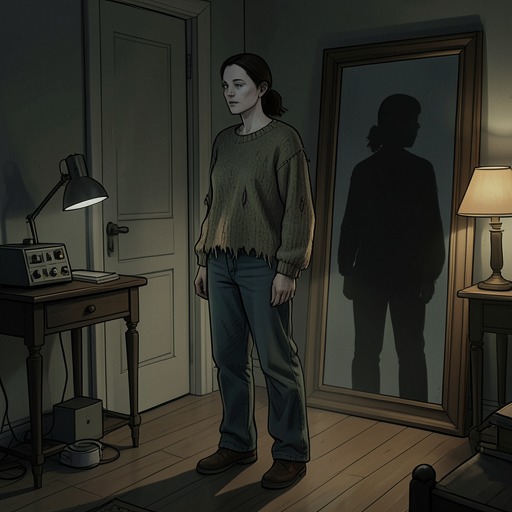
Polly Drayton
The GodmotherPolly Drayton is the woman Robbie Dexter leaves after six years together, a publican’s daughter whose work and home life offer little independence from her parents. The novel presents her heartbreak alongside Robbie’s retrospective guilt, then shows her watching his reunion with Rachel Elliot and grasping at the possibility that he may return. Her story is shaped by the disparity between what she expects from Robbie and how little security she believes she can claim for herself.
Identity and circumstances
At twenty-eight, Polly lives with her parents and works in their pub, serving bar snacks and pulling pints. Robbie thinks of her as sweet, moody, and emotionally unsettled; when he recalls ending their relationship in October, he feels that he has taken the best years of her life without offering anything in return. His reflection establishes the imbalance he perceives in their six-year partnership, though his guilt does not itself change her circumstances.
The pub supplies both her livelihood and the limits of her daily life. Polly helps in the kitchen as well as serving tables, while her parents expect her to work as though that obligation had come with her birth. She has three CSEs and twelve years of experience working the deep-fat fryer; as the years pass, she sees fewer prospects for escape and becomes more timid about answering her parents back. Their household is the security she can count on, but it is also a place in which she feels treated as a source of labour rather than as an adult making her own choices.
Robbie and the ended relationship
Robbie’s account of their partnership is not only regretful but also revealingly unequal. He remembers Polly as someone who could coax a fire from damp wood and help move sheep through a copper-sulphate foot bath, yet who looked to him for inspiration in domestic and other matters. He regards her as a follower who struggled to express herself and relied on another person’s imagination. This is Robbie’s assessment, not a neutral measure of her abilities: his own sense that he must supply direction helps explain both his frustration and his guilt at having remained with her without offering the future she wanted.
Polly, for her part, loves Robbie, his crumbling cottage, and the disorder of his life. She feels less like a burden beside someone whose surroundings are themselves a mess, and she remembers the gratitude he showed for her help—unlike the constant work her parents expected. That attachment makes the breakup more than the loss of a boyfriend. Robbie had become bound up with a possible life beyond the pub and with a version of herself that felt less burdensome, even though their relationship had not given her a dependable future.
Heartbreak and watching Rachel return
When Rachel’s black car approaches Station Cottage, Polly watches from her bedroom above the pub’s front bar. She chews the dry ends of her hair; the smell of chip fat clings to her skin and clothes, while the sight of Robbie’s former love arriving intensifies the self-hatred associated with her broken heart. The contrast is stark: Rachel arrives in a sleek car, following directions toward the cottage, while Polly remains upstairs in the pub where she works. Polly does not confront the visitor in this moment. She observes the reunion from its edge, and her position makes clear how little control she has over the event that threatens the hope she still places in Robbie.
On New Year’s Eve, Polly is again in the pub, working and trying to catch her breath upstairs. Mr Bernard, a retired polo player, has bought her two double gins while flirting badly; the crowded bar and freely circulating drinks make the evening a party for the customers as much as another work shift for her. She expects Robbie to come later. Since Rachel’s car has gone and Polly knows of no other local parties, she persuades herself that he will not spend the night alone. Her expectation is not evidence that he has promised to return; it is hope built from the absence of an apparent alternative.
Hope, family pressure, and the London invitation
Polly’s mother’s refrain, “Expect nothing and you won’t be disappointed,” gives voice to the family’s defensive outlook. Her mother says Polly raised her hopes and gave herself too freely, insists that the family warned her, and points to Robbie’s uncertain prospects—his head in the clouds and his attention given to animals rather than building his business. Polly knows there is truth in the practical criticism, but that knowledge does not settle what she feels. Her mother’s remarks reach her as shame, not consolation, and the advice to expect less cannot erase six years of attachment.
The next change comes when Robbie invites Polly to London for a long weekend, describing it to her parents as a chance to see whether they can sort things out. Polly tells her parents that the woman they have heard about is Robbie’s sister, recently returned from Canada, and says they will stay first with her and then at a five-star hotel with an indoor pool. She even offers the prospect of a week away and breakfast in bed with the newspaper. These details are lies, and she recognizes how easily they flow once she begins. They reveal how urgently she wants the invitation to mean a renewed relationship, and how she manages her parents’ suspicions by giving the trip a reassuring explanation. The available account leaves the proposed visit unresolved: it records Polly’s hopeful story to her parents, not what happens in London.
Narrative role
Polly’s perspective complicates the reunion between Robbie and Rachel. Robbie’s guilt emphasizes the cost of ending his long relationship with Polly, while Polly’s own scenes show the material and emotional vulnerability that guilt cannot repair: low-paid work in her parents’ pub, diminishing confidence, and a hope that Robbie will offer a life beyond it. Her watch from the bedroom window and her later invention of a reassuring account for her parents mark two different responses to uncertainty—silent observation and active concealment. Together, they make her neither simply an obstacle to Rachel’s return nor merely an object of Robbie’s remorse, but a character with her own longing and limited room to act.