Polly's ultrasound photograph
The GodmotherPolly Drayton’s ultrasound photograph is the object through which Robbie Dexter confronts the pregnancy’s physical reality and his unresolved feelings about Polly. Passed to him in a brown envelope by way of Rachel Elliot, the black-and-white scan turns an uncertain, emotionally charged absence into an image he cannot stop studying.
Delivery and Appearance
Polly arrives at Rachel’s door with the envelope, says it is for Robbie, and backs away. Rachel, responding to the misery in Polly’s face, asks whether she wants to see him; Polly shakes her head and withdraws. The scan therefore reaches Robbie indirectly, carried by a brief encounter in which the sender cannot bring herself to meet him.
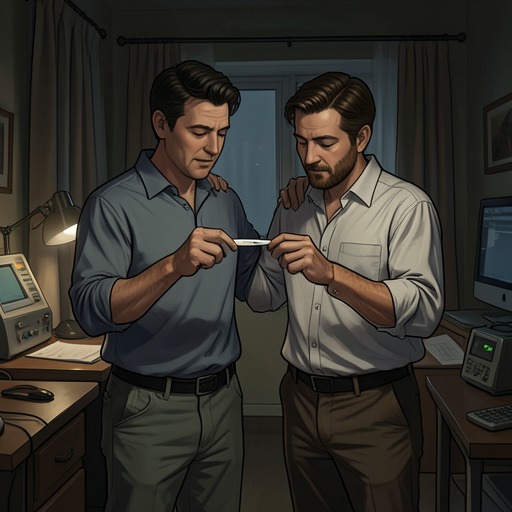
The photograph is blurred but unmistakably shows a foetus. Robbie has no idea how many weeks old it is. He can make out an elongated head, small fuzzy feet, and a thin white line trailing from the middle of its belly. The indistinct image offers enough detail to make the pregnancy tangible, but not enough to answer the questions he brings to it: he even tries to discern the baby’s sex and cannot.
Robbie’s Repeated Looking
Robbie holds the image up to the kitchen window again and again, perhaps for the twentieth time that week. He had feared the envelope might contain something appalling, yet the scan unsettles him in a way he had not anticipated. Its small, curled form seems to be holding itself for comfort, an impression that gives the photograph an intimate presence despite its blur.
Looking at it intensifies rather than settles his uncertainty. Robbie wonders whether Polly has told her parents or gone to London for an abortion. He does not want a baby, or the painful entanglement of having one with Polly; at the same time, the thought of the foetus ending as medical waste horrifies him. The photograph does not decide what he wants. Its power lies in keeping incompatible responses before him at once.
Meaning and Consequences
The scan becomes a focus for Robbie’s grief over Rachel as well as his fear for Polly. After putting it down, he thinks of Rachel and breaks into sobs. Later, when Polly has called her parents from London and promised to return by the weekend, Robbie imagines the image buried in the bottom of the black wheelie bin behind the wood shed, but wishes the truth were as easy to hide. The photograph has become inseparable from the pregnancy it represents: concealing or discarding the image cannot make the underlying situation disappear.
That tension persists as Robbie waits for Polly to come home, relieved and terrified in equal measure. The scan gives him no clear knowledge of what Polly will choose or what their relationship will become; instead, its repeated presence makes postponement feel like borrowed time. A small, blurred picture thus carries a consequence larger than its physical size, forcing Robbie to face a future he neither welcomes nor can simply dismiss.