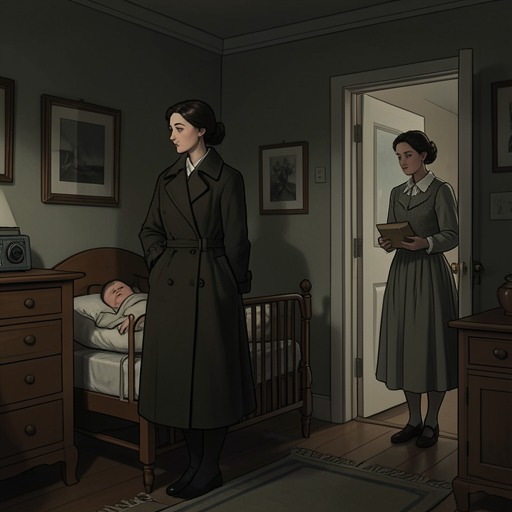
Rachel Elliot and Leo's godmother–godchild relationship
The GodmotherRachel Elliot and Leo's godmother–godchild relationship turns an abstract bond into a brief, consequential experience of care. Rachel invites Joy Dalton to bring her young son for a visit, then discovers, while minding Leo, that the pleasure of closeness can answer some of her longing for motherhood without requiring her to become his parent. The encounter ends not with a resolution to that longing but with a changed sense of what she already has: four godchildren, and a relationship with Leo that lets her feel tenderness without the full burden of parenthood.
The Bond and Rachel's Invitation
Rachel is Leo's godmother, a role that carries emotional significance beyond ceremonial kinship. She wants to know him better while he is still small, and writes to Joy Dalton inviting her to bring him over for a break and perhaps some shopping. The invitation is personal as well as practical: Rachel is not merely offering to help with childcare but hoping to build a closer connection with her godson before he grows older and, in her joking apprehension, turns his attention to rave music, drugs and much younger women.
That wish sits beside a history of maternal longing. Rachel had tentatively cradled Leo when he was a baby the previous summer, and the moment was followed by a painful resurgence of desire for a child of her own. Her invitation therefore carries an emotional hope that she does not reduce to godmotherly duty. She wants the relationship itself, and the opportunity to be more present in Leo's life.
A Short Visit and Its Small Anxieties
Joy Dalton comes from France for a short holiday with Leo. She stays with Rachel for two nights, but leaves Rachel alone with her godson for only a couple of hours. At fourteen months, Leo approaches objects with exuberant physical affection. Rachel's first strong concern is the cat: she fears that Leo's bear-hugging enthusiasm may hurt it, and tries to distract him. When she shuts the cat outside, however, Leo weeps inconsolably, while the cat appears affronted too. Rachel gives way and brings them together again.
Watching them, Rachel sees the cat repeatedly hop out of reach when it has had enough. The episode gives the visit a modest practical texture: caring for Leo means following Joy's instructions about bottles and naps, keeping an eye on a toddler who tackles whatever is near him, and judging when to intervene and when to let him explore. It also shifts Rachel's attention. Once the cat has been forgotten, Leo drags one of the books she has bought for him across the floor, and the possibility of a shared moment replaces her earlier vigilance.
The Moment of Closeness
Rachel lifts Leo and the book onto her lap. He curls against her, puts his thumb in his mouth and nestles close as she helps him press the buttons that make the cow moo and the mouse squeak. The scene is made of small acts—holding him, guiding his fingers, attending to his pleasure—but their emotional effect is large. Rachel forgets the clock and the rest of Joy's instructions. Her attention settles on the child beside her, including the soft smell of his head, rather than on the demands and anxieties she had brought to the task.
The moment recalls her earlier cradling of Leo as a baby and the wound of longing that followed it. This time, the longing recedes. Rachel recognizes that she has four godchildren and that they have been part of her life all along, even when she had not fully noticed what that meant. The recognition does not make her Leo's mother or erase her desire for motherhood. Instead, their bond gives her a distinct form of intimacy: the pleasure of being trusted with a child and sharing his company, without the continuous responsibilities of raising him.
Meaning and Limits of the Relationship
The relationship matters because it complicates a simple opposition between having a child and having none. Rachel's short spell caring for Leo is genuinely absorbing, yet it does not turn into a fantasy that godmotherhood is identical to parenthood. The narrative preserves the difference: Joy provides the instructions and remains Leo's mother, while Rachel has a brief, bounded responsibility. That limit is part of the comfort Rachel finds in the experience, not a failure of affection.
By the end of the scene, Rachel describes the appeal to herself as the fun without the heartache, a form of perfect parenting only in the qualified, imagined sense available to a godmother. Leo has not resolved every question about Rachel's future, and the visit lasts only a couple of hours. But her response marks a real change in perspective: instead of seeing maternal fulfilment solely as something missing, she can recognize affection and connection already present in her relationship with Leo and her other godchildren.