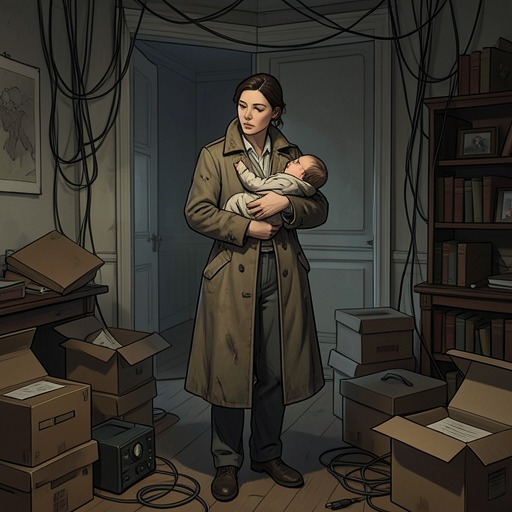
Rachel Elliot–Joy Dalton friendship
The GodmotherRachel Elliot–Joy Dalton friendship is a longstanding bond marked by real affection, increasing distance, and a renewed sense of responsibility when Rachel becomes godmother to Joy’s son Leo. Their friendship brings Rachel into close contact with a life built around children and domestic demands, while Joy’s account of life in France complicates the idea that a longed-for change necessarily brings lasting contentment.
Shared history and growing distance
Rachel and Joy’s friendship began at an old-fashioned boarding school. They had a formative point of connection in the shared difficulty of having fathers in the armed forces, and the relationship endured beyond those school years. By the time Rachel travels to France for Leo’s christening, however, they see each other only once or twice a year, usually at a dinner party or for an evening at the theatre. The move from London to Wimbledon had already made meetings less easy; Joy’s subsequent move to France places still more distance between them.
Rachel recognizes that her knowledge of Joy has thinned along with the frequency of their meetings. At the christening, she studies her friend’s tired appearance and wonders whether it reflects only the strain of moving and caring for children. The uncertainty matters: Rachel knows enough to notice a change, but not enough to confidently interpret it. She also understands the broader drift in her friendships. In her view, marriages and family lives can reduce the intimacy she is able to maintain with women friends, especially when she struggles to feel close to their husbands. Her affection for Joy remains, but it no longer guarantees the easy understanding their shared past might suggest.
Leo’s christening and Rachel’s role
Joy and her husband ask Rachel to take Leo, and the guests encourage the godmother to hold him. Joy thanks Rachel for accepting the role and for travelling such a long way, emphasizing that the friendship goes back many years. Rachel accepts the importance of the moment even as the ceremony makes her conscious of her unfamiliarity with babies. She holds Leo for a while, but is not entirely in the mood to perform the expected godmotherly warmth.
That hesitation sits beside Rachel’s growing awareness that something in her own life feels different. She has professional success, financial comfort, friends, and an independent life in Chelsea, yet senses an emerging dissatisfaction she would rather ignore. The christening does not settle what she wants, but it places her in the presence of a young family at a moment when the question of having a child is becoming newly charged for her. Joy’s trust gives the occasion personal significance: Rachel is not simply a guest observing motherhood from outside, but a chosen participant in Leo’s life.
The visit also exposes the unevenness between the friends’ circumstances. Rachel is accustomed to leaving situations that make her uncomfortable; after the gathering, she invents an early departure and returns to her hotel. She remembers the Daltons’ unfinished, uncomfortable house and the fact that she knows few of their local friends. Her escape conveys her preference for solitude and control, but it also shows how far she is from the daily conditions Joy has taken on. Rachel can leave the crowded house; Joy is living there with her family.
France, family life, and the letter
In her diary, Rachel records that the christening went well and that the French ceremony felt romantic. She notes that all the godparents spoke together, easing her concern about her accent, and that Joy and her husband had organized a reception despite much of the house remaining uninhabitable. The account is courteous, but Rachel admits that she was not in the mood for the celebration. Her diary thus preserves both the public success of the visit and her private distance from its rituals.
Weeks later, on a flight, Rachel finds a letter from Joy among her post. Joy’s tidy handwriting recalls her former work as a primary school teacher and her earlier insistence that dealing with children had put her off having any of her own. The contrast gives Rachel a measure of how much Joy’s life has changed. In the letter, Joy describes a difficult first winter in France: persistent rain, a cold and damp house with cracks that let in the wind, and the demands of caring for Leo, who wakes repeatedly at night and will not take formula. She is still struggling to learn French and finds it hard to concentrate on study while managing the household and a baby.
Joy also describes the comforts and compromises of expatriate life. There are many English people nearby, and the shared complaints and familiar tea provide a form of companionship, even as she and her husband continue trying to integrate with their French neighbours. Her husband’s work is going well, much of it for other English people renovating properties, but that success has not repaired their own house. Rachel reads the letter for what it says and for what it seems unable to say. She wonders how many exclamation marks Joy might need before she openly admitted to being unhappy. That interpretation is Rachel’s, not a confession from Joy; the friendship is close enough for Rachel to suspect concealed disappointment, but not close enough for Joy to state it plainly in the letter.
Dreams and what friends can recognize
Joy’s letter turns the friendship into a point of comparison between two women reassessing their lives. Joy imagines that future prosperity might allow the family to retire somewhere tropical, away from leaking roofs and household work. Rachel, reading this hope, wonders whether dreams are ever simply fulfilled or whether fulfillment makes them give way to new desires. She applies the question to her own uncertainty about having a child: would motherhood also become a reality that had to be replaced by another dream?
Her answer remains an intuition rather than a plan. Rachel imagines the effort of combining office work and childcare, but feels a warm conviction that she would somehow manage. Joy’s experience does not remove Rachel’s desire; neither does it confirm the effortless version Rachel pictures. Their friendship instead gives her an imperfect view of what family life entails: exhaustion and practical constraints coexist with attachment, while a move pursued as a fresh beginning can bring its own frustrations. Joy’s difficulties are visible to Rachel in the details of the letter, yet remain partly veiled by its cheerful presentation. The bond therefore retains its tenderness and history without restoring their former closeness, and it helps Rachel recognize that another person’s life cannot supply a simple answer to her own.