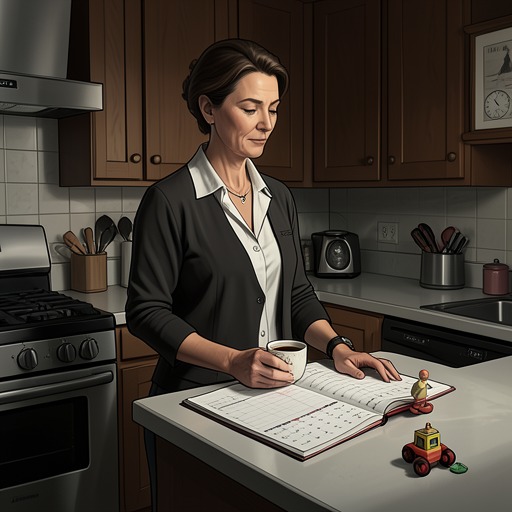
Rachel’s diary
The GodmotherRachel’s diary is a black leather book that turns Rachel Elliot’s private thoughts into a running record of intention, hesitation, and self-presentation. It first appears in a hotel room after a christening, where an interrupted attempt to enjoy solitude gives way to writing; later, its pages register Rachel’s decision to have a child and her plan to ask Nathan Kramer to help. The diary matters not because it settles what will happen, but because it makes visible the distance between a decision confidently written down and a future still beyond Rachel’s control.
The Book as a Physical Object
The diary lies among the contents of Rachel Elliot’s small suitcase, which hotel staff have unpacked and arranged neatly across the bed. The distinction between help and intrusion is marked by the fact that the suitcase itself has not been repacked. Rachel picks up a folded pair of white silk stockings and throws them toward it, but they fall short, fluttering onto a black leather book near the far edge of the bed. She rolls over, retrieves the book, draws a gold ballpoint pen from its broad spine, and begins writing. The diary enters the scene through this small accident: an everyday object made newly significant by the failed throw that directs Rachel’s attention to it.
Its physical presence also contrasts with the hotel room’s elaborate comforts. Rachel has returned from the christening to a four-poster bed, embroidered cushions, and a mint chocolate left on her pillow. She considers ordering room service, then realizes she wants nothing. The carefully arranged room has not produced the pleasure she expected from time alone. Once the diary is open, however, she has something to do with that unsettled time: she can turn experience into an account, selecting what to record and how to frame it.
A Dated Account of Turon
The September 12 entry begins with Rachel Elliot’s impression of Turon as beautiful. She describes arriving on Saturday, relieved to be away from London, and staying at a palace-like hotel. She records the Dalton family’s house in its setting beside a small tributary of the Loire Valley, and notes that the children, including Leo, look suntanned and healthy. Joy Dalton has been occupied with christening arrangements, but seems pleased with the move. These details make the diary a record of observed places, family circumstances, and Rachel’s immediate judgments, not simply a repository for major decisions.
Rachel also writes about the christening and the reception afterward. Hearing the ceremony in French seems romantic to her; the godparents speak together, easing any embarrassment about her accent. Joy and her family have made considerable efforts to host the reception despite many rooms in the house remaining uninhabitable. Rachel describes doing her part as a godmother and greeting relatives. The entry thus preserves both the event’s social ease and its practical limitations, while showing Rachel placing herself within the gathering as a participant with a defined role.
That composed account sits beside a less settled response to the weekend. Rachel had deliberately extended her stay because she anticipated the pleasures of hotel mints, a swimming pool, elegant meals alone, and time to herself. When the solitude actually arrives, the prospect loses its appeal; the room that looked inviting in a brochure feels empty, and the time she had wanted becomes a refined form of punishment. After this mood swing, she returns to the diary with fresh energy. The change is important: writing does not erase the disappointment, but gives Rachel a way to resume attention and shape an experience that has failed to match its promise.
Recording a Decision About Motherhood
Later, the diary becomes the place where Rachel Elliot commits a consequential thought to the page: she has decided to have a child. She has avoided writing for days, afraid of fixing such a large decision in concrete form, and chooses a hurried moment before Anita Cavanagh arrives. Even as she writes, Rachel imagines an audience inside her head that will hear and judge her; she wants the account to be lucid. The diary therefore records not only what she has decided, but also her awareness of how a private declaration may be evaluated.
Rachel’s next entry sets out a plan: during a two-day stopover in Washington, D.C., on the way to Bermuda for a Mallarmé Skincare Products plc shoot, and at what she considers the right point in her cycle, she intends to ask Nathan Kramer to help her conceive. She feels confident that this is right and observes that her flat could accommodate a baby and a nanny. But the entry does not end in uncomplicated certainty. Rachel begins a further thought, then crosses out its last six words and stops. The diary preserves the plan and the hesitation together: her practical arrangements are specific, while an unfinished sentence marks something she elects not to complete on the page.
Private Intention and Conflicting Counsel
The diary’s record of Rachel’s resolve gains force from the conflict surrounding motherhood in her relationships. Anita Cavanagh, Rachel’s old friend, warns her that a child could cost her independence and that paid childcare would not remove the emotional pull between work and staying at home. Anita speaks from the strain of her own experience: she has two young children, has repeatedly subordinated career opportunities to Giles Cavanagh’s career, and feels caught in a marriage shaped by resentment over their unequal burdens. Rachel’s written plan does not make those costs disappear; it shows her reaching a decision while a close friend insists that its consequences cannot be managed simply by money or preparation.
As an object in the narrative, Rachel’s diary gives private intentions a distinct form without making them predictions. Its dated entries move from the immediate textures of a visit—the rain-washed air, the arranged suitcase, the French ceremony—to a major life decision framed in terms of timing, housing, and childcare. Yet the crossed-out words and Rachel’s initial reluctance to write expose the limits of that practical confidence. The diary offers a record Rachel can organize, but it cannot organize the future for her; its significance lies in holding resolve and uncertainty on the same page.