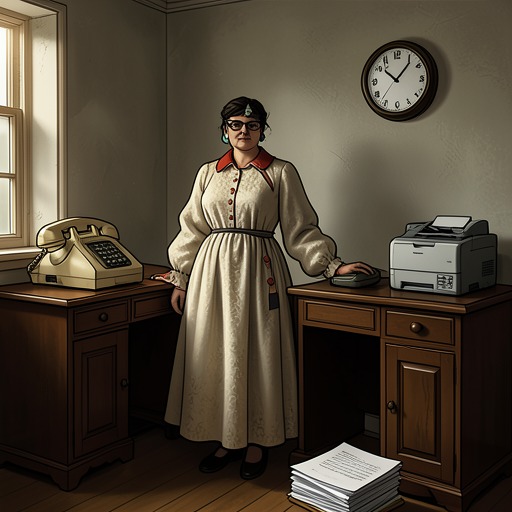
Rachel's letter to Will
The GodmotherRachel's letter to Will Raphael is an attempt to turn unanswered calls and an uncertain friendship into a direct conversation. Written while Rachel Elliot is between jobs, it mixes mock exasperation with genuine bafflement: she asks why Will has not been in touch, refers to the portrait he made of her, and proposes meeting for a drink. The letter matters as a small but deliberate act of initiative. Rachel begins it on a computer, pauses over how far to go, then sends it through the post; the change of medium gives her attempt a physical, consequential form without revealing whether Will replies.
Occasion and purpose
The letter opens with a formal address to Will Raphael and an account of Rachel's unsuccessful efforts to contact him over several weeks. Rather than settling on one explanation, she runs through increasingly dramatic possibilities: he may have left the country, his answering machine may not work despite appearances, or he may have suffered a severe accident and be in hospital. The escalation gives her complaint a comic edge, but its stated conclusion is that she is baffled and confused. The jokes do not resolve the silence; they make it possible for her to confront it without disguising the fact that it troubles her.
Rachel says she might find Will's reluctance less peculiar if other people did not seem to think that the two were close friends. Their apparent closeness is therefore part of the problem the letter addresses: she is not simply requesting a meeting with an acquaintance, but trying to understand a connection that others recognize and that his lack of response makes difficult for her to read. She calls the situation embarrassing, yet continues writing. The letter's central purpose is both practical and interpretive: to ask for contact, and to find out what their friendship means in the face of his silence.
What Rachel says
Rachel makes clear that she values the portrait Will made of her and thanks him for delivering a copy. She then turns from appreciation to uncertainty, wondering whether he has decided that he no longer likes her and whether this explains his failure to return her calls. The portrait gives her a concrete point of connection within an otherwise confusing exchange: she can acknowledge a thoughtful act even as she questions the distance that has followed it. She does not claim to know Will's reason; the letter lays out possibilities and asks, in effect, for an answer.
She also recalls Will's earlier suggestion that she hides behind a defensive system of other people and telephone communications. Rachel redirects that criticism toward him, asking whether he is now doing the same thing. This reversal makes the letter more than a request for a drink. She accepts that Will's advice has influenced her resolve to be more open and forthright in the second half of her life, while using the same principle to challenge his apparent withdrawal. The exchange remains pointed but not openly hostile: her frankness is joined to a wish to meet rather than a declaration that the friendship is over.
The invitation is phrased with teasing impatience. Rachel proposes a drink before the next millennium, joking that Will might otherwise be unable to fit it into his action-packed social calendar. She adds that she is between jobs and can be contacted at home, giving him a straightforward way to respond. The sign-off, Rachel's self-description as “Confused of Chelsea,” turns her uncertainty into the letter's wry public face without pretending that the underlying question has been answered. A postscript asks whether Will knows Polly and, if so, requests details. Rachel offers no explanation for the question, so it remains a separate, pointed inquiry rather than a resolved part of the letter.
Drafting, interruption, and posting
The letter takes shape during a pause in Rachel's life. After three idle weeks, she feels mellow and is learning to enjoy free time rather than fear it. She anticipates the challenges of a new job, but also values the two additional days each week that will be her own. She imagines using that time for friends and hobbies, for being a godmother, and for looking for a cottage in Kent or perhaps Norfolk. These plans place her request to Will within a wider effort to make room for a life beyond work; they do not suggest that the meeting has already been arranged.
As Rachel types, her cat repeatedly interrupts, first placing himself between her and the screen and then nudging her chin. She laughs, picks him up, and tells him she is trying to pursue a man and finding it difficult. The interruption briefly makes the letter's subject part of the domestic scene: Rachel's attempt to reach Will is not abstract correspondence but something she is composing at home, with the cat competing for her attention. The exchange also keeps the comic register in view as she moves toward a more vulnerable request.
Rachel had first intended to fax the communication to Will's office number. Instead, she seals it in a long white envelope, affixes a stamp, and posts it in the box at the end of the road that evening, moving through the wet night like a thief. The change from an office fax to a posted letter is a concrete decision in the object's history: what begins as words on a screen becomes a private, addressed message sent from her home. The narrative records its dispatch, not its delivery or reception, so the act of posting is the last confirmed stage of the communication.
Significance and limits
After returning, Rachel tells the cat that this is all she can do. She reassures him that his place in the household is secure and jokes that neither a man nor a child will separate them, though she allows that compromises may eventually be necessary. Her remark connects the letter's immediate pursuit of Will with the future she is imagining for herself, but it is playful rather than a report that a relationship or a child is forthcoming. The cat's unimpressed look and swift departure provide a small comic counterpoint to Rachel's confident assurances.
The letter thus gives form to two kinds of uncertainty without resolving either. Rachel is unsure why Will has stopped responding and whether the friendship others perceive is shared in the same way by him; she is also making plans for a new job, more personal time, and a possible cottage. Her response is not to wait silently for clarity, but to write, challenge him with his own earlier advice, and offer a specific invitation. Yet the account ends with the envelope posted and Rachel back at home, not with Will's answer. The letter's significance lies in that balance: it records a determined effort to make contact while preserving the unanswered space that prompted it in the first place.