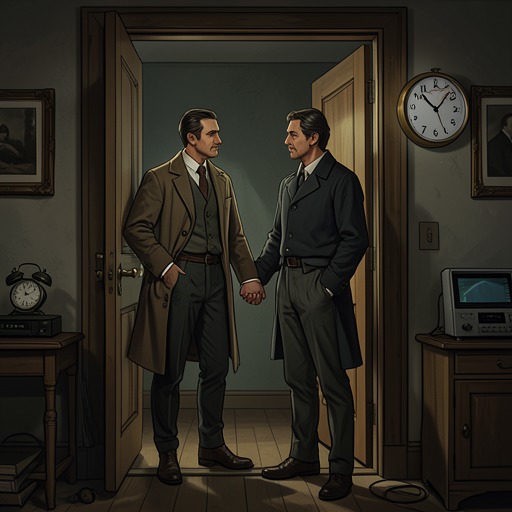
Will reveals his infertility to Rachel
The GodmotherWill Raphael reveals his infertility to Rachel Elliot during a dinner at his home, turning his unexplained resistance to their growing closeness into an explicit conflict over who has the right to decide what Rachel’s possible desire for motherhood means. His disclosure clarifies why he had held back, but Rachel objects that he and Anita Cavanagh have presumed to define her feelings for her. The argument does not settle whether Rachel wants a child; instead, her return to Will’s house and their renewed intimacy leave both questions—the future of their relationship and her maternal longing—open.
Background and the withheld reason
Rachel’s wish to become a mother predates this conversation. She has written in her diary that she has decided to have a child, and she has asked Nathan Kramer to provide the means of conception while promising that she would raise the child on her own. Later, when she and Robbie Dexter rekindle their relationship, she secretly stops using contraception, reasoning that at almost forty every cycle matters and that she could manage alone if their future together failed. These choices show the pressure she feels from time, but also the effort to keep control of a decision whose consequences involve other people.
A magazine article she reads while stranded at Robbie’s house asks why conception is becoming increasingly problematic and notes the growth in infertility treatment. That reading places fertility in the wider context of uncertainty, but it does not supply Rachel with an answer to what she personally wants. By the time she grows close to Will, Anita has told him that Rachel is interested in having children. Will takes that information as a reason to resist a relationship, though he does not initially tell Rachel that this is what he has done.
The disclosure at dinner
The disclosure occurs after Anna Raphael has invited Rachel to Will’s home in circumstances Rachel interprets as an awkward attempt to bring them together. Rachel is prepared to leave, but Will asks her to stay for food. They eat lasagne and garlic bread; his affection is apparent, yet he seems to close down rather than explain himself. When Rachel teases him about being more comfortable with his artistic work than with real life, she notices his discomfort. He then puts down his cutlery, folds his arms, and tells her there is something she needs to know—the reason he has been trying not to see her and resisting his attraction to her.
Will tells Rachel that he cannot have children, explaining that he has congenital absence of the vas deferens. He says that he learned of the condition while he was with Ginnie and that it was among the many things that depressed her about him and about life. The disclosure gives Rachel the medical fact, but it also reveals the personal history attached to it: Will understands infertility not as an abstract possibility but as something that affected his former marriage. His account is measured, and he says that Rachel’s interest in children made him feel he had no right to enter her life and waste her time. He believes he knows how consuming the desire for a child can become.
Rachel’s objection and departure
Rachel asks whether Will decided they should not see each other because of his condition. He says that this was not his first consideration, but that Anita’s report of Rachel’s wish for children changed how he viewed the relationship. Rachel’s anger is directed less at the fact of his infertility than at the decision he made from it. She tells him that her possible interest in motherhood should not have been allowed to rule him out of her life, and that neither he nor Anita knows what she feels about such a complex and personal subject.
The distinction matters: Will has meant to spare Rachel a relationship that might conflict with her wish for a child, while Rachel experiences that protection as an assumption made without her. His disclosure gives her grounds to understand his withdrawal, but it does not make his choice hers. She leaves in anger and disappointment, furious that he has discussed her private feelings with Anita and decided their significance without speaking to her. The confrontation therefore exposes both the practical stakes of Will’s infertility and the relational harm caused by treating Rachel’s uncertain desire as settled fact.
Return and unresolved choices
Rachel’s departure is interrupted by a flat battery. She returns to Will’s door asking to use the telephone, while making clear that she is still angry and no longer certain whether she wants to be a mother. She had thought she did, she says, but now she is unsure. That qualification changes the meaning of Will’s earlier assumption: her longing is real, but it is not a fixed instruction that can determine every relationship in advance. The immediate problem of her car brings her back into the house, yet she recognizes that crossing the threshold may begin something difficult to reverse.
Once Rachel is inside, Will takes her into his arms. The gesture does not answer her questions about motherhood or undo the argument, but it marks a return to their attraction after the disclosure has made its central obstacle speakable. Jack, who has been asleep, wakes and joins their exchange. Will offers Rachel champagne and asks her to make her call, have a drink, and read Jack a bedtime story before leaving. Rachel tries the telephone and then says that the line is engaged, although she knows it is not. Her invented delay keeps her with Will and Jack a little longer; the scene ends not with a decision about children, but with Rachel choosing, for the moment, not to hurry away.
Significance
The event joins biological circumstance to a question of agency. Will’s condition is consequential to the possibility of having children together, and his experience with Ginnie helps explain his concern; nevertheless, his attempt to act on Rachel’s behalf turns care into presumption. Rachel’s response insists that a wish for motherhood does not erase her authority over the meaning of that wish, or over whether she wants to pursue a relationship with someone who cannot father a child. Her uncertainty remains intact after the disclosure, rather than being resolved by it.
The scene also reverses the pattern of concealment surrounding Rachel’s fertility choices. She had previously kept her attempt to conceive from Robbie, hiding her contraceptive cap and reasoning privately that she could cope alone. With Will, the crucial fact is his to disclose, and the consequences depend on whether they can discuss it without substituting assumptions for her judgment. Their renewed closeness does not promise a solution to infertility or establish a settled future. Instead, the event leaves the relationship possible while making clear that neither attraction nor concern can decide Rachel’s reproductive choices for her.