Will's portrait of Rachel
The GodmotherWill's portrait of Rachel is a black-and-white photograph by Will Raphael that turns a moment of looking into a consequential object. Rachel Elliot recognizes herself in its poised, guarded expression and likes the image more than she expected; at the same time, its place in Will Raphael's flat gives Polly Drayton material for a false account of their relationship. The portrait holds both a private connection and a misleading public meaning, becoming part of the chain of events that separates Rachel from Robbie Dexter.
Creation and visual design
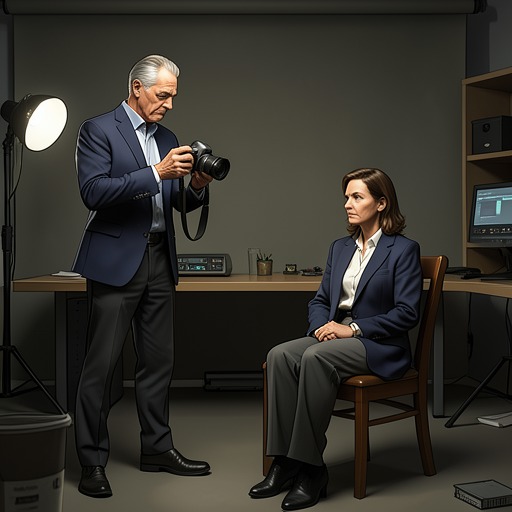
Will Raphael's attention to the portrait begins before the photograph is complete. He borrows the old, dark leather chair that Rachel Elliot had used, imagining how it would hold her slim frame and set off her fair hair and skin. His aim is not a technical trick but a particular impression: Rachel should appear at once fragile and protected, as if the chair could comfort her while leaving her somewhat lost within it. The finished photographs satisfy that intention. For Will, the chair and pose are not incidental props; they help give visible form to the vulnerability and strength he senses in Rachel.
The image he later studies is large and black-and-white. Light and shadow divide Rachel Elliot's face: one side falls into shade while the other catches the light. Her eyes appear bold but questioning, and her body curls away from the lens. Will reads that arrangement as a warning to keep his distance. The portrait therefore preserves a tension rather than resolving it. Rachel is present for the camera, yet her turned posture seems to resist being wholly possessed by its gaze. The contrast between the directness of her eyes and the withdrawal of her body gives the photograph its particular charge for Will.
Rachel's response to the image
When the photograph reaches Rachel Elliot, she examines it at home and is surprised by how much she likes it. Her face shows more creases than she had imagined, but her broad smile offsets that discovery without making her look smug. She also approves of the pose: one leg is bent beneath her, the other just touches the floor, and the overall effect seems both relaxed and confident. She feels that the image shows her as she would have liked to appear, though she could not have deliberately arranged the result herself.
Her reaction is not simply approval of a flattering likeness. Rachel studies the photograph as a representation of herself that has escaped her own control, and finds that it nevertheless feels right. The picture gives her a way to see her age and expression without reducing the result to the creases she notices first. Its chair, posture, and smile combine into an image she can accept as hers. That response stands in contrast to Will Raphael's more intimate reading of the same photograph: what he sees as guarded longing is, for Rachel, an unexpectedly assured and relaxed version of herself.
Rachel also wonders why Will Raphael brought the photograph in person but did not ring the bell, and why it arrived without a note or even a compliment slip. The delivery leaves her with an image but no explanation of what its maker intends by giving it to her. She briefly considers taking it to Devon, where Robbie Dexter might like it, but remembers Robbie's recent emotional fragility and puts the photograph in a drawer instead. She decides that explaining matters with Robbie must come before trying to explain Will Raphael. The image is therefore withheld at precisely the moment when its presence might have prompted a conversation, while Rachel's uncertainty about Will remains unresolved.
Display and misinterpretation
The portrait also circulates beyond the exchange between its maker and its subject. Polly Drayton finds a framed photograph of Rachel Elliot on the wall of Will Raphael's flat. Its framed display makes the image look significant to her: it is not merely a loose photograph but a portrait given a place in Will's home. Polly uses that discovery, together with her knowledge that Will and Rachel are friends, to claim that they have been seeing each other. She presents the suggestion as a slight extension of what she already knows, while privately recognizing that the portrait has helped her assemble the story she wants Robbie Dexter to believe.
The photograph does not prove an affair, but its visible presence gives Polly Drayton's fabrication a persuasive detail. Robbie hears that Will has a framed picture of Rachel in his flat, and rejects Rachel's attempt to explain. He tells her not to contact him again, extending his refusal into the future. Later, Rachel tells Will Raphael that Polly said they had been seeing each other, adding that her relationship with Robbie was already over by then. The portrait is thus drawn into a false story whose force depends on converting an object of personal attention into apparent evidence of a secret relationship.
Narrative function
The portrait links three different perspectives without making them equivalent. Will Raphael sees in it Rachel Elliot's guardedness and the possibility of intimacy; Rachel sees an image that makes her look more relaxed and confident than she expected; Polly Drayton sees a framed object that can help her secure Robbie Dexter's commitment. Its meaning changes with each viewer and each setting, while the photograph itself remains unchanged. The difference between what it depicts and what others infer from it is central to its role in the plot.
For Rachel and Will, the portrait offers a form of communication that is both unusually direct and conspicuously incomplete. It records Rachel's face and pose, and Will has invested them with his own hopes, but the unaccompanied delivery leaves Rachel to interpret his silence. For Polly and Robbie, the same image becomes a substitute for knowledge: its presence is made to stand in for a relationship that the photograph cannot establish. The portrait consequently marks the gap between being seen and being understood. It is a careful piece of looking, but its passage through the story demonstrates how easily a private image can be made to support a public misunderstanding.