Amy Loughren
The Good Nurse: A True Story of Medicine, Madness, and MurderAmy Loughren is a nurse at Somerset Medical Center whose clinical judgment helps expose patterns in Charles Cullen’s medication records and whose friendship with him makes that work a profound personal conflict. The book presents her not simply as a source for the investigation, but as someone whose care for patients, fear of institutional retaliation, serious illness, and attachment to Cullen all bear on what it costs her to act.
Identity and Background
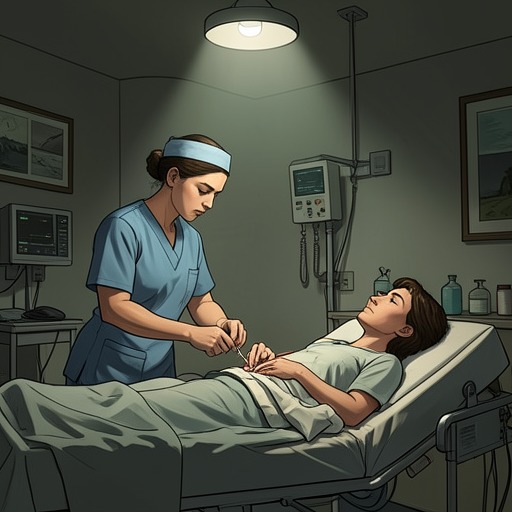
Loughren is a registered nurse in a cardiac care unit, a direct, outspoken person who describes herself as a pain in the ass. At thirty-six, she has two daughters, a nursing degree, and a leased white Jaguar. Her life is divided between a home in upstate New York and her New Jersey job, a separation she works to preserve. Panic attacks sometimes keep her from leaving home; on days off she may drink wine, while her nights are often spent working. Behind her forceful manner, the book describes a harder-to-name sense of emptiness and a history of an abusive childhood.
That background helps explain why Cullen’s company carries unusual weight for her. She does not fully share herself with her daughters, boyfriends, or most coworkers, but she comes to feel entirely safe with him. She also believes he needs her protection. Their friendship therefore begins as more than workplace ease: it offers each of them, in different ways, a shelter from the people and pressures around them. That trust will later make the evidence she helps uncover difficult to reconcile with the person she thought she knew.
Friendship, Work, and Illness
On the varied overnight shifts at Somerset, Loughren and Cullen develop a familiar rhythm. While waiting for the Pyxis medication system or enduring a long report, he makes dry comments about hospital bureaucracy and shares stories about depression, bad luck, and being bullied. His wry self-presentation seems to her like something she can understand and protect. Their friendship grows in the quiet hours of hospital work, among routine tasks and the small exchanges that make a difficult shift bearable.
One October night, Loughren is leaning against the hard wall of the nurses’ station when Cullen finds her and helps her into an empty room. She sits on the bed, gasping for air, before explaining that the nurse working in a leading cardiac unit is herself slowly dying of heart failure. The irony is stark, but the episode also makes her illness a practical fact of the relationship: Cullen sees her in a moment of vulnerability, and she has to live with a serious condition while continuing to work in the unit where the investigation will unfold. When investigators later fit her with a recording device, they see her pacemaker scar.
After she becomes sick, Cullen’s patient killings at Somerset begin, and the book says that once they start, they do not stop. It does not claim that Loughren knew of them at the time. Her later recollections of their shifts instead acquire a different meaning: details that once seemed like quirks of a shy coworker become possible clues when she understands what the investigation is examining.
From Nursing Concern to Investigation
Loughren’s unease about medication controls precedes her cooperation with police. A manager asks her to sign a new insulin adjustment form, requiring nurses to record an estimate of how much insulin remains in a vial. Loughren considers the estimate unreliable and objects to being made accountable for what she cannot accurately measure. She also recognizes that the sudden change suggests something may have happened on her unit, possibly to patients. Her supervisor does not tell her what is behind the new procedure. Her questions about why insulin is being treated like a narcotic express both clinical skepticism and a nurse’s demand to know what risks her patients may face.
By the time investigators interview her, Loughren knows that she is regarded as Cullen’s friend and that insulin and his name have become associated with a death. Other nurses avoid her as if suspicion could spread by contact; friends worry about her, and she is frightened for herself. Unlike other nurses who fear for their jobs, she openly admits that fear in her interview. Detective Danny Baldwin shows her a Pyxis printout from the night Reverend Florian Gall died. Loughren recognizes Cullen’s records and sees that they challenge her defense of him. She can now imagine that he did something strange and terrible, but she cannot easily fit that possibility together with her idea of her friend.
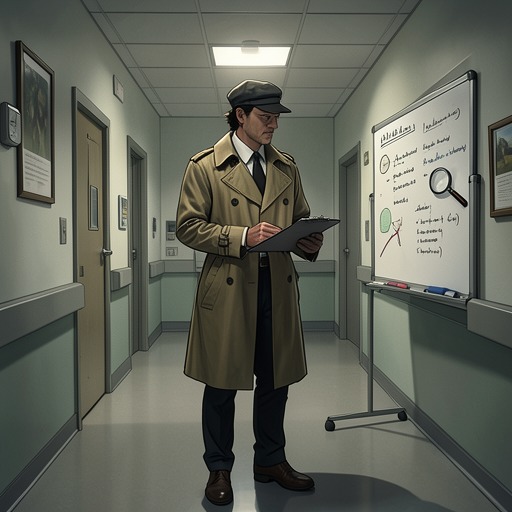
The investigators’ first sheet is only one among many. As Loughren works through the stack, she explains that the troubling pattern lies not in one isolated order but in the orders considered together. She shows Tim Braun and Baldwin that Cullen repeatedly called up digoxin and canceled the orders. Because a canceled order could still have opened the Pyxis drawer, the pattern raised the possibility that medication could have been removed without appearing as a completed order. Loughren counts at least twenty-seven such digoxin cancellations from Cullen’s start at Somerset through June 27, including eight in February alone; no other nurse on the unit had ordered even a fifth as many.
Her reading of the records also complicates the case the detectives are building. Their focus is on whether Cullen’s digoxin orders correspond to Reverend Florian Gall’s death, but Loughren sees that the orders do not align neatly with the digoxin deaths. Tylenol orders, by contrast, do. She cannot prove that Cullen ordered one medication and took another, but she finds the Tylenol pattern bizarre from a nursing perspective and wonders whether she was the first person at Somerset to notice it. Her expertise does not make the records self-explanatory; it enables her to show investigators what questions a nurse would ask of them.
Loughren also rereads ordinary work habits as possible access to medication. She remembers Cullen wheeling a portable charting computer down the hall after report, like a mailman with a cart. At the time, she assumed he wanted quiet. Looking back, she considers whether the position near the hallway doors could have mattered because that was where drugs arrived. The memory remains an interpretation, not proof, but it shows how her professional familiarity lets her reconstruct the unit’s routines in investigative terms. The investigators likewise need her to explain how Cullen’s Cerner records should be read alongside the Pyxis reports.
The Informant and the Cost of Trust
Loughren does not move from friendship to cooperation without hesitation. She knows that becoming an undercover agent would mean lying to Cullen, to her employer, and to people around her, while placing her job at risk. The detectives are strangers, and they could be mistaken or manipulating her; Cullen is her friend, whose side she has habitually taken. When she finally chooses to proceed, she tells the detectives to turn on the recorder and explain what they want to know. The decision is not presented as a clean escape from uncertainty. It is a commitment made while uncertainty remains.
She continues to feel divided between her identity as a nurse and her hidden role in the investigation. She fears being fired by the institution she hopes to improve and feels alone with the strain of having broken ranks. Tim Braun and Danny Baldwin work late; Loughren comes by after her shift with coffee and more paperwork. Their meetings make her feel less alone and more courageous, but her sense of risk persists. At the same time, she is helping investigators build a case against the man whose protection and friendship had once made her feel safe.
For a recorded call, the detectives set her up in an old Narcotics Division office, where outgoing calls appear as private numbers. Just before eleven, she phones Cullen at home in a bright, affectionate manner. Later, before their in-person meeting, technicians fit the microphone high on her body; she jokes about the awkward placement even as the procedure exposes the scar from her pacemaker. That contrast captures the operation’s personal cost: the nurse’s humor is still present, but her body and private attachment are now part of the machinery of an investigation.
At the prosecutor’s office, Loughren watches Cullen’s interview on closed-circuit television. He appears stooped and affectless, in prison scrubs, with his arms and legs chained. She feels nauseated and overwhelmed by guilt, thinking that she has done this to him. The reaction reveals the emotional cost of cooperation without undoing the evidence that led her there. Her role requires her to hold together the friend she grieves for and the suspect whose records she helped interpret.
Aftermath and Narrative Significance
After Cullen’s arrest, Loughren quits nursing. The detectives later give special thanks in an acceptance speech to the confidential informant identified as Agent Amy, a public acknowledgment that leaves her identity compressed into the covert name she used during the investigation. She is subsequently married and works as a hypnotist and past-life regression therapist, a calling the book directly connects to her experiences with Cullen. Her life after nursing is therefore not described as a return to the old division between home and hospital, but as a change in work shaped by what she has lived through.
In October 2012, Loughren travels to New Jersey State Prison in Trenton to see Cullen for the first time since his confession. She asks him to forgive her; he tells her that what happened was not her fault. The meeting does not erase her guilt or restore the earlier friendship. It gives their final exchange a different kind of clarity: she had acted against someone she cared about because the records and investigation could no longer be reconciled with her trust in him.
Loughren’s importance lies in the way the book joins expertise to intimacy. Pyxis printouts become legible through her knowledge of how nurses order and cancel medication; old routines become newly troubling through memory; and the work of reporting a friend becomes inseparable from the fear of losing a job and the burden of guilt. Her account resists a simple opposition between loyalty and betrayal. Caring for Cullen had once meant defending him, but once the evidence altered what she could believe, care also required her to help investigators understand what had happened.