Cerner PowerChart
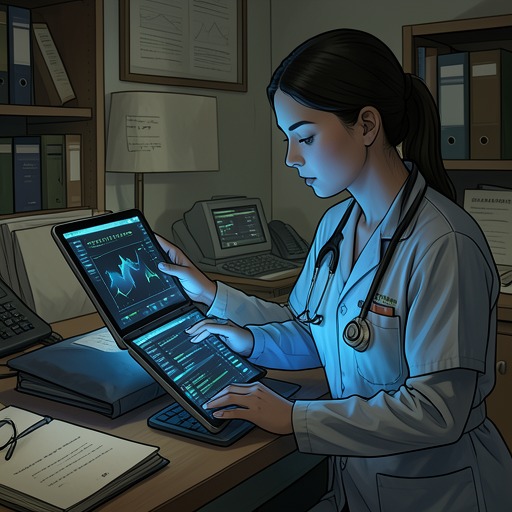
The Good Nurse: A True Story of Medicine, Madness, and MurderCerner PowerChart is the mobile electronic patient-record system through which nurses could review a patient’s chart, including notes, allergies, code status, and laboratory values. In the hospitals where Charles Cullen worked, it served first as an ordinary tool of bedside care and later as a source of investigative evidence: its records helped show that he had repeatedly examined patients outside his own assignments, including patients whose conditions he had helped make worse.
Definition and Clinical Use
At Somerset Medical Center, Cerner PowerChart was a compact database accessed on a mobile computer cart. Nurses used it to enter or consult patient information, while Pyxis handled medication orders and dispensing. The distinction mattered. Pyxis could record a drug request; Cerner PowerChart could place that action against a patient’s changing clinical course and record when a chart had been consulted.
The system was intended to support care for patients a nurse was responsible for during a shift. Looking up another nurse’s patients was not a normal practice, according to Amy Loughren. Cerner PowerChart therefore contained more than clinical facts: its access history could make visible a pattern of attention that ordinary handoffs and bedside observations might miss.
Cullen’s Use of the System
Cullen’s conspicuous devotion to the mobile computer initially reinforced his reputation as an unusually diligent nurse. At Somerset, he was quick with handoffs, efficient in his work, and often among the first to finish his initial checks. Amy noticed that he spent hours charting, sometimes away from the scrutiny of the nursing station, and teased him about writing a novel. His colleagues saw a nurse who seemed serious, attentive, and willing to help.
His physical placement with the cart later took on a different significance. After shift reports, he regularly wheeled the computer down the hall toward an isolated corner near the elevator doors. Amy had assumed he wanted quiet in which to work. Revisiting the routine, she recognized that the position also gave him a view of the pharmacy runner bringing medication deliveries. Cullen would meet the runner and take the delivery tote, appearing to help stock the unit. That realization suggested a way to obtain drugs without using Pyxis at all; Cerner PowerChart did not itself establish how the drugs were acquired, but its records could be compared with the work pattern Amy remembered.
Cullen also used the system to follow patients’ progress. On June 14, 2003, he arrived early and reviewed charts before selecting Jin Kyung Han, who was not his patient. Her cardiologist had discontinued digoxin after deciding it might worsen her arrhythmia. Cullen then obtained digoxin through a canceled Pyxis order and injected a dose eight times larger than any Han had previously received. When he returned to work, he used the chart to check her condition: her heart rate had fallen, she had vomited, and a blood test showed her digoxin level had risen from 0.63 to 9.94. An antidote was ordered, and Han survived, though she remained unwell.
Cullen also studied Reverend Florian Gall’s chart during the night, using the portable computer to follow the drama of the numbers. Gall had initially improved, his digoxin had been discontinued, and his condition had begun to stabilize. He later suffered cardiac arrest and died; his bloodwork showed digoxin levels far above the expected range. The chart did not by itself explain what had happened, but it placed Cullen’s attention alongside a patient’s changing condition and a fatal result.
From Clinical Record to Investigative Lead
The Somerset County Prosecutor’s Office initially concentrated on Pyxis activity. Investigators obtained records showing the times Cullen had called up drugs, the medication involved, and the patient to whom it was billed. Those reports seemed promising, but the evening before Gall’s overdose showed no digoxin withdrawal by Cullen. The expected direct record of a drug purchase did not provide the answer investigators sought.
Amy realized that investigators had not obtained Cerner information. She explained that the system could provide a running timeline of patients’ progress in the cardiac-care unit and a timestamped record of every occasion on which Cullen had opened a chart. The distinction changed the investigation: instead of looking only for a recorded medication transaction, detectives could examine which patients Cullen had followed and when. Amy’s explanation also revealed how much specialized clinical knowledge was needed to recognize what the records could show.
The two systems became more revealing when read together. Amy demonstrated that Cullen had called up and canceled digoxin orders at least twenty-seven times between the start of his Somerset employment and June 27, including eight times in February. The canceled orders could open the Pyxis drawer without appearing as completed withdrawals, a method that could account for access not visible in ordinary transaction records. But Cullen stopped making digoxin requests after Gall’s death, while abnormal patient laboratory results continued. The Pyxis pattern was suggestive, not conclusive; Cerner’s access history offered another line of inquiry rather than a standalone proof of poisoning.
Evidentiary and Narrative Significance
Cerner PowerChart’s importance lies in the difference between a patient record as a tool for care and that same record as a trace of attention. During ordinary shifts, Cullen’s repeated charting could look like diligence. Once Amy understood that he was consulting patients outside his assignment, the timestamps became a way to test that impression against the sequence of patient events. The same habit that had helped him appear conscientious could also leave an evidentiary pattern.
The system’s significance also depended on interpretation and access. Investigators knew to seek medication records, but Amy had to tell them that a separate clinical database existed and explain what its entries meant. The records did not explain themselves: Pyxis could obscure a canceled request’s practical effect, while Cerner PowerChart could show chart access without proving why Cullen had looked. Read together with patient histories, work assignments, and Amy’s knowledge of nursing routines, they made previously disconnected details legible. Cerner PowerChart thus becomes a quiet counter-record to Cullen’s helpful public persona: not a witness that can speak on its own, but an archive whose timestamps acquire force when someone knows how to read them.