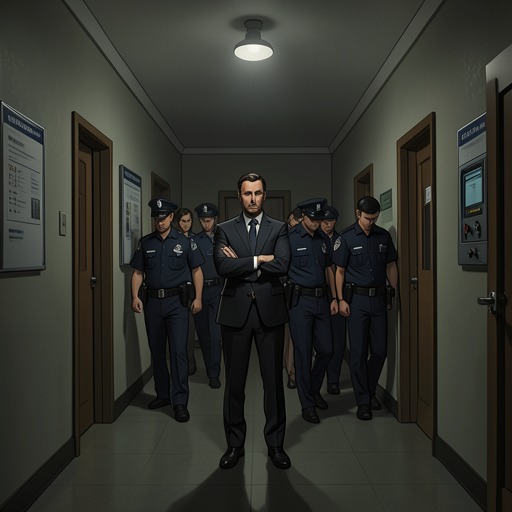
Charles Cullen is arrested
The Good Nurse: A True Story of Medicine, Madness, and MurderCharles Cullen’s arrest turns a covert investigation into a public criminal case, but it does not immediately resolve the investigators’ central problem: how to make him talk. The arrest was deliberately staged as an ordinary traffic stop, with uniformed officers taking Cullen into custody so that Tim Braun and Danny Baldwin could question him later. News of the arrest drew more than 175 calls to the prosecutor’s office, while Cullen’s agreement to speak with Amy Loughren brought the investigation back to the friendship that had helped expose him.
The investigation behind the arrest
The arrest followed a pattern of medical emergencies that had resisted easy explanation. At Saint Barnabas Hospital, investigators found an intravenous bag that tested positive for insulin; tiny needle punctures along its perimeter made accidental damage seem unlikely. Patient records showed no prescription or nursing notation to account for insulin in the bloodstream of patients who had suffered unexplained crashes. Hospital security personnel compared staff schedules with the times of the emergencies, and Charles Cullen emerged as one of the nurses present at every code under review. The evidence raised grave suspicions, but complicated illnesses, irregular shifts and uncertain links between individual cases made the pattern difficult to prove.
The institutional response to warnings had also been uneven. At Saint Barnabas, an approach to local police had been rebuffed, and hospital investigators continued their own inquiries while tainted bags and further episodes deepened their concern. Later, at Somerset Medical Center, New Jersey Poison Control director Steven Marcus warned administrators that the cluster of illnesses might reflect a criminal act and that suspected incidents had to be reported to the state within twenty-four hours. Somerset said it would wait until it had completed an internal investigation. Marcus had already contacted state health officials, but the delay illustrated how a hospital’s preference for investigating internally could obstruct prompt outside intervention.
Amy Loughren’s reassessment of Cullen’s routines supplied a more specific explanation for how he could obtain drugs without appearing in the Pyxis records. She recalled that he positioned himself near the elevator doors and routinely took the pharmacy runner’s delivery tote, seemingly to help stock the unit. In retrospect, that access meant he could handle delivered medication without needing to use the Pyxis system. The discovery helped investigators understand why a search for suspicious recorded withdrawals might not capture his methods; it also connected his apparently helpful habits to the practical opportunities available on a hospital floor.
A planned traffic stop
At 4:40 p.m., Cullen drove his Ford Escort out of the Office restaurant parking lot and west along Route 22. Danny had alerted officers Timothy Musto, Michael Vanouver and Detective Douglas Brownlie, who were waiting nearby in a marked Somerset County Sheriff’s Department car. Braun and Baldwin wanted to conduct the arrest themselves, but the investigators understood that a person arrested and advised of his rights by the same officers might later treat their request to talk as unserious. A uniformed stop was intended to make the encounter look routine and leave the later questioning to the investigators in suits.
About fifteen minutes after Cullen set out, the marked car came behind him with its emergency lights on. Cullen pulled onto the paved shoulder shortly before the turnoff to Frontier Road. The officers ordered him out and onto the ground, handcuffed and searched him, then placed him in the rear of their car. The arrest’s ordinary traffic-stop appearance concealed a carefully divided operation: uniformed officers made the seizure, while Braun and Baldwin waited to question the suspect afterward.
Cullen was taken to the Somerset County Prosecutor’s Office at 40 North Bridge Street and secured to a handcuff cable bolted to the floor in an upstairs interview room. There, he looked up at Braun and Baldwin, who stood over him in the confined space. Their arrival marked the transition from arrest to interrogation, but custody alone had not yet produced an account from him. The book’s sequence keeps that uncertainty alive: the investigators have brought Cullen into the room, yet still need him to choose to speak.
Public exposure and Amy’s return
News that a suspect had been arrested for patient murders at Somerset Medical Center broke on a Friday afternoon. Within less than a minute, calls began flooding the prosecutor’s office switchboard. More than 175 inquiries and calls from tipsters and concerned family members came in. The volume transformed a case that had been worked through hospital records and private warnings into an urgent public matter. Braun and Baldwin could not immediately attend to Cullen: they had to leave detectives Brownlie and Magos to handle the callers before walking across to the county jail.
At the jail, the investigators found Cullen curled on his bed, staring at the wall. They proposed that he speak with Amy first, with the possibility of talking to them afterward. Cullen agreed. The arrangement depended on the fact that Amy was not simply another investigator to him: she had been his friend and coworker, and she had helped police while he believed she remained his friend. The arrest therefore carried a personal consequence alongside its legal one. The person brought back into the interview process was also someone Cullen trusted, while Amy now had to face the emotional cost of that trust being used in the investigation.
Before the return trip to the prosecutor’s office, Danny gave Cullen a Miranda Warning Form to read aloud. It was the second warning since the arrest, and Cullen wrote yes and his initials beside each line, then signed the form. Danny watched him complete it, had the pen taken away, and led him to the car. These procedural steps make clear that the renewed interview was not merely an informal conversation: Cullen was in custody, the warning was documented, and his agreement to speak came after the investigators had laid out the terms.
What the arrest changes
The arrest established that the case had passed beyond a hospital’s internal handling and into criminal custody, but it did not erase the evidentiary and institutional difficulties that had preceded it. Earlier incidents had been hard to connect conclusively to Cullen; warnings had met hesitation, and his access to pharmacy deliveries had provided a possible route outside the medication system’s ordinary records. The carefully arranged stop solved a narrower problem: it brought him before investigators without making Braun and Baldwin the arresting officers who would later seek his cooperation.
The public response and the return to Amy’s presence give the event two different forms of pressure. Outside the interview room, families and tipsters demanded attention as the case became news. Inside, Cullen’s willingness to speak with Amy rested on a relationship whose meaning had changed for her but had not, in that moment, disappeared. His arrest was thus both a procedural threshold and a rupture in that friendship. It secured custody; the work of turning custody into disclosure still lay ahead.