Charles Cullen’s patient-poisoning murders
The Good Nurse: A True Story of Medicine, Madness, and MurderCharles Cullen’s patient-poisoning murders turned ordinary hospital access into a means of killing: patients received drugs they had not been prescribed, while the acts that delivered them could resemble routine nursing care. The deaths were not discovered all at once. They emerged through anomalous insulin results, nurses’ observations, medication records, and, ultimately, Cullen’s confession—evidence that exposed both a serial pattern and the difficulty of proving individual crimes within a medical system.
Early Signals at Saint Barnabas
At Saint Barnabas Hospital, unexplained insulin crashes first appeared as scattered emergencies. Fred Belf began vomiting after receiving heparin; when nurses disconnected the drip, he improved. Testing then found insulin in his IV bag. Its exterior bore tiny needle punctures, including three along the edge—an unusual location that made accidental damage seem less plausible. Laboratory work on other patients showed exceptionally high insulin levels, much of it foreign to their bodies: insulin had been administered to them.
The initial alternative was error: perhaps a nurse had misread an order or mislabeled a vial. But Thomas Arnold and his colleagues found no prescription for insulin in the patients’ charts and no notation that it had been given. The incidents had occurred across intensive-care, critical-care, and cardiac units, with codes sometimes overlapping. When Arnold and Joe Barry compared staff schedules with the times of the emergencies, only three nurses had worked every code. Cullen drew particular attention. The pattern was alarming, but at this stage the case rested on a cluster of unexplained events, laboratory findings, and access—not yet a proven account of each patient’s death.
The concern reached nurses through changed procedures as well as investigation. Amy Loughren was asked to sign an insulin adjustment form recording her estimate of the amount remaining in a vial. She considered the estimate unreliable and refused to sign, but her manager did not explain why insulin was suddenly being treated with heightened accountability. The new rule signaled that something had happened on the unit without telling staff what it was. Later, when colleagues associated Amy with Cullen and with the insulin issue, that withheld information became a source of fear and suspicion around her.
Methods at Saint Luke’s
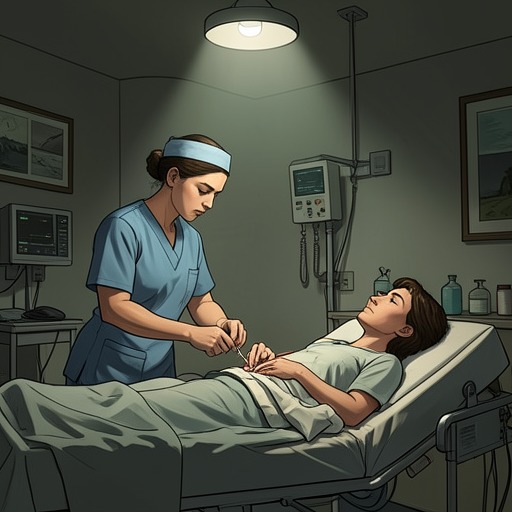
At Saint Luke’s, Cullen could make a lethal intervention resemble a legitimate task. In one account, he injected digoxin through the piggyback port of an elderly patient’s IV, a route nurses routinely used to flush a line. The drug was clear, and the patient’s private room offered little chance of being observed. Afterward, Cullen put the vial and used needle in the sharps container, returned to the nurses’ station, and waited until the patient coded. He then took part in the response as code leader. The ordinary sequence—access to the line, disposal of supplies, and presence at the code—could conceal the act inside the work of caring for the patient.
Another method depended less on a bedside injection than on access to the medication room. On June 1, 2002, Cullen arrived early for a night shift, collected medicines delivered by a pharmacy runner, and entered the supply room alone. He prepared syringes and injected their contents into saline bags, then placed the altered bags in named patient trays as antibiotic preparations. Colleagues saw him stocking medication and helping to set up IV lines; the separate steps did not appear connected. His usefulness to coworkers and his visible participation in emergencies could therefore make the same conduct look like routine assistance.
The night-shift setting repeatedly shaped these opportunities. Cullen preferred the hospital after visitors and administrators had gone, when the halls were quieter and the rooms remained private. He watched patient monitors and medication routines, and Amy Loughren later reconsidered his customary position near the end of the CCU hallway. From there, he was close to the doors and often the first person to meet the pharmacy runner. What she had taken for helpfulness—Cullen relieving the runner of a delivery tote and stocking the unit—could also give him access to drugs without using the Pyxis system.
Medication concerns at Saint Luke’s included a dangerous paralytic as well as drugs associated with the deaths. During a weekend review, nurses found that 60 milligrams of vecuronium bromide had apparently been reconstituted in syringes, although no patient in the CCU had been prescribed it during those four shifts. The drug could leave a person unable to move or call out while pain remained possible. Nurses watched the medication room; Kim Wolfe saw Cullen arrive early, move chairs, and then enter the room alone. Her observation raised suspicion, but surveillance of access did not by itself establish what had happened to a particular patient. Cullen later confessed to killing patients at Saint Luke’s, and seven patients there were specifically identified as victims.
Deaths and Suspicion Across Hospitals
Nurses’ observations at Saint Luke’s supplied a pattern that ordinary chart review had not resolved. Lynn Tester noticed that patients who seemed to be recovering sometimes died suddenly after Cullen changed their IVs. Robin Saulsberry saw him leave a patient’s room shortly before an unexpected code and believed the patient may have received Pronestyl, which Cullen had been found dumping from the medication closet. Tester calculated that Cullen worked 26 percent of the hours but was present for 58 percent of the deaths. Another nurse recalled that the unit averaged twenty to twenty-two Code Blues a month while Cullen worked there, then went six months without a code after he left. These comparisons sharpened suspicion, but they did not identify a cause for every death.
At Somerset Medical Center, Amy Loughren’s memories of Cullen’s habits took on a different meaning as the investigation developed. His position by the hallway doors, his regular contact with the pharmacy runner, and his access to delivered drugs suggested a route around Pyxis that investigators had not initially recognized. Meanwhile, Bruce Ruck raised the existence of two other patients with unusually abnormal glucose readings and asked whether insulin and C-peptide levels had been measured. Questions about apparently isolated glucose emergencies were becoming part of a broader inquiry into whether patients had received drugs from outside their prescribed care.
The deaths included cases in which the evidence eventually became more specific. Florian Gall’s toxicology report, received on November 29, 2003, found digoxin at substantial levels in the vitreous fluid, spleen, heart, and kidney, while testing excluded roughly ninety-six other drugs. The cause of death was amended to digoxin toxicity and the manner to homicide. Investigators had established both a murder and the drug involved, but medication records showing that Cullen could have obtained digoxin did not prove that he had administered it to Gall. Cullen also killed Pasquale Napolitano on July 13, though at the time he did not know the patient’s name.
Michael Strenko’s collapse shows how a suspected poisoning could be entangled with a prolonged resuscitation. Cullen told Strenko’s parents that their son’s condition was hopeless; his mother ordered him to leave. At about two in the morning on May 15, after the family had endured the resuscitation, she finally waved away the last shock paddle and Strenko flatlined. The scene records the death and the family’s refusal to accept Cullen’s intervention in the moment, but it does not itself establish the medication evidence behind the case.
Investigation, Evidence, and Scope
At Saint Luke’s, nurse Pat Medellin distrusted the hospital’s assurance that Cullen had harmed no patients. She believed unusual deaths had occurred on her unit and knew Cullen had been removed for diverting dangerous medications. On August 29, 2002, she took her concerns to an acquaintance in the Easton police department. The report moved through police and coroner channels to the Lehigh County district attorney’s office, after which state troopers interviewed hospital staff. Their accounts of sudden deaths on the night shift were strikingly consistent.
The first reviews nevertheless failed to produce prosecutable proof. An outside pathologist examined seventeen charts selected by Saint Luke’s and found no basis to conclude that Cullen had harmed anyone. Hospital-ordered chart reviews likewise identified neither suspicious administration of vecuronium nor suspicious deaths. The limitations were consequential: reviewers lacked some of the medication information and nurse statements that might have given the charts context, while the records themselves could not reliably distinguish a deliberate act from an error or an unexplained medical decline. When Cullen moved on to Somerset with neutral references, the deaths and concerns did not travel as a settled finding of homicide.
At Somerset, the Pyxis reports and Cerner printouts linked Cullen to access and movement across the ward, but investigators recognized that access was not proof of murder. A medication order could be defended as valid; canceled orders could be called mistakes; movement through patient records could be interpreted as harmless or merely unsettling. By then Cullen was no longer working there, so catching him in the act risked exposing another patient to danger. The investigation needed a confession or other direct evidence, not simply a troubling coincidence between his shifts and patient emergencies.
That distinction defines both the reach and the limits of the known case. Cullen confessed to killing, among others, five Saint Luke’s patients whose deaths were at issue in the litigation; the book records seven patients specifically identified as killed by him at that hospital. Those figures establish a documented group of victims, not a complete count of every death for which he might have been responsible. Across the hospitals, the decisive pattern was built from more than one kind of clue: altered IV bags and foreign insulin, access to drugs, timing around codes, nurses’ recollections, toxicology, and finally confession. The murders depended on clinical routines that made access ordinary; their recognition depended on people learning to read those routines as possible evidence of harm.