Danny Baldwin
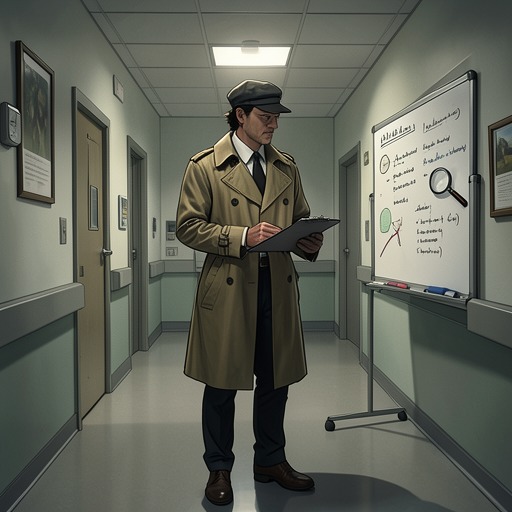
The Good Nurse: A True Story of Medicine, Madness, and MurderDanny Baldwin is a Somerset County detective whose energy and investigative persistence help turn suspicions about Charles Cullen into a focused murder investigation. As lead detective, he works across the boundaries between police procedure and hospital medicine: interviewing nurses, carrying medical records to experts, taking personal responsibility for a search warrant, and matching tips against employment and drug-dispensing records. His progress is painstaking rather than conclusive at first; the central challenge is not merely finding a suspect, but converting unexplained patient deaths into evidence that can sustain a homicide case.
Identity and Background
When Tim Braun checked the Major Crimes on-call rotation, Baldwin was the new detective assigned to respond. He was ten years younger than Braun and had recently joined the Somerset County Prosecutor’s Office, but he was not new to demanding investigations. The two had first met in Newark, New Jersey, where Baldwin had built a strong reputation in an elite auto-theft task force and served in Essex Homicide. In Somerset, he was the office’s only Black detective. The account describes him as a former linebacker, six and a half feet tall and 250 pounds, with a shaved head and a restless, visibly energetic manner. Those details establish both his conspicuous presence and the ambition Braun sees in his younger colleague.
Baldwin’s physical energy is paired with a willingness to take responsibility for difficult investigative choices. When the investigation reaches the point of searching Cullen’s home, he is the detective who asks the assistant prosecutor to trust his assessment of probable cause. He works for hours on the warrant’s legal language and accepts that any professional fallout will land on him first. His later uncertainty does not erase that decision; it shows that he understands the difference between believing a theory and having enough evidence to justify an intrusive step.
Building a Case from Medical Uncertainty
One of Baldwin’s early tasks is to follow a death through the formal machinery of investigation. On a Saturday morning he travels to the Medical Examiner’s Office, observes the autopsy of McKinley Crews, returns to his desk at the Somerset County Prosecutor’s Office, completes the I-1-00 paperwork, and calls Braun from his car. Crews is described in the report as an older Black man with nothing visibly wrong with him. The sequence is procedural, but it also marks the problem Baldwin and his colleagues face: a death can demand police attention without presenting an obvious physical explanation.
Medical expertise is essential, yet it does not immediately provide a usable case. After Somerset Medical Center’s five-month internal investigation, the detectives find that it has produced only four pieces of paper and no answers. The patients appear to have been poisoned with drugs, but the hospital supplies no Pyxis records, no interviews or background from its lawyer, and no physical evidence. Baldwin and Braun are left with a medical mystery that the institution’s own specialists have not resolved and with few obvious places to continue looking.
Baldwin carries the records to the regional medical examiner, Nobby C. Mambo, and helps pursue expert review of the six unexplained incidents. Mambo and a state toxicologist regard Florian Gall’s unusually high digoxin levels as the most promising basis for a homicide case. That judgment gives the investigation a possible victim around whom to organize its work, but it is not a verdict or a complete evidentiary chain: the detectives still cannot build a case from paperwork alone. Baldwin’s role here is a form of investigative translation, bringing hospital documentation to people qualified to interpret it while confronting the gap between a medically suspicious death and proof of murder.
Interviews, Search, and Operational Judgment
By the time Baldwin has been interviewing hospital nurses for a week, he has encountered fear about job security repeatedly. Amy Loughren stands out because she acknowledges that fear directly and does not look toward Mary Lund when she does so. Baldwin notices the difference. The moment matters less as an instant solution than as a change in the quality of the interview: a nurse is willing to state a concern openly, rather than leaving investigators to infer it from silence or hesitation.
The search of Cullen’s home in Bethlehem becomes Baldwin’s most explicit personal wager. A team of Somerset County investigators and prosecutors, joined by a liaison from the Northampton County District Attorney’s Office, serves Catherine Westerfer with a warrant at her front door. Investigators spend three hours searching Cullen’s house and car, concentrating on controlled substances he might have stolen from a hospital. Baldwin has vouched for probable cause and helped prepare the warrant; on the drive back, he recognizes that the consequences of the decision will reach him first. The evidence describes his doubt after the search, not a discovery of stolen drugs, so the episode is significant chiefly for the risk he accepted and the uncertainty that remained.
Baldwin and Braun also plan Cullen’s arrest around the later interrogation. They want to make the arrest themselves, but recognize that the officer who arrests and advises a suspect of his rights should not be part of the team that questions him afterward. Baldwin radios ahead to uniformed officers and another detective positioned nearby. The intended stop is made to look like a routine traffic stop, leaving the suited investigators free to approach Cullen later. The arrangement shows Baldwin attending not only to whether police can take Cullen into custody, but to how the separation of roles may affect the suspect’s willingness to speak.
From Leads to a Victim List
The investigation’s scale becomes clearer through Baldwin’s work on information already gathered. He leads the effort to cross-reference about 175 tips with Cullen’s work schedule, assignment sheets, Pyxis records, and Cerner transactions. The first result is a list of twenty-six high-probability victims from Cullen’s year at Somerset Medical Center alone. Cullen identifies a few names as immediately familiar to him and says he will need to review the charts for the others. The list is therefore a substantial investigative advance, not a final accounting: it organizes leads around dates, access, and records while leaving further review necessary.
That distinction between a pattern and proof runs through Baldwin’s work. Pyxis reports and Cerner printouts connect Cullen to drugs that killed Gall and show how he could have obtained them, but Prosecutor Wayne Forrest regards that as far short of proving murder. Baldwin’s investigation has to make records, patient histories, expert judgments, and witness accounts converge. The tip cross-reference expands the possible scope of the case; it does not remove the need to establish what happened to each patient.
Career and Narrative Role
After Cullen’s arrest, the length of the interrogation is recorded with a revealing discrepancy. Baldwin’s report lists six hours, while the timeline notes that Cullen had been processed by 6 p.m. and that the interview did not end until 3 a.m. The record thus preserves both the investigative paperwork and a longer clock-time span, without making those figures identical. Baldwin’s name remains attached to the work not only through the interviews and reports, but through the case’s demanding passage from arrest to sustained questioning.
Baldwin later transfers out of Somerset County and becomes a detective with the Monmouth County Prosecutor’s Office; he also works as an adjunct professor of criminal justice. In the account of Cullen’s investigation, he functions as both Braun’s junior partner and the lead detective willing to carry a high-stakes decision himself. His importance lies in the accumulation of work: observing an autopsy, pursuing expert assessment, recognizing a candid witness, accepting responsibility for a warrant, arranging the arrest to preserve the interrogation, and finding a way to organize 175 tips into a victim list. The case advances not through one decisive revelation, but through the disciplined joining of fragments that institutions and records had left apart.