Drug cocktails
The Good Nurse: A True Story of Medicine, Madness, and MurderDrug cocktails are combinations of medications whose interacting effects can push a vulnerable patient toward collapse more effectively than a large dose of one drug alone. In Amy Loughren’s reconstruction of suspected poisonings by Charles Cullen, the idea explains both the changing laboratory results and how drugged IV bags might have reached patients without Cullen having to administer them himself. The method is presented as an investigative theory grounded in medication records, patient data, and the routines of a hospital ward—not as proof that every unexplained incident involved the same combination of drugs.
Principle and Intended Effect
Amy describes the combinations as a pharmacopeal mélange: each medication has its own biochemical effect, but together they can act in complementary ways. One drug may push while another pulls, making it possible to tip a susceptible patient over the edge without relying on a correspondingly large amount of any one substance. The patient’s physiological response, rather than a single conspicuous dose, becomes central to the pattern.
The interval between a cocktail’s administration and its effects also matters. A patient might crash, enter a code, or appear to recover before the implications become clear. In Amy’s formulation, laboratory reports become the answer to a riddle whose clues are the medication combinations and the patient’s subsequent course. The idea helps account for why suspicious results could remain difficult to interpret when investigators looked for one drug, one order, or one obvious moment of administration.
Routes into the Patient’s IV
The hospital’s ordinary procedures offered several possible routes. In one scene, Cullen injects digoxin directly into the piggyback port of an elderly woman’s IV. Because nurses routinely use that port to flush an IV line, the action could appear legitimate if interrupted; the drug is clear like saline. Afterward, Cullen puts the vial and used needle into a sharps container, returns to the nurses’ station, and later takes part in the code. This is a direct injection, distinct from Amy’s later theory about combinations placed in bags for other nurses to deliver.
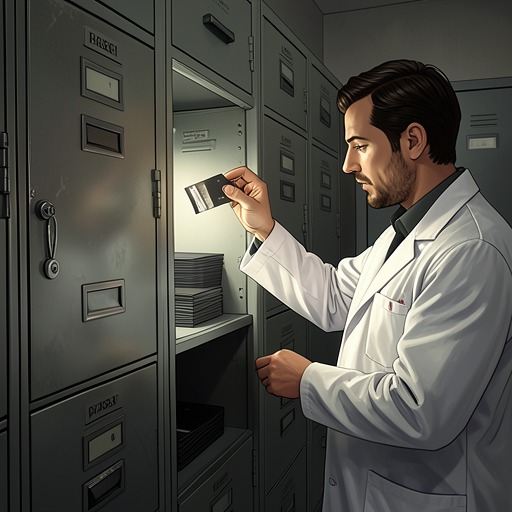
Another passage describes Cullen alone in a medication room after collecting a pharmacy runner’s deliveries. He draws up liquid, injects saline bags, switches bags, and places the prepared antibiotic cocktails in patient-named trays. The account emphasizes how routine the task could look: a nurse stocking medication and helping colleagues prepare IV lines. The evidence does not specify the substances in each prepared bag, so this scene establishes a covert bag-tampering route rather than identifying a particular recipe.
Amy later reasons that a mixture placed in IV bags near the Pyxis could reach patients through the work of other nurses. They might carry the bags to patients without knowing they had been altered. On this hypothesis, Cullen would not need to enter each patient’s room or be present when a patient deteriorated. The distinction between preparation and delivery is crucial: the clinical workflow could conceal the connection between a person who altered a bag and the nurse who hung it.
Access, Records, and Concealment
The medication system provided investigators with an incomplete view of access. Pyxis reports recorded time-stamped drug orders, the units and drugs involved, and the patients to whom orders were billed. But a cancellation could leave a different impression from a physical removal: after Amy accidentally canceled an order and saw that the drawer had opened, she recognized how a medication might be taken without appearing as an acknowledged withdrawal. Reviewing Cullen’s records, she found at least 27 canceled digoxin requests between his arrival at Somerset Medical Center and June 27, including eight in February. Other nurses in the unit had placed fewer than a fifth as many such requests.
The pattern was suggestive, not conclusive. Investigators could not establish from those records alone that Cullen had stolen drugs through canceled orders. His digoxin requests, including cancellations, stopped four days after Reverend Florian Gall’s death, while unexplained laboratory findings continued. That contrast left open the possibility that Cullen had another source of medication—or that he was not responsible for the incidents Amy was trying to explain. Pyxis data could raise a theory while also showing the limits of that theory.
Amy identified Cerner as another essential record. Unlike Pyxis, which logged medication orders, Cerner held patient information such as notes, allergies, code status, and laboratory values. It also recorded chart access. Investigators initially had not obtained that data; Amy explained that it could provide a timeline of patients’ progress and show when Cullen had looked at their charts. The distinction between the systems mattered: an order history could help trace drug access, while a patient record could show what happened afterward and when Cullen checked the result.
Monitoring the Effects
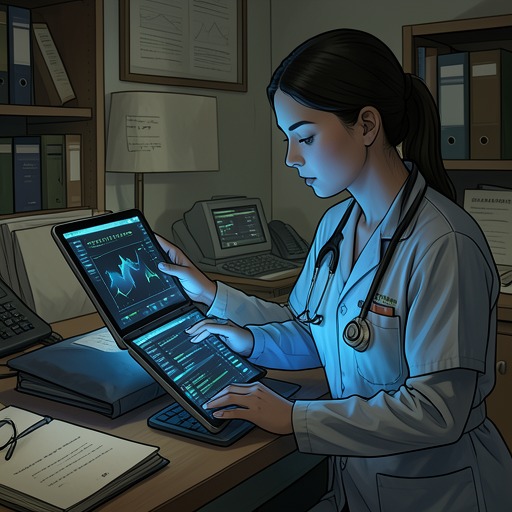
Cullen’s chart activity gave Amy a way to connect possible preparation with later patient responses. The records contained thousands of his Cerner log-ins, sometimes hundreds in a night, including access to patients who were not assigned to him. Amy considered whether he had been studying their status and laboratory results rather than using the system only for his own patients.
She proposed that Cullen could prepare a drug mixture, place it in an IV bag near the Pyxis, and let other nurses deliver it as part of their ordinary work. He could then return to his corner of the unit and use Cerner to follow the patient’s laboratory reports and progress. Because the system retained that information, he could review the course later as well; he would not have to be at the bedside when the patient’s condition changed. Amy’s image of him following events through the records underscores how the proposed method joined concealed drug delivery to retrospective observation.
That reconstruction remained Amy’s interpretation of the data, not a direct observation of every step. Its force came from bringing several kinds of evidence together: unusual combinations in medication records, unexplained laboratory results, access to delivered drugs, and repeated chart reviews. In this account, the drug cocktail is not only a pharmacological idea but also a way to read a dispersed pattern across ordinary hospital systems.
Investigative and Narrative Significance
The cocktail theory changed the investigative question from whether one suspicious drug appeared in one order to how multiple drugs, different routes of access, and delayed patient responses might fit together. It also exposed the limits of relying on a single record. A canceled Pyxis order could conceal an unacknowledged removal; a pharmacy delivery could bypass the dispensing system; Cerner could document later chart checks without identifying what had been put into an IV bag. Each record illuminated a different stage, and none alone supplied the whole sequence.
For Amy, interpreting those patterns carried a personal cost. The clinical knowledge that let her explain how drugs might work together also implicated the ordinary nursing actions through which a prepared IV could reach a patient. She had been Cullen’s friend and had delivered drug cocktails without knowing, at the time, what they might contain. The concept therefore binds the book’s procedural investigation to its emotional reversal: familiar acts of care—stocking medication, preparing lines, checking charts—can look different once their possible place in a concealed sequence becomes visible.