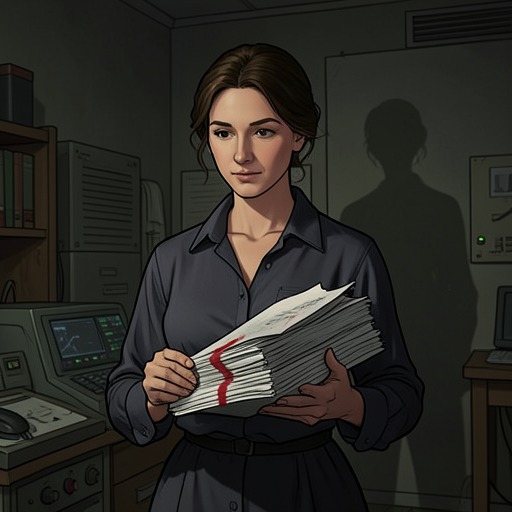
Kim Wolfe
The Good Nurse: A True Story of Medicine, Madness, and MurderKim Wolfe, a thirty-one-year-old day nurse in Saint Luke’s Hospital’s coronary care unit, becomes an important witness when an everyday piece of medical waste refuses to behave as expected. A needle will not fit into the sharps bin; when she looks inside, she finds white cardboard boxes instead of used sharps. Following that small physical anomaly, she helps uncover a hidden supply of drugs and watches Charles Cullen enter the medication room. She does not see him poison anyone, but her observations help transform suspicion into a specific, testable lead.
Identity and Position
Wolfe works the day shift in the CCU, where medication storage and the disposal of used needles are part of routine nursing practice. She knows the sharps container as a one-way receptacle: needles go in, and only Environmental Services, whose staff hold the key, opens it to remove hazardous medical waste. Since AIDS had heightened concern about hepatitis and needle-stick injuries, nurses had little reason to investigate the bin themselves. Wolfe’s decision to look is therefore a break in routine, prompted not by an assignment but by a simple mismatch between what she expects to hear and what happens.
She is also a familiar colleague to Cullen. They have crossed shifts for more than two years. Wolfe likes him and regards him as friendly, though not a close friend; his quirks do not trouble her, and she knows him as generous with his time when another nurse needs help. That history gives the later observation its force. The person she sees enter the room is not a stranger whose behavior already appears suspicious, but someone whose ordinary helpfulness has helped make him seem safe.
The Sharps Bin
The discovery begins on a rainy June afternoon in 2001, when Wolfe finishes with a needle and places it in the sharps box. Usually it clinks against the bottom. This time there is no sound, and the needle will not even fit. Curious, she lifts the lid and peers through the opening. Instead of used needles, she sees white cardboard boxes.
Wolfe leaves the medication room to find Gerry Kimble and Candy Wahlmark at the nursing station. Kimble, a veteran of the unit with sixteen years there, goes back expecting that the younger nurse may have been startled by something trivial. He finds the boxes too. He calls Environmental Services, whose staff unlock the container, and the contents are emptied into a bedpan. In a spare room, Kimble and Wahlmark carefully separate the drugs from the needles, laying the recovered items out on a counter. Wolfe’s initial curiosity has brought the irregularity into view; the group’s careful sorting makes it legible as a dangerous stash rather than an oddity in the waste bin.
The substances make the discovery more alarming. The recovered material includes syringes containing a reconstituted 60 milligrams of vecuronium bromide, a powerful paralytic. No patient on the CCU had been prescribed the drug during the four-shift weekend. The danger is not only that medication has gone missing: a drug capable of stopping a patient’s muscles from moving or breathing has been prepared and hidden among discarded sharps, with no legitimate order to explain its presence.
Watching the Medication Room
Because the stash could have been placed there by someone with access to the unit, Kimble, Wahlmark, and Wolfe take turns watching the medication room while continuing their patient-care duties. From her position at the nursing station, Wolfe has a clear view. She first sees a man she does not recognize enter using the access code and prop the door open with a sneaker while he restocks. About half an hour later, she sees the pharmacy worker enter with the code and leave the door open as well. The two ordinary-looking visits make the access pattern harder to interpret, not easier: several people can enter, and restocking is part of the room’s normal use.
At 6:20 p.m., Cullen arrives early, as usual. Wolfe is glad to see him. While she and Wahlmark keep their attention on their charts, he performs his familiar rearrangement of chairs around the nursing station, taking them down the hall in pairs. On his way back, he stops at the medication-room door, enters the code, and slips inside. The door locks behind him. Wolfe runs to alert Wahlmark, only to find that Wahlmark has already been watching.
Five minutes pass before the door opens. Cullen leaves and walks away down the hall. Wolfe goes to the medication room, enters the code, and looks inside: the sharps box is full again. The sequence does not show what Cullen did behind the closed door, and Wolfe does not claim to have witnessed an injection or a poisoning. Its importance lies in its timing. After the nurses have discovered drugs concealed in the bin and begun to monitor the room, Cullen’s brief, private visit is followed by the reappearance of the very kind of hidden contents that prompted their scrutiny.
From Observation to Alarm
Wolfe and Wahlmark immediately alert Ellen Amedeo, the ICU floor manager, who is at home. They tell her they know who has been using the deadly vials of vecuronium. Their conclusion is an urgent inference based on the sequence they have just observed, not a direct view of Cullen handling the drug. The distinction matters: Wolfe’s account supplies a strong investigative lead, while the concealed room activity itself remains unseen.
The sharps box is not opened again until the Monday-morning shift change, when Kimble and supervisor Terry Koehler, wearing sterile gloves and watched by hospital security, empty it onto the counter. This time they find several dozen bottles, including ten spent vials of vecuronium. The drugs had already been used on Edward O’Toole seven hours earlier. The later inventory gives the earlier discovery its full weight: the bin was not merely an illicit hiding place but part of a chain connecting prepared medication to a patient who had been poisoned.
Wolfe’s role is defined by the limits and value of what she can see. She notices a needle that does not fit, looks where nurses are not ordinarily expected to look, helps expose the hidden drugs, and watches a colleague whose familiar helpfulness initially made him unremarkable. She neither conducts the hospital’s investigation nor supplies proof of what happened inside the locked room. Instead, her precise observations mark the point where an unexplained cache becomes linked to Cullen by opportunity and timing, and where the unit’s ordinary routines begin to be read as possible evidence.