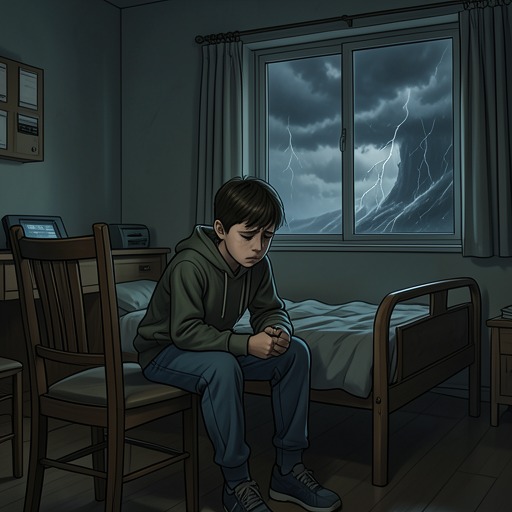
Nobody treats my pain. Only I treat my pain.
The Good Nurse: A True Story of Medicine, Madness, and Murder“Nobody treats my pain. Only I treat my pain.” is a sentence the book uses to crystallize Charles Cullen’s conviction that his suffering was both intolerable and beyond anyone else’s care. It first appears as words he was not yet willing to say after his mother’s death; later, it helps frame his drinking as a private means of relief and his repeated efforts to make that suffering visible to his wife.
First Context: Grief and Silence
After his mother died in a car accident in December 1977, Cullen was angry, inconsolable, and unwilling to talk to the psychiatrist who treated him following a suicide attempt. He returned home to what the narrative describes as the hole left by his mother. The phrase is introduced at this point not as a spoken declaration but as something he could not yet bring himself to say. Its first force is therefore bound to silence: pain is present, but he does not offer it to another person in words.
That silence is not presented as an absence of suffering. The passage places the sentence beside Cullen’s bereavement, suicide attempt, first hospital stay, and refusal to speak with the psychiatrist. The claim that only he can treat his pain emerges from that history as a private rule about who may act on suffering, before the book later shows drinking serving that role.
Relief as Self-Treatment
In the account of Cullen’s drinking, the phrase takes on a practical dimension. He sees no benefit in talking. Alcohol initially lifts his spirits, quiets the noise, and makes time feel like a constant present. The relief is temporary and self-focused: drinking helps him bear what he experiences as daily suffering, while reinforcing his sense that other people fail to understand it.
The narrative presents this as Cullen’s perception, not as proof that his wife, Adrianne Cullen, is indifferent to his pain. He feels wronged and misunderstood, and believes that she does not appreciate the depth of his frailty. Yet the means he chooses to communicate that distress deepen the distance between them. He arranges for her to encounter him on the phone with a funeral parlor, asking about burial rates, and stages a scene with prescription pills scattered beside him. Adrianne’s annoyance, rather than sympathy, confirms his sense of futility; he carries the hurt forward and looks for another way to elicit care.
A Sentence in Tension
The sentence’s two halves pull in opposite directions. The first names a failure of care; the second turns that failure into a solitary doctrine. But the later scenes show Cullen repeatedly trying to make Adrianne witness his pain and respond to it. His insistence that only he can treat it coexists with a desire for recognition and care from someone else.
That tension gives the phrase its significance. It links the young Cullen who could not yet speak after bereavement to the adult who turns to alcohol and dramatic displays of distress, without treating those actions as equivalent or claiming that the sentence explains them completely. It names a recurring conviction in the book: that his suffering is real to him, that others do not adequately recognize it, and that his chosen forms of self-treatment can leave him more isolated.