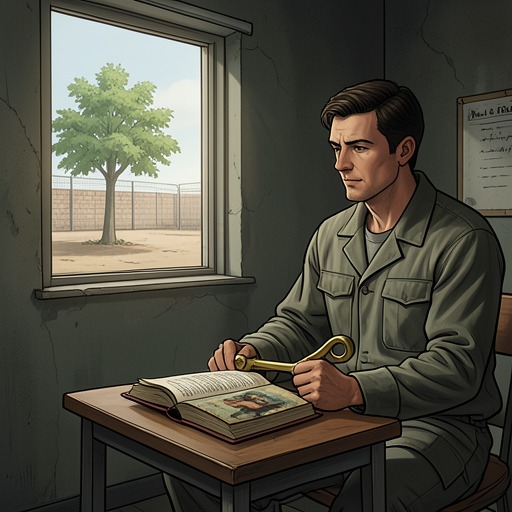
Somerset County Jail
The Good Nurse: A True Story of Medicine, Madness, and MurderSomerset County Jail, in Somerville, is where Charles Cullen’s arrest became a long period of confinement and cooperation with investigators. The book presents the jail less through its architecture than through routines and thresholds: a bed in a cell, a series of buzzing doors, escorted walks across the lawn, and the steady return to patient records. From this confined setting, the investigation widened across years and hospitals, while Cullen’s interactions with religious advisers eventually helped set a kidney-donation proposal in motion.
Arrest and the first encounter
After news of Cullen’s arrest for patient murders at Somerset Medical Center reached the public, the Somerset County Prosecutor’s Office received more than 175 inquiries and potential-victim reports. Tim Braun and Danny Baldwin left the office for the county jail, while detectives stayed behind to handle the calls. The account marks the change in scale: the case was no longer only a private investigation, but a public event drawing tipsters and families who feared that someone they knew might have been harmed.
Inside the lockup, Braun and Baldwin found Cullen curled on his bed, staring at the wall. The men had passed through a metal detector and a sequence of electronically buzzing doors to reach him. This brief first sight of the arrested nurse is starkly different from the image of the helpful hospital worker whose access and actions had been under investigation. At the jail, he is under guard and physically confined, yet the case is still far from resolved.
Amy Loughren’s encounter with Cullen during this period takes place not in the jail but in a room at the prosecutor’s office, where she watches an interview-room feed on closed-circuit television. She sees him arrive in prison clothes, stooped and affectless, with his arms and legs chained. Her response—guilt and grief at having helped bring about his arrest—shows how the investigation’s consequences crossed the boundary between custody and the relationships that preceded it. The jail supplies the immediate context for the transfer and detention; the book keeps the camera-room scene distinct from the lockup itself.
Confinement and the investigation
Months became years at Somerset County Jail, and Cullen’s life acquired a regularity he had rarely known outside custody. He had a cell, spy novels, time to exercise or shower, and meetings with a Catholic deacon and the head chaplain. The account emphasizes the repeated shape of this life rather than presenting confinement as a single dramatic interval: daily routines continue while investigators keep bringing him back to the records of the dead.
Guards escorted Cullen across the lawn to the prosecutor’s office, where he sat with Braun or Baldwin and worked through patient files. The materials included arrhythmic EKGs, final flatlines, and bloodwork. The investigation kept expanding: boxes of charts arrived nearly every week, covering sixteen years of deaths at nine hospitals. Cullen’s confinement therefore did not end his access to the case. Instead, escorted trips returned him to the clinical evidence, where his knowledge as a nurse could assist detectives and lawyers in examining patients’ records.
The contrast between the jail’s measured routine and the scale of those files gives the setting its particular narrative force. The investigators dealt with paperwork in offices, taking breaks for food as the seasons turned; Cullen worked through the files with black coffee and grew thinner. The task was not a brief interrogation but an extended review, continuing as the investigation moved toward closure. The jail held the suspect while the inquiry reconstructed events across many years and institutions.
Religious life and the kidney proposal
Religious practice became another part of Cullen’s routine in custody. Reverend Kathleen Roney had ministered to him since he came to the Somerset jail in 2003 and taught him meditation techniques associated with the Desert Fathers. The Jesus Prayer that Cullen recited at sentencing came from these lessons. In the book’s account, the jail is therefore not only a place of surveillance and case review; it is also where repeated meetings with a chaplain introduced forms of spiritual discipline into his confined life.
During a weekly service with the visiting Catholic deacon, Tom Sicola, Cullen casually asked whether an inmate could donate a kidney. Sicola sought guidance from his supervisor, Reverend Kathleen Roney. The question connected jailhouse ministry to a request outside the prison: Ernie Peckham needed a kidney, and Cullen believed that he might be able to give one. The possibility was striking in light of Cullen’s crimes, but the proposal emerged through ordinary channels of religious contact rather than through the investigators’ review of medical records.
Once the donation became public, Roney faced anger from people close to Peckham. Pat Medellin, his mother, told her that she was never to speak to the family again and blamed Roney and Johnnie Mask for the distress surrounding the proposed transplant. Roney maintained that the effort was intended to help save Peckham’s life, not to harm it. That conflict shows how Cullen’s incarceration did not isolate the effects of his case: decisions made through jail relationships continued to affect a recipient’s family and the people trying to arrange help.
Narrative significance
Somerset County Jail is a hinge between arrest and the lengthy work of establishing the reach of Cullen’s crimes. The first visit by Braun and Baldwin fixes the immediate fact of custody; the recurring escorted journeys to the prosecutor’s office make the jail part of an investigative process measured in charts, hospitals, and years. Its routines also hold together sharply different versions of Cullen: the prisoner who stares at a wall, the cooperating nurse who studies records, and the inmate who asks whether he can donate a kidney.
The jail’s significance lies in that unresolved coexistence. Custody does not supply a simple ending to the story, and religious instruction does not erase the harm for which Cullen is being investigated and punished. Instead, the place gathers the case’s aftermath into a continuing sequence: confinement, cooperation, spiritual counsel, and a proposed act of giving that provokes further pain. The book treats the jail as a lived setting in which the consequences of Cullen’s crimes remain active, rather than as a mere backdrop between arrest and sentencing.