Stony Brook Hospital
The Good Nurse: A True Story of Medicine, Madness, and MurderStony Brook Hospital is the medical setting for two stages of Ernie Peckham’s kidney crisis: the exhausting dialysis that could not halt his decline, and the transplant that brought him a kidney donated by Charles Cullen. The book links the hospital’s ordinary, repeated work of treatment to a highly unusual operation whose donor was a convicted serial killer. At the nearby Stony Brook medical complex, Peckham’s failing kidneys and Cullen’s offer of an organ converge in a surgery that gives Peckham a chance to live while leaving the donor’s motives unresolved.
Setting and Role in the Story
Stony Brook Hospital first appears as the place where Peckham receives dialysis. The account identifies his treatment there as three sessions a week, each lasting two hours. Dialysis removes fluid and filters blood through a machine, compensating for kidneys that can no longer perform those functions. For Peckham, however, the regimen had become another full-time job without stopping his health from deteriorating. The hospital is therefore not presented as a cure or a turning point at first; it is where the limits of ongoing treatment become part of everyday life.
The transplant later expands the hospital’s significance. In August 2005, a kidney from Cullen is flown to the Stony Brook medical complex, and Peckham undergoes surgery there. The narrative places the hospital within a larger medical landscape: the routine of repeated dialysis gives way to a rare live donation and a complex operation. It is a place of care, but also the point at which the book’s separate stories of a gravely ill patient and a jailed nurse become physically connected.
Peckham’s Dialysis and Decline
Peckham’s kidney failure followed an infection he had not noticed. After contracting strep, probably from what initially seemed like a minor illness, the infection spread; his immune response produced protein formations that clogged the microscopic filters in both kidneys. His body accumulated toxins and fluid, his hands and face swelled, and his urine darkened. By the time he sought medical help, his kidneys had failed. The account’s description makes clear why dialysis at Stony Brook Hospital was necessary, but also why it could not restore his former life.
The treatment imposed a demanding rhythm without delivering stability. Peckham’s vascular access repeatedly clotted, while a surgically created access port in a major neck vein remained like an open wound and exposed him to further infections. He had to give up his scoutmaster post and reduce his time at the local VFW. The hospital is associated not only with a medical procedure but with the narrowing of his ordinary activities as kidney failure reshaped his days. Dialysis could keep filtering his blood, yet it did not offer the prospect of getting his life back.
A transplant was difficult to obtain. The book notes that about sixty thousand people in the United States were waiting for kidneys, and that a deceased-donor kidney could involve a wait of five to seven years. A living donor generally offered a longer-lived organ, but Peckham had no medically eligible relatives; a random stranger was exceedingly unlikely to be a perfect tissue match. His mother, Pat Peckham, had already mortgaged her house to help with medical bills. She placed a public appeal in a local newspaper, giving Ernie’s blood type and the hospital’s donation hotline, but no donor came forward through that notice. Stony Brook Hospital thus stands at the end of a narrowing set of options: the site of dialysis while Peckham waited, and later the destination of an appeal that eventually reached an extraordinary potential donor.
The Transplant at Stony Brook
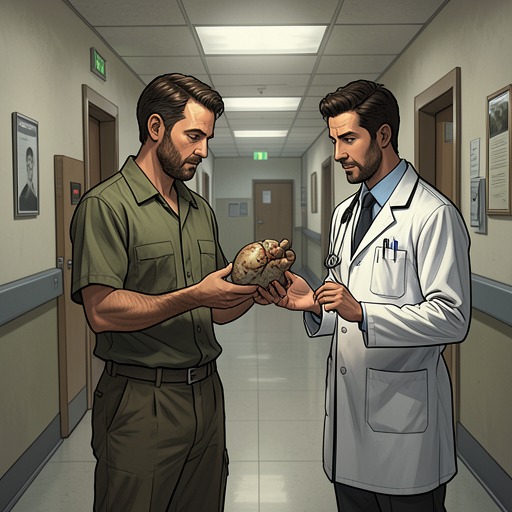
In August 2005, Cullen received a clipping of the newspaper appeal in jail. Peckham was the brother of Catherine Westerfer, Cullen’s estranged former girlfriend and the mother of his youngest child. Cullen and Peckham were not close; they were not even acquaintances. Nevertheless, Cullen offered to donate a kidney. On August 18, the kidney was placed in a red Coleman cooler and flown north from Trenton aboard a Lifestar helicopter, past Manhattan and up Long Island to the Stony Brook medical complex.
The operation brought the donor organ into Peckham’s body through precise surgical work. While Peckham lay anesthetized, surgeons opened the left side of his abdomen and positioned the kidney in his pelvis. They joined its renal artery to his blood supply and connected vein to vein. When a clamp was removed from an external iliac artery, the kidney swelled pink with oxygenated blood. The account makes the transplant’s result both bodily and immediate: the organ was alive again, and so was Peckham’s prospect of survival. The scene’s focus on the kidney’s connection to his circulation gives the hospital a concrete role in the transition from dependence on dialysis to life with a transplanted organ.
Medical Care and Moral Uncertainty
The transplant does not settle what Cullen’s donation meant. The book sets the act against the fact that Cullen had killed patients and against his sudden public effort to save Peckham. For victims’ families, the offer could look ironic or manipulative; the narrative asks whether it arose from compassion, a compulsion, or a desire for redemption, but does not claim to know. The operation at Stony Brook therefore carries a tension that the medical procedure itself cannot resolve: one person’s donated organ may sustain Peckham, while the donor’s reasons remain inaccessible.
That uncertainty also shapes the hospital’s narrative significance. Stony Brook is neither the scene of Cullen’s crimes nor the place where his motives are explained. It is where consequences meet: Peckham’s illness, the limits of dialysis, his family’s search for a donor, and Cullen’s decision to offer an organ all become material in medical care. The hospital’s rooms and surgical work make the outcome tangible, but they cannot make the donation morally simple. The kidney’s successful connection to Peckham’s blood supply is a clear physical event; what the gift signifies remains contested.