Tim Braun
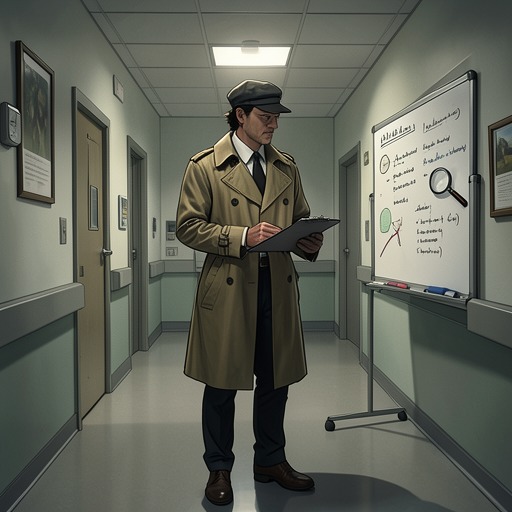
The Good Nurse: A True Story of Medicine, Madness, and MurderTim Braun is a homicide detective whose investigation of Charles Cullen is shadowed by an earlier failure: the unsolved murder of nurse Ethel Duryea, a case Braun had been ordered to leave alone. When a series of unexplained deaths and poisonings at Somerset Medical Center brings him back into homicide work, Braun confronts a problem that his experience has not prepared him to solve. The evidence is medical, the hospital controls much of the information, and the suspected killer can keep working while investigators struggle to prove what happened.
Identity and Background
Braun learned homicide as a detective in Newark, where the work arrived as a shifting queue of deaths. A new case could immediately displace an old one: detectives called the most urgent case a redball, a temporary priority that changed with every new body. The term captures the environment Braun knew—relentless, reactive, and governed by demands that could make even a grave case seem expendable. He had once worked security at Saint Barnabas Medical Center, but the anonymous elderly bodies he carried there as a teenager did not yet mean what a murder victim would mean to him later.
In Newark, Braun grew accustomed to the distance required by the job. The language of law enforcement made deaths impersonal, he understood, because feeling every loss too intimately could make the work impossible. Yet distance did not erase his unease about a system in which violence seemed routine and families might have learned to expect that their children would die or go to prison. His experience gave him practical fluency in triage and investigation, but it also taught him how easily the machinery of a case could take precedence over the person who had died.
At forty-two, Braun believed he was slowing down. The Somerset County Homicide position offered better pay, less danger, and a closed office rather than the constant demands of Newark. He kept his old cold-case materials in a cardboard box in his closet and told himself that Ethel Duryea’s ghost would understand. The refuge of a quieter job, however, did not free him from the case that had altered his sense of what police work could accomplish.
The Duryea Case and Its Afterlife
Duryea, a respected fifty-year-old nurse, was shot on a sidewalk in an affluent Newark suburb. A jogger found her in the snow, her purse untouched. The absence of witnesses, leads, and suspects made the murder a cold case, but Braun kept working it. Over the course of a year he connected the bullet to a gun, then spent another six months tracing the gun to a multimillion-dollar insurance scam. The inquiry suggested that someone in local hospital emergency rooms had been selling privileged patient information to lawyers pursuing slip-and-fall claims. Braun came to suspect that Duryea had been killed as a whistleblower.
His superiors told him to stop. When he disregarded the warning, he was temporarily transferred out of Homicide to courthouse duty. The message was larger than a reassignment: Braun could work ordinary street crimes, but his investigation had reached toward interests his superiors would not challenge. The case left him with knowledge he could not turn into an official resolution. He believed he had found the murder weapon, while Duryea’s family and the press would not know that the lead had been traced.
That unfinished case returns as more than background when Braun investigates Cullen. The Somerset inquiry feels disturbingly familiar: a possible killer, a hospital setting, and connections investigators cannot yet make usable in court. Braun is no longer able to treat the question of whether he can prove the case as separate from the question of what may happen while he waits. The ticking clock of Cullen’s continued access to patients turns the old frustration into present danger.
The Somerset Investigation
On October 3, 2003, Somerset County prosecutor Wayne Forrest called Braun about a death at a hospital. Braun initially suspected that a politically connected or wealthy victim had prompted local officials to make the police respond. The situation proved far more unusual. Four days later, Braun and Detective Danny Baldwin attended a meeting at Somerset Medical Center, where the hospital’s lawyer explained that it had experienced six unexplained patient incidents in its Critical Care Unit over five months. Five patients were dead. The hospital had conducted its own internal investigation without identifying a source, and it had contacted the prosecutor only after the latest death.
Braun and Baldwin were entering a case whose central facts were being presented as abnormal laboratory findings and life-threatening symptoms, not confirmed homicides. The hospital had experts and access to its own records, but the detectives initially had little to work with. Their briefing yielded no clear account of causation, and the hospital’s internal inquiry had produced only four pieces of paper. The patients’ deaths were still described as incidents or unexplained medical occurrences; the available lab results could be disputed, and Cullen’s possible involvement in events at other hospitals was circumstantial. Investigators lacked the medication records, interviews, and physical evidence needed to tie a suspect to a crime at Somerset.
The technical gap mattered. Braun and Baldwin were homicide investigators confronting questions that belonged, at first glance, to medical professionals. The hospital had performed its own investigation, while investigators had to seek information from other agencies and overcome the limits on what they could obtain. What looked like a medical mystery was also an accountability problem: the more the events remained institutionally defined as unexplained occurrences, the harder it was for police to establish a prosecutable homicide.
Braun saw Cullen as a continuing risk well before the evidence could support an arrest. The investigation had uncovered a troubled work history, earlier investigations, and a personal history that included repeated suicide attempts and an arrest. But suspicion did not equal proof. Arresting Cullen without a case, Braun believed, would alert him to the surveillance and leave him free to return to the street. In the meantime, Cullen continued to move through the world, and investigators feared he might kill again.
Building a Case Under Pressure
The toxicology findings in the death of Reverend Florian Gall gave the investigation a firmer foundation. A report received on November 29 identified substantial digoxin concentrations in several tissues and established digoxin toxicity as the cause of death and homicide as the manner. For Braun and his team, Gall was now a murder victim and digoxin the weapon. Yet a confirmed poisoning still did not prove who had administered it. Pyxis reports and Cerner records could show that Cullen might have had access to the drugs; they could not, by themselves, prove that he used them to kill Gall. Cullen could offer ordinary explanations for medication orders and cancellations, while patterns that seemed suspicious to Amy Loughren might be difficult to establish in court.
Braun’s central evidentiary problem was therefore the distance between opportunity and attribution. The detectives had a victim, a drug, and a suspect, but not a reliable link between them. With Cullen no longer working at the hospital, they could not simply wait to catch him in the act without risking another patient’s life. Braun and Baldwin needed a confession or an admission to someone Cullen trusted. Amy’s calls produced valuable information, including the fact that Cullen was actively looking for work, but the slow, methodical approach threatened to leave him free for too long.
Braun also sought expertise beyond the local investigation. Although Forrest had forbidden contact with the Federal Bureau of Investigation, Braun eventually reached out through a Newark contact and a state agent to the FBI’s profilers at Quantico. He gave them the unvarnished account, including the investigation’s mistakes, rather than smoothing away the rough parts. The profilers told him that medical serial killers were overwhelmingly female and that their common explanations often involved heroism or mercy; male medical killers were rare and more often associated with sexual motives or power and control. Cullen did not fit their familiar categories. They sent Braun a questionnaire intended to help classify Cullen and anticipate his behavior, but there was not enough time to complete the consultation before the arrest.
The Arrest and Later Career
When the case-building strategy stalled, Braun and his colleagues turned to a direct approach. The arrest plan accounted for the procedural separation between the officer who took Cullen into custody and the detectives who would question him. At 4:40 p.m., Cullen drove away from a restaurant; officers had been positioned nearby after Baldwin radioed ahead. Fifteen minutes later, a marked car stopped him on the paved shoulder near the turnoff to Frontier Road. The uniformed officers arrested him and transported him to the prosecutor’s office, where Braun and Baldwin could meet him as investigators rather than as the arresting officers.
The scene carries the pressure that had governed Braun’s investigation from the start: police had to act without pretending that the evidentiary problem had vanished. A marked car and a routine-looking traffic stop were part of the plan to make the arrest compatible with a later interview. Braun’s work was not simply to suspect Cullen, but to create a path from suspicion to a case the investigators could pursue.
Braun retired after Cullen’s conviction. He later established a private investigation practice specializing in medical murder and volunteered with a national task force that helps local law enforcement investigate child murders. The Duryea case remained unresolved: in 2010, it was finally leaked that the murder weapon had been traced years earlier to another murder, as Braun had known, but her killer was never named and the case remained officially open. That ending gives his career a stark symmetry. Cullen’s case reached a conviction, but the earlier investigation that taught Braun how power could stop a case still had no answer for the victim’s family.
Narrative Role and Significance
Braun’s story joins two kinds of investigative failure without treating them as identical. In the Duryea case, pressure from above forced him away from a lead that threatened powerful interests. In the Cullen investigation, the obstacle was also institutional, but it included fragmented evidence, medical complexity, and the difficulty of turning suspicious access into proof of murder. The old case makes Braun alert to the possibility that procedure and authority can protect the wrong people; the new one tests whether persistence can overcome those limits before the suspected killer harms someone else.
His method is shaped by both experience and disillusionment. Newark taught him to reorder cases as new bodies arrived; Duryea taught him that a case could go cold because the institution chose not to pursue it; Somerset made delay feel morally consequential. Braun’s arc is not a clean transformation from cynicism to triumph. It is a return to difficult work by a detective who already knows that solving a case and securing justice are not always the same thing—and whose later career remains marked by the murder he could investigate but never officially resolve.