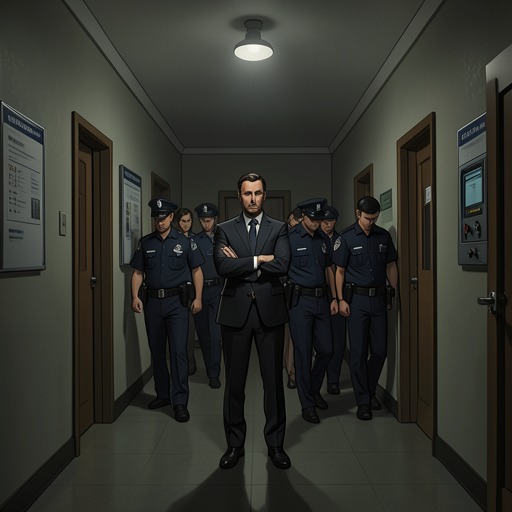
Amy Loughren’s Undercover Meeting with Charles Cullen
The Good Nurse: A True Story of Medicine, Madness, and MurderAmy Loughren’s undercover meeting with Charles Cullen was the point at which a friendship became an instrument of investigation. Wearing a concealed microphone, Amy faced the nurse she had come to believe was a serial killer and asked him plainly whether he was capable of harming patients. The meeting yielded no confession, but it forced Cullen to confront the question he had long evaded and helped open the way to his later, seven-hour account of his crimes.
An operation built around a friendship
The detectives had intended to wait months before making this move. They no longer believed they had that time: Amy needed to get Cullen talking, and she needed to do it face-to-face. The plan had two aims. If she could draw him across the state line, they could arrest him in New Jersey and avoid extradition proceedings; if he spoke, the conversation might reveal what investigators could not yet prove.
Amy was not simply asked to meet Cullen. She was wired. A technician fitted a small microphone high on her chest, between her breasts. When the detectives noticed the scar from her pacemaker, the operation briefly became less important than the possibility that the stress might endanger her. They offered to let her withdraw. Amy assured them she could continue, despite her pounding heart, and asked whether the pacemaker would interfere with the equipment.
The risk was intensified by the intimacy of the assignment. Cullen had already said that he thought his phone might be bugged, and that suspicion seemed to add a charged, almost romantic quality to the rendezvous for him. Amy’s phone, in fact, was tapped. She had arranged to meet him at Carrabba’s, an Italian restaurant she chose in part because she wanted the food. Tim Braun and Danny Baldwin were impressed by her ability to keep ordinary preferences in view while carrying the weight of the investigation.
A changed plan and a live microphone
The restaurant’s closure disrupted the intended setting. Tim and Danny had driven over to scout Carrabba’s and found it shut. Rather than cancel, the investigators followed Amy and Cullen as they moved on. The accidental change could make the meeting look improvised, an advantage if Cullen was suspicious. The detectives watched from an unmarked Crown Vic as Amy and Cullen arrived separately, discovered the closure, and went back to their cars.
The equipment itself offered little reassurance. The wireless unit had been borrowed from Narcotics and was regarded as unreliable. Tim and Danny listened from the car as Amy and Cullen entered the new restaurant, greeting one another amid the noise of doors, conversation, and dishes. Amy asked for a quiet booth. The detectives leaned in to listen, hoping the microphone would capture a conversation that could otherwise disappear into the ordinary sounds of a lunch date.
The change of venue unsettled Amy. As she drove, she could operate the car but could scarcely hear anything except the rush of blood in her ears. She tried to narrate the move to the detectives, then turned up the radio, using the music to smother the noise of panic. At the restaurant she composed herself and greeted Cullen warmly. The performance had to preserve the familiarity between them even as every word became potential evidence.
The question neither could avoid
Cullen spoke freely about the allegations and the circumstances of patients who had died mysteriously. He seemed comfortable discussing the cases and could speak about the hospitals and investigators as people who suspected him. Amy eventually interrupted the account with a question that made the encounter more than an exchange of information: “Charlie?” Amy says. “I need to ask you something. Are you capable of doing those things?” Cullen sagged. She repeated the question, bringing the issue back from the investigators’ suspicions to his own capacity to act.
The conversation moved toward whether Cullen wanted the cycle to end. After he observed, “This is over and over again,” he asked, “Do I want it to be over?” Amy gently asked whether he wanted to be caught and whether he wanted it to be “really over.” Cullen began to speak about the charges, but did not give a clear answer. When Amy urged him to confess, he replied, “I can’t.” His words registered the pressure of the encounter without yet becoming an admission.
Amy made the stakes explicit. She told him she had spent years in nursing without ever being accused of murder, while he had been accused repeatedly and was believed to have killed people. Then she joined affection to accusation: “I’m here, Charlie,” Amy says. “I’m here, because—I love you. And I’m here because—I know you killed those people.” Cullen stopped moving. Amy repeated that she knew. The friendship that had made the undercover meeting possible now gave her words their force: she was not speaking as a distant interrogator, but as someone who knew him and was willing to name what she believed he had done.
The encounter breaks, but does not end the case
When the meeting was over, Amy pushed through the restaurant’s front entrance and stopped, dazed, holding the door handle. Tim and Danny waved and called to her across the parking lot. She reached the car before breaking down and sobbing in Danny’s arms. The detectives brought her into the Crown Vic to collect herself. The recorder was still between the seats, its tape turning in the plastic window. Seeing it brought her back to the purpose of the operation, and she asked whether they had captured anything.
Amy told the detectives that she had said she knew. Cullen’s face had changed, and he had repeated a phrase in a low, strange voice. Her recollection was not certain: she thought he had said, “Let. Me. Go. Down. Fighting.” The words did not amount to a confession, and the meeting did not resolve what investigators still needed to establish. Its immediate result was more limited and more consequential: Amy had confronted Cullen with her belief, and his reaction suggested that the exchange had reached him.
The later interrogation carried the conversation further. After Amy again helped make a route for him to speak, Cullen began recounting his history to the detectives, starting with Reverend Gall and continuing backward through earlier episodes. He spoke for seven hours, stopping for food, coffee, and breaks, and gave investigators forty cases before the tape ran out. His account remained carefully framed: he described patients as having passed away and himself as having intervened, rather than calling his actions killing or murder. The undercover meeting was therefore not itself the confession. It was the difficult confrontation that helped move Cullen from talking about accusations to telling the long, self-protective story investigators could examine.