Charles Cullen–Ernie Peckham kidney transplant
The Good Nurse: A True Story of Medicine, Madness, and MurderCharles Cullen’s kidney transplant for Ernie Peckham turned a prison letter into a life-saving operation and an ethical spectacle. Cullen, a convicted serial killer serving time in the Somerset County Jail, donated an organ to the brother of his estranged former partner, Catherine Westerfer. The transplant gave Peckham a chance beyond worsening dialysis and a years-long wait for a donor; it also brought Cullen back into public view, where the apparent generosity could not be separated from the crimes that had made him notorious.
A plea from outside prison
In August 2005, an envelope arrived for Cullen at the jail in Somerville. Inside was a clipping from a Long Island community newspaper, marked with a brief handwritten request for help. The article concerned Ernie Peckham, a metalworker with a wife and four children who was gravely ill with kidney failure. Peckham was Catherine Westerfer’s brother and therefore connected to Cullen through their past relationship and their child. Cullen knew who he was, but the two were not friends or even close acquaintances.
Peckham’s kidneys had failed after an infection, and dialysis was not arresting his decline. He spent three two-hour sessions each week at Stony Brook Hospital; his access veins repeatedly clotted, while a surgical port in his neck left him vulnerable to infection. He had given up his scoutmaster position and reduced his involvement with the local VFW. A transplant offered the prospect of getting his life back, whereas dialysis had become an exhausting routine that did not stop his health from worsening.
A kidney from a living donor offered advantages over one from a deceased donor, but the usual family route was unavailable: no relative in Peckham’s family was medically eligible. The public appeal was therefore a search for an unlikely match with a stranger. His mother, Pat Peckham, had already mortgaged her house to help meet his medical bills. She gave the local newspaper his blood type and the hospital’s donation hotline number, hoping that someone might respond. No donor came forward through the appeal. She then sent the clipping directly to Cullen in prison, asking him to consider helping her son.
A decision under scrutiny
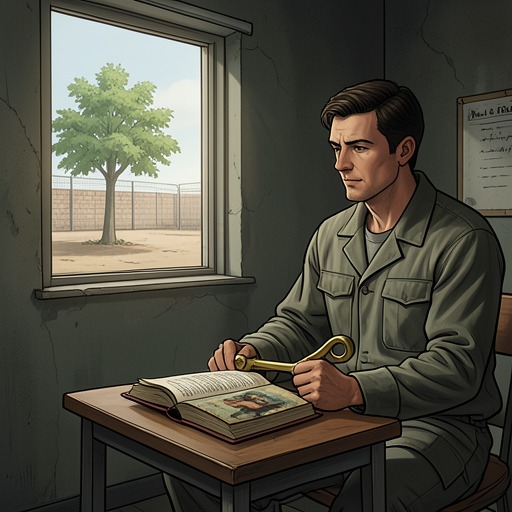
For Cullen, the request joined a person’s urgent medical need to a highly charged relationship: Peckham was the brother of the former partner who was also the mother of Cullen’s youngest child, a child he had never seen. Cullen did not recall any meaningful friendship with Peckham. Yet the possibility of donation was real, and the request came when Peckham’s condition made time matter.
The proposed gift immediately acquired meanings beyond the medical. Cullen had killed patients; now he was offering an organ to save one. Victims’ families could see the act as manipulative or as another way for him to command attention, rather than as uncomplicated compassion. The possibility that he might use the donation to seek redemption—with Westerfer, with God, or with himself—could not be settled from the outside. Cullen himself did not explain his motives. Reverend Kathleen Roney, his jail chaplain, resisted reducing him to the label of a monster, while recognizing the enormity of what he had done. The contrast was not a resolution of Cullen’s character but the event’s central difficulty: the same man who had taken lives could now make a choice capable of extending one.
Roney helped move the proposal into medical testing. A hospital kit contained color-coded tubes for Cullen’s blood; Stony Brook Hospital would compare its antigens with Peckham’s to determine whether donation was possible. The match seemed improbable. When the results showed that Cullen was a perfect six-for-six antigen match, Roney and those praying with her regarded it as a miracle. Further tests, including examinations that could not be conducted by sending equipment to the jail, still lay ahead, but the match transformed an appeal into a viable transplant plan.
From jail to operating room
The operation required discretion because Cullen was a security risk and the donation was attracting attention. Guards took him from the jail to Saint Francis Medical Center without initially telling him why. He was given a paper gown, had blood drawn, and was handcuffed to a bed. In the morning, staff told him to respond only to direct questions and assigned him the alias Johnny Quest. Under medication that left him woozy, he was given forms to sign. He signed one with the alias, then another identifying him as Charles Cullen, also known as Johnny Quest; the first document was not legally binding. The repeated use of the alias made the secrecy surrounding the transfer tangible, even to Cullen, who found the arrangement ridiculous and did not know what was happening.
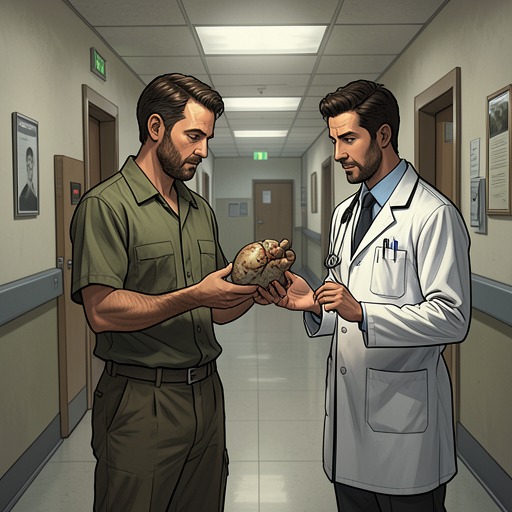
After the kidney was removed, it was placed in a red Coleman cooler and loaded onto a Lifestar helicopter. The flight carried it north from Trenton, past Manhattan and toward Long Island. On August 18, it reached Stony Brook Hospital, while Cullen remained at Saint Francis Medical Center. The separate routes—donor under guard, organ in a cooler, recipient awaiting surgery—turned the donation into a chain of controlled movements rather than a public bedside exchange.
Peckham was anesthetized in the operating room. Surgeons opened his left abdomen, moved aside the abdominal wall, and placed Cullen’s kidney in the pelvis. They joined its renal artery to Peckham’s blood supply and connected the veins. When the clamp was removed from an external iliac artery, the transplanted kidney filled with oxygenated blood and became active in Peckham’s body. The account presents the procedure through its physical particulars: sutures, vessels, tissue, and a small organ newly functioning in another person. The medical event was real and immediate, even as its larger moral meaning remained unsettled.
Meaning and aftermath
The transplant reversed the direction of Cullen’s public identity without erasing it. The man known for killing patients became a living donor, but the organ did not make the past disappear or establish a definitive motive. The book leaves open whether the act arose from compassion, compulsion, a wish for redemption, or several impulses at once. Its force comes partly from that refusal of an easy conversion story: a potentially life-saving deed coexists with a record of murder, and neither fact cancels the other.
The donation also brought Cullen back into the headlines and raised concerns about the effect of publicity on his family. What seemed in prison to be an act of help could also be understood as a return to influence over another life and over the public story surrounding him. That ambiguity belongs to the event itself, not merely to later judgments of it. Peckham needed a kidney; Cullen was able to provide one; the circumstances made the gift both medically consequential and morally difficult to interpret.
The narrative places the transplant beside the institutions and procedures that had failed to prevent earlier patient harm. In other episodes, medical access and routine nursing actions—such as injecting through an IV line or handling medication deliveries—provided opportunities for Cullen to poison patients. Here, the same medical world of blood tests, controlled access, transport, and precise intervention served a different purpose: transferring an organ intended to sustain life. The contrast gives the transplant its particular significance without making it an absolution. The kidney’s return to function is concrete; what the donation means about Cullen remains unresolved.