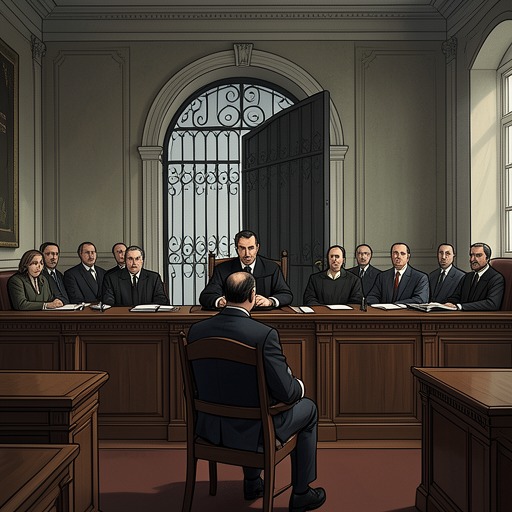
Cullen’s Outburst at the Lehigh County Courthouse
The Good Nurse: A True Story of Medicine, Madness, and MurderOn March 20, 2006, at the Lehigh County Courthouse in Allentown, Charles Cullen turned a hearing intended to give victims’ families a voice into a prolonged confrontation with the judge. He demanded that Judge William Platt step down, then kept shouting after the judge refused and court officers tried to silence him. The outburst delayed the families’ statements and ended with Cullen bound, gagged, and still chanting as he was taken from the courtroom.
Setting and Stakes
The day’s proceedings unfolded against a stark public setting. Allentown was described as a former steel town living amid the remains of its prosperity; downtown’s ceremonial architecture stood alongside people searching for cans. A small procession of families in dark formal clothes moved through the partly gutted courthouse, their little blue OfficeMax stickers identifying them as victims of the Angel of Death. They carried statements they had prepared to read, bringing private loss into a public legal proceeding.
The route to the courtroom passed through stripped rooms, file cabinets, and flickering corridors before opening into a bright nineteenth-century Italianate chamber. Its marble, gilt, and elaborate ornament made it imposing, but the hard surfaces would magnify and distort every sound. Cullen entered with his hands chained in front of him and his legs secured in institutional leather. The restraints gave him the appearance of physical danger, though the account emphasizes that this was not the threat he posed in that setting. The court’s spectacle of control would soon be tested by a disturbance made of voice rather than physical force.
The confrontation also carried an immediate human stake: the families had come prepared to speak about what Cullen had done to their lives. His public conduct would interrupt that opportunity even as the proceeding moved toward additional life sentences. The narrative sets this disruption against his remaining public aspiration, a kidney donation that was still entangled in official concern and delay. A man who presented himself as compassionate and eager to help was now choosing, in front of bereaved families, to prolong their ordeal.
The Challenge to the Judge
Cullen began by reciting, from memory, statements Judge Platt had made to the press. He then used them to demand that the judge leave the case. His formal request was denied; Cullen did not accept the ruling as the end of the matter. He interrupted the judge and repeated the demand, turning a legal challenge into a contest over who would command the room.
The exchange became more forceful through repetition. Cullen’s insistence that the judge step down was not a single protest but a refrain, returned to after the court had answered him and after the judge warned him. As the account tells it, Cullen’s voice filled the chamber. The language of judicial authority remained present, but its ordinary power to settle the exchange was visibly failing: the judge issued a warning, and Cullen shouted over it.
This insistence contrasts with the story Cullen had previously told about himself. When explaining his departure from Saint Barnabas Hospital to Adrianne, he had cast himself as a principled nurse punished for opposing a strike and made a scapegoat after insulin was injected into IV bags. Later, in his account of patients’ deaths, he avoided the words kill and murder, describing himself instead as having intervened or been compelled to intervene. At the courthouse, however, the account offers no softened version of his conduct: the disruption is public, sustained, and directed at people gathered to grieve.
Escalation and Restraint
The judge warned Cullen that continued disruption would result in him being gagged and restrained. Cullen continued shouting. Court officers pulled a spit mask over his head, but the mesh did not stop the noise. They wrapped it with a towel and pushed him into a chair, trying to contain both his movement and his voice while the families held their statements against their chests.
The measures did not restore order. Under the towel, Cullen’s shouts became a muffled bass cadence, while fragments of his insults remained audible. The sergeant holding him began to lose his grip; as it loosened, Cullen’s voice grew clearer. The judge scowled, and the sergeant tightened his hold. Several women in the jury box raised their hands to their faces in horror. The scene’s progression—from warning, to mask, to towel, to renewed shouting—makes restraint look less like a single decisive intervention than a series of unsuccessful attempts to get the hearing back under control.
The court officers then brought in a large roll of duct tape and crossed it over Cullen’s mouth. Even that did essentially nothing to stop him. While the victims read their personal statements, Cullen continued to shout, the two forms of speech occupying the same room but carrying radically different claims on its attention. Their carefully prepared words answered the harm he had caused; his repeated demand to the judge competed with, and threatened to overwhelm, their chance to speak.
Sentence and Aftermath
The proceeding concluded with three more life sentences, to be served concurrently with the sentences already handed down, and the stated consequence that Cullen would remain in prison for the rest of his natural life. Court officers frog-marched him out, bound and gagged, with duct tape over his mouth. He was still chanting when the elevator doors closed. The silence afterward was described as terrible: the end of the noise did not mean that the families had received satisfaction or that the proceeding had repaired what they had lost.
In the hallway, the families gathered, shaken and unsatisfied. Julie Sanders, whose friend had been overdosed by Cullen, interpreted the outburst as deliberate disrespect and contrasted it with his claims of compassion and his wish to donate a kidney. She asked whether he understood what he had done to their lives. Her reaction identifies the central reversal of the event: Cullen’s desire to control the courtroom displaced the people whose losses the proceeding was meant to acknowledge.
The outburst also sits uneasily beside Cullen’s frustration that his kidney donation had been delayed. He believed the state’s concern—that he might harm another patient because his crimes occurred in a hospital—was an obstacle to helping someone, and that delay was depressing him. Yet in the courthouse he used the public occasion not to demonstrate care for others but to prolong their distress. The event’s significance lies in that collision between his self-image as a helpful or compassionate man and the visible effect of his actions: a courtroom meant to hear victims became, for a time, an arena dominated by the accused.