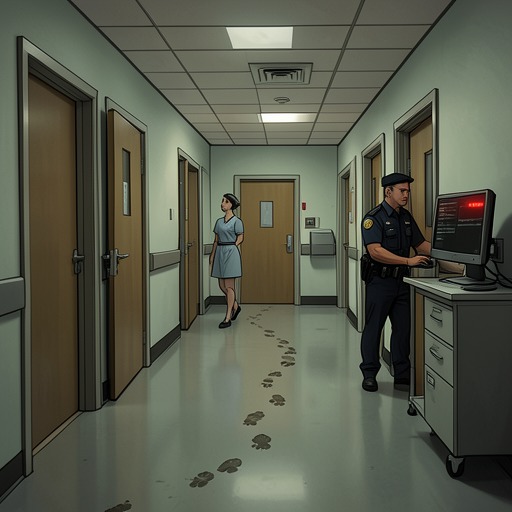
Hospital failures to report and prevent suspected patient harm
The Good Nurse: A True Story of Medicine, Madness, and MurderHospital failures to report and prevent suspected patient harm is the recurring institutional pattern through which the book’s suspected poisonings are allowed to persist: abnormal laboratory results and unexplained patient crashes are noticed, but the response is repeatedly slowed by the limits of internal inquiries, uncertain responsibility, and concern for the hospital. The failures do not take one form. At Saint Barnabas Medical Center, investigators struggled to turn suspicious insulin findings into a provable case; at Liberty Nursing and Rehabilitation Center, a nurse was dismissed without a criminal investigation; and at Saint Luke’s Hospital, administrators arranged a quiet resignation and private warnings that did not reach every hospital. The result is a chain of missed chances to protect patients across institutions.
Recognizing a Pattern, Proving a Case
At Saint Barnabas Medical Center, laboratory tests showed that patients who had suffered unexplained episodes of hypoglycemia had exceptional insulin levels, much of it foreign to their bodies. The initial possibility was an ordinary medication error, but Thomas Arnold and investigators found no prescription for insulin and no nursing notation that it had been administered. That absence could indicate two mistakes—or deliberate administration followed by omission from the chart. Either way, the evidence called for investigation.
Arnold and Joe Barry, a former New Jersey State Police major who had become the hospital’s senior security vice president, compared work schedules with the times of patient codes. Three nurses had worked every code, and Charles Cullen drew particular attention. Arnold found him notably unconcerned; when they eventually brought him into a conference room, Cullen refused to answer questions. The investigators had a suspect, but suspicion was not proof. Cullen’s irregular work as a staffing-service nurse, including last-minute shifts, complicated attempts to align his presence with patient events. The patients were already seriously ill, making it difficult to connect an insulin spike to a single episode or to a later death.
The investigators sought outside help. On March 5, 1991, Arnold and Barry presented the case to Livingston chief of police Don Jones over lunch. They described probable homicides on at least two units and physical evidence of criminal intravenous tampering, but Jones declined to take on the investigation, saying the evidence was not yet enough and that the hospital should handle the matter internally. Arnold and Barry could not yet prove their suspicions themselves, but the refusal left the burden with the institution whose patients were at risk.
Their internal response was extensive but inconclusive. They installed stop-motion cameras in the medication-storage room, interviewed staff, physicians, and families, and imposed a new sign-out protocol that subjected insulin to controls like those used for morphine. In October, two more patients in the cardiac care unit developed unexplained hypoglycemia and were connected to insulin-tainted intravenous bags. The suspicions sharpened, but the investigators still lacked proof. Then Cullen left Saint Barnabas, and the insulin spikes stopped. The sequence gave the hospital a powerful warning, but not a resolved criminal case.
Internal Handling and the Displaced Cost
A similar gap between a clear warning and an accountable response appears at Liberty Nursing and Rehabilitation Center. After Charles Cullen injected insulin into Francis Henry, an elderly resident with a broken vertebra stabilized by a halo device, Henry suffered violent seizures, fell into a coma, and died soon after returning to the nursing home. Liberty’s internal investigation found massive levels of foreign insulin in his blood, although insulin was absent from his chart and had not been prescribed. Because Henry was immobilized, an accidental self-administered overdose was extremely unlikely.
Liberty did not initiate a criminal investigation. Instead, it fired senior nurse Kimberly Pepe, who sued for wrongful termination. Pepe’s lawsuit alleged that supervisors had initially been looking at Cullen, her coworker, rather than at her; Liberty denied suspecting him, and the suit was later settled out of court under sealed terms. The book does not establish why Pepe was selected. It does establish the practical consequence: a patient had been poisoned, suspicion pointed toward the night shift, and no criminal inquiry followed. Liberty moved Cullen from intensive care to the psychiatric wing, where he was later seen entering a non-patient’s room with syringes and giving her unprescribed drugs. After a scuffle left the woman with a broken wrist, the hospital fired him for violating drug protocol—not for Henry’s death.
At Saint Luke’s Hospital, missing medication and hidden drug containers brought administrators, risk managers, hospital counsel, and outside lawyers into a response shaped explicitly by what would be best for the hospital. After security staff found drug vials in a sharps box, the hospital arranged to question Cullen when another cache was discovered during his shift. The lawyers had patient records, laboratory reports, and the vials; Cullen recognized that the evidence included shifts corresponding to his and records of dangerous vecuronium overdoses. He called the questioning a foregone conclusion. The hospital offered him a resignation with neutral references, with the incident kept off his record. Security escorted him through the unit and left him in the parking garage.
The settlement of the employment relationship did not amount to a public warning. Saint Luke’s later maintained that its investigation and chart reviews had not identified suspicious deaths tied to the missing drugs or other actions by Cullen. Yet in August 2002, senior administrators and the lawyer involved in the case privately contacted local hospital colleagues to ask about unusual incidents and to say Cullen should not be considered for rehire. Those warnings were not passed to the public, the police, or the State Nursing Board; Somerset Medical Center was not among the hospitals contacted. A private effort to limit rehiring thus coexisted with the absence of a broader alert that might have allowed another institution to act on the risk.
Somerset and the Fragmented Chain of Responsibility
At Somerset Medical Center, the book makes the costs of delay visible through the clash between Poison Control and hospital administration. Bruce Ruck and Steven Marcus believed the laboratory data were not ambiguous and feared that patients were being deliberately killed. Ruck repeatedly argued that the matter belonged to the police, while Somerset officials did not promptly acknowledge the warning or return the call. Their exchange exposes a jurisdictional divide: medical staff could treat and investigate unusual clinical events, but the Poison Control officials believed that suspected intentional poisoning required police work.
By the time Somerset brought detectives into a meeting, it described six incidents in the critical care unit over five months. The hospital’s lawyer carefully avoided calling them homicides: the cases were presented as unexplained incidents with abnormal laboratory findings and life-threatening symptoms. Five of the six patients had died. The hospital said it had already conducted an internal investigation, but had not identified the source. The timing mattered: the prosecutor had been contacted only after the death of McKinley Crews, the sixth patient named at the briefing.
The county investigators then encountered the consequences of a weakly preserved evidentiary record. Somerset’s five-month investigation had produced only four pieces of paper, while the detectives lacked useful Pyxis medication records, interviews, and physical evidence. The patients’ cases were still described as incidents rather than confirmed homicides, and the abnormal laboratory results could be contested. Investigators knew that patients had been poisoned with drugs, but could not yet establish the cases against Cullen at Somerset. As police sought subpoenas and help from state agencies, information remained divided among the hospital, investigators, and the New Jersey Department of Health and Senior Services. The delay was not merely elapsed time: it left the people responsible for building the case without records that could connect medication access, clinical events, and individual actions.
Warning Signs, Trust, and the Human Consequences
These institutional failures also reach patients’ families and the staff asked to work inside the uncertainty. After Helen Dean identified a pinprick on her inner thigh, her son Larry called her doctor; when she became violently ill and died, he pressed the oncologist and nurses for an explanation. The oncologist confirmed that no injection had been scheduled, and nurses identified the male nurse his mother had named as Cullen. Larry took his accusation directly to the Warren County prosecutor. His response contrasts with the hospital’s initial uncertainty: a family member who believed his mother had been murdered forced the concern beyond the ward.
At Somerset, Amy Loughren’s refusal to sign an insulin adjustment form began as a dispute about a procedure she considered unreliable. Nurses had previously used insulin kept in a small refrigerator; the new form required an electronic signature estimating what remained in a vial. Amy objected that she could not accurately measure the amount by eye and demanded to know why insulin was suddenly being controlled like a narcotic. Her manager did not explain what had happened. The procedure therefore conveyed danger without giving bedside nurses the information needed to understand it. When police interviews later made staff fear for their jobs and reputations, Amy’s earlier resistance and friendship with Cullen made her a focus of suspicion among coworkers.
The evidence that changed Amy’s understanding was not an institutional briefing but a Pyxis printout shown to her by Danny Baldwin. It recorded Cullen’s activity on the night Reverend Florian Gall died. Amy could now imagine that her friend had done something terrible, but could not reconcile the record with the person she thought she knew. When investigators later asked her to take risks as an undercover agent, she had to weigh her loyalty to Cullen against the possibility that the police were right, as well as the danger to her job and professional identity. She ultimately shared records and worked with the detectives, but the emotional and occupational cost was real: she felt isolated, afraid of being fired, and caught between nursing colleagues and investigators.
Institutional Meaning
The book presents failure less as one decision than as a recurring sequence: suspicious findings are difficult to prove; internal inquiries retain control; outsiders hesitate or lack records; and warnings are kept within limited professional or local networks. Each step can be defended in isolation—an inconclusive chart review, a disputed medical interpretation, a lack of evidence, a neutral employment reference—but their cumulative effect is to move a suspected danger rather than stop it. Cullen’s transitions between hospitals make that accumulation consequential: Saint Barnabas saw the insulin pattern end when he left, Liberty fired him for a separate drug-protocol violation, and Saint Luke’s arranged his resignation while failing to warn every later employer.
The motif also complicates the meaning of protection. Hospitals controlled medication, staffing, records, and internal investigations, yet the people most dependent on those systems—patients, relatives, and nurses—could be left without a clear account of what was happening. Larry Dean had to make the accusation himself; Amy had to infer danger from a new insulin form and later from a single printout. The failures described here are therefore not only failures to identify a perpetrator. They are failures to turn warning signs into timely, shared knowledge and to make patient safety outweigh the institutional convenience of treating each episode as an isolated problem.