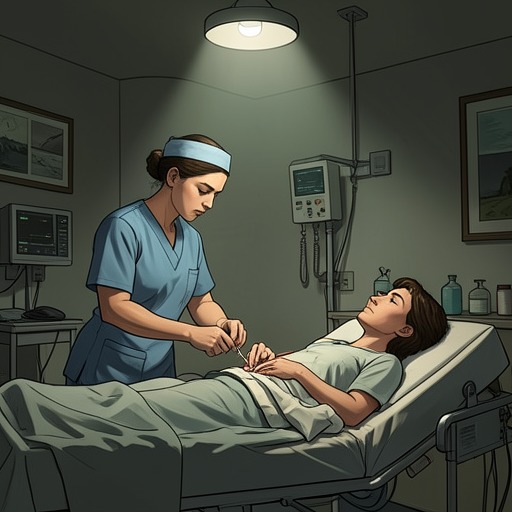
Matthew Mattern
The Good Nurse: A True Story of Medicine, Madness, and MurderMatthew Mattern is presented through the catastrophic injuries that brought him to Lehigh Valley Hospital and the slow, uncertain course of his care. His case becomes a measure of the ward’s helplessness—and, when Charles Cullen intervenes, a stark instance of Cullen exercising control over life and death.
Identity and Injury
Mattern was twenty-two and had been trapped in a burning car wreck before being rushed to Lehigh Valley Hospital with burns over 70 percent of his body. Even for the ward’s most hardened nurses, his condition was grim. Applying the Rule of Nines, staff privately estimated that he was 92 percent likely to die. Survival remained possible, but death seemed much more probable.
His youth made the severity of his injuries harder for the ward to absorb. Visitors arrived in an unusual outpouring of distress, while older nurses thought of sons or grandsons and younger nurses of friends, lovers, or themselves. The account gives Mattern no dialogue or personal history beyond the accident; his presence is registered instead in the reactions of those gathered around his bed.
The Slow Code
Mattern’s course was described as a slow code: a Code Blue unfolding in slow motion. Cullen watched as surgeons amputated him piece by piece. Mattern had been burned through to the bone, and his extremities were gone. The nurses imagined that, even if he survived and the transplants took, he would remain profoundly injured, an amputee enclosed in scar tissue and a pressure suit. Some privately prayed for the death they believed inevitable.
That expectation did not make the death easy or impersonal. Mattern’s youth and the successive amputations gave the ward a visible, prolonged encounter with suffering, while the possibility of survival kept the outcome uncertain. The slow code named that drawn-out interval between continued treatment and the staff’s expectation that Mattern would die.
Cullen’s Intervention
On August 31, 1999, Cullen loaded Mattern’s IV with a bolus dose of Digoxin. The slow code ended before sunrise. Some nurses thanked God for what they understood as intervening grace; Cullen simply returned to the parking garage. Mattern’s death was thus received by the ward as the anticipated end of an already devastating case, even though Cullen had deliberately hastened it.
The act sits within Cullen’s pattern of seeking relief through interventions that gave him a sense of control. The account says that these actions often had little to do with the patients themselves: he attended to outcomes more than to the people in his care. Mattern’s death therefore marks both the end of a particular slow code and the conversion of Cullen’s private compulsion into a fatal act against a patient.
Narrative Significance
Mattern’s case brings the ward’s emotional and clinical pressures into direct contact with Cullen’s violence. His injuries and the nurses’ expectation of death make the fatal intervention appear, at first, to coincide with an outcome many had already feared. That convergence is crucial: the circumstances that made death seem inevitable also made Cullen’s deliberate role less immediately distinct from the course of care.
The episode also gives concrete form to the difference between the ward’s collective helplessness and Cullen’s individual exercise of power. Mattern is not presented as a consenting patient or as a character whose inner life the narrative explores; he is a severely injured young man whose treatment and death expose the danger of Cullen’s ability to act within a medical crisis.