Mountainside Hospital
The Good Nurse: A True Story of Medicine, Madness, and MurderMountainside Hospital is central to Charles Cullen’s early life because it stands at two opposing beginnings: the death of his mother, which intensified his grief and distrust, and the nursing education through which he found a vocation. The same institution that he associated with an irreparable loss later welcomed him into a professional community where, for the first time, he felt special and cared for.
A place of loss and anger
In December 1977, while Charles was home from high school, his mother suffered an epileptic seizure at the wheel and died in a head-on car crash. He was not told at once how she had died. When he went to Mountainside Hospital looking for her, staff told him that she was dead and that her body had already been taken away. The account gives no indication that the hospital caused her death; what mattered to Charles was the way he encountered the news and the absence of his mother’s body. He felt that the staff had lied to him, and the loss left him furious and beyond consolation.
That reaction attached a powerful personal meaning to the hospital. In time, Charles came to believe that the deception he thought he had experienced at Mountainside was characteristic of hospitals more generally, a belief the narrative presents as his own conclusion rather than an established fact about the institution. The location thus enters his story not simply as the site of a family tragedy, but as the place around which he formed a durable suspicion of the very institutions that would later define his working life.
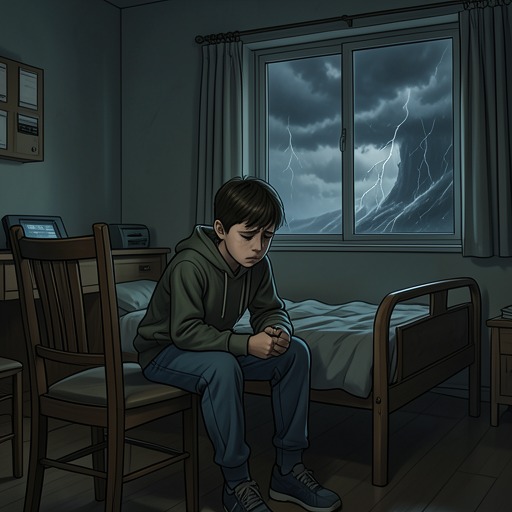
The death also preceded a period of acute despair. After trying to find his mother at Mountainside, Charles turned again to suicide; the attempt brought his first hospital stay and his first psychiatrist, though the account does not identify that treatment as taking place at Mountainside. He was not ready to talk to the psychiatrist. In the narrative, the hospital encounter instead marks the depth of his isolation: he returned to the home where his mother was no longer present, carrying grief that he could not yet express to anyone else.
The return to nursing
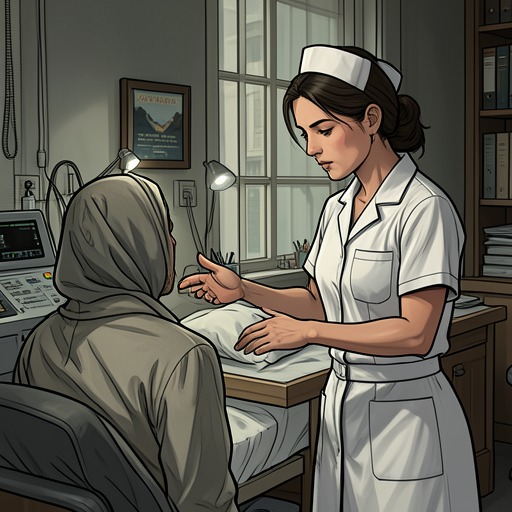
Six years after his mother’s death, Charles returned to Mountainside in a different role: in March 1984, he was the only male student at the Mountainside Hospital School of Nursing in Montclair, New Jersey. He was bright, did well academically, and found that both the coursework and the uniform suited him. The school’s sisterly atmosphere felt familiar and comfortable, an important contrast with the loneliness and disorder he had associated with home.
His first experience of recognition there came through a small, largely symbolic act. When the honorary class president left two weeks into the first semester, a classmate urged Charles to run in her place. She presented him as a natural choice because he was bright, handsome, and male, and promised to do the work of campaigning herself. He was flattered but initially reluctant; the more she pressed, the more he found himself content in the passive role of candidate. He won. The position carried little formal power, but its meaning to him exceeded its duties: it suggested that he could be selected, admired, and accepted by others.
A changed meaning
The narrative explicitly links the student election to a change in Charles’s self-image. The hospital that had been bound to his mother’s death now appeared to have chosen him. Six years earlier, he had searched there for his mother and left angry; as a nursing student, he was treated as a promising member of a class. He experienced the election as confirmation that he was special, and as something close to love. Mountainside’s significance therefore rests less on a documented institutional transformation than on the reversal in Charles’s experience of the place.
His schooling was not financially effortless. Charles paid for it through anonymous shift work at fast-food and retail jobs, wearing uniforms and doing routine tasks such as restocking, filling condiment bars, and mopping floors. He saw an irony in the way his Navy experience translated into civilian work, since those jobs, too, required uniforms. These details place his nursing education within a life of practical labor and repeated attempts to find a role that fit. At Mountainside, however, the uniform belonged to the profession he would make his own, and the schoolwork offered a direction that his earlier efforts had not.
Narrative significance
Mountainside Hospital concentrates a contradiction that shapes Charles’s early trajectory: he blamed a hospital for failing him at the moment of his greatest loss, yet returned to that same institution and found a vocation there. His mother’s death did not simply disappear when he entered the nursing school; rather, the place acquired a second, sharply different association, one of recognition and belonging. That juxtaposition makes the school’s welcome emotionally consequential without erasing the grief that preceded it.
The location also frames the beginnings of Charles’s relationship with health care as both personal and professional. He entered nursing after failed attempts to find a way forward through suicide and military service, and Mountainside became the setting where training and community offered a new identity. The story does not present the school election as the cause of his later actions, nor does it assign those later events to Mountainside. Its importance is more specific: it shows how a place he associated with loss could also become the first institution in which he felt chosen.