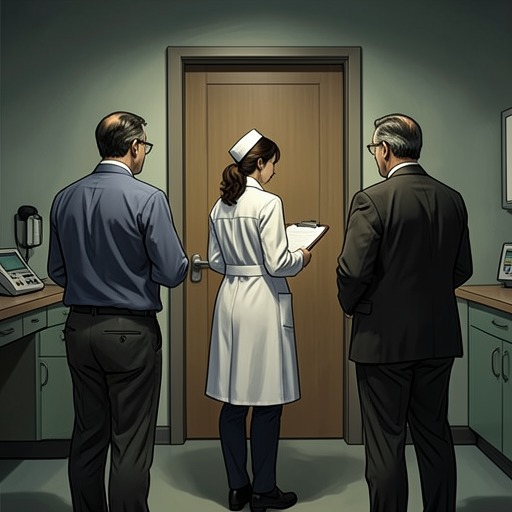
New Jersey’s reporting duty for suspected patient poisonings
The Good Nurse: A True Story of Medicine, Madness, and MurderNew Jersey’s reporting duty for suspected patient poisonings is the obligation, as described in the account, to notify state authorities when hospital incidents raise a credible possibility that patients have been deliberately poisoned. Its decisive significance at Somerset Medical Center was that a suspected criminal act could not be contained as an internal medication review: the New Jersey Poison Control Center insisted that patient safety and the state’s reporting requirements demanded escalation, even while hospital administrators wanted to finish their own investigation first.
The duty and the threshold for reporting
The reporting question arose as clinicians and administrators tried to interpret a cluster of unexplained illnesses at Somerset Medical Center. Some incidents involved insulin and others digoxin; hospital personnel were still considering medication error and other explanations. The New Jersey Poison Control Center’s position was that uncertainty about cause did not justify treating the cases solely as adverse drug reactions. If someone might be deliberately harming patients, the matter was also forensic, and the appropriate authorities needed to know.
Bruce Ruck, speaking for the New Jersey Poison Control Center, told pharmacy chief Stuart Vigdor that toxicological surveillance carried an obligation to report to the state. In a later conference call, Dr. Steven Marcus made the point more forcefully to William Cors and Mary Lund: if someone at the hospital was purposely poisoning patients, the hospital had a legal obligation to report it. Marcus characterized the cluster as a sentinel event, meaning an event in which patient safety was threatened, and urged Somerset to involve both law enforcement and the New Jersey Department of Health and Senior Services.
The account presents the duty as a practical threshold for action, not as a requirement that a hospital first prove who caused an illness. The unresolved possibility of deliberate harm was precisely why the state and police needed to be brought in. The book does not specify a statutory citation, penalty, or complete legal test; its emphasis is on the concrete obligation repeatedly communicated to Somerset during the dispute.
Somerset’s internal review and the delay
The conflict developed while Somerset was still examining alternative explanations. The hospital checked for manufacturer recalls and adverse drug interactions, verified that intravenous equipment and bedside monitors were functioning, and reran laboratory tests to rule out a testing error. It also tightened controls on insulin and digoxin, making nurses more accountable for access to the commonly used medicines. These steps addressed possible causes and access, but they did not resolve whether the incidents were accidental or criminal.
Somerset’s administrators told the New Jersey Poison Control Center that they would not report the incidents until they had conducted a thorough internal investigation. Ruck and Marcus regarded that sequence as dangerous: internal inquiries could continue while the suspected risk to patients remained unresolved. After the first conference call, the hospital still had not promptly called back. When Ruck reached Vigdor again, he approached the conversation in a deliberately casual manner, but the underlying disagreement remained whether reporting to the state was an obligation or a step the hospital could defer.
In a subsequent call, Marcus pressed the point that the hospital was already outside the twenty-four-hour reporting period for the incidents. Somerset again said it would complete its investigation before notifying either the state health department or the police. Marcus warned that the New Jersey Poison Control Center would report the matter itself if the hospital did not act, and that the circumstances would look worse if the center had to do so. The dispute was therefore not only about what the evidence meant; it was about who would control the timing and channel of disclosure.
Escalation and the eventual report
Marcus had already taken the concern beyond Somerset. He contacted Eddy Bresnitz, the state epidemiologist and assistant commissioner of the health department, describing a cluster of illnesses that might be based on a criminal act. He also emailed Amie Thornton, an assistant commissioner, summarizing four untoward clinical events and Somerset’s reluctance to report them before completing its own review. On the later call, Marcus disclosed that the conversations had been recorded, making the hospital’s position and the warning it had received part of a documented record.
A few hours after that call, Lund reported four patient incidents to the New Jersey Department of Health and Senior Services by fax and email. The report identified Reverend Gall and Jin Kyung Han among the patients affected by digoxin, and described the other incidents as insulin-related. It outlined the checks Somerset had completed, including its examination of equipment, laboratory results, recalls, and possible drug interactions, as well as its tightened pharmacy controls. The hospital also described its review of records and its independent interviews with involved staff.
The report did not itself establish that the illnesses were deliberate, identify a perpetrator, or settle the question of responsibility. It did, however, move the information beyond Somerset’s internal process and put the state on notice of both the patient incidents and the hospital’s investigative steps. In that sense, reporting was not a substitute for investigation; it was the means of bringing external authorities into a case whose cause remained uncertain.
Institutional consequences and significance
The dispute illustrates the difference between managing a possible medication problem and reporting a suspected threat to patients. Somerset introduced tighter controls on insulin and digoxin and searched for innocent explanations, yet the New Jersey Poison Control Center argued that those internal measures could not discharge the separate duty to alert the state. The delay mattered because it left the hospital deciding for itself when suspicion had become serious enough to share with outside authorities.
The same atmosphere reached bedside staff. Amy Loughren objected when Somerset changed its insulin procedure and asked nurses to sign for their estimates of how much insulin remained in a vial. Her supervisors did not explain what had happened, but the new accountability measure led her to suspect that something serious had occurred on her unit. Later, rumors linked insulin, a patient death, and Charles Cullen; colleagues knew Amy was his friend, and some avoided her. When investigators showed her Cullen’s Pyxis record from the night Reverend Gall died, she began to consider that her friend might have done something terrible, a possibility she had previously resisted. Her subsequent cooperation carried personal and professional risk, and she felt increasingly isolated from her workplace even as she shared records with the investigators.
Those consequences show why the reporting duty is more than an administrative formality in the book’s account. A suspected poisoning can generate evidence scattered across clinical records, pharmacy controls, staff accounts, and police inquiries; an internal review may be necessary, but it can also postpone scrutiny and leave employees to interpret unexplained changes without being told why they matter. The duty’s central function is to prevent a hospital’s uncertainty or preference for internal handling from becoming a reason to keep a credible patient-safety threat from state authorities.