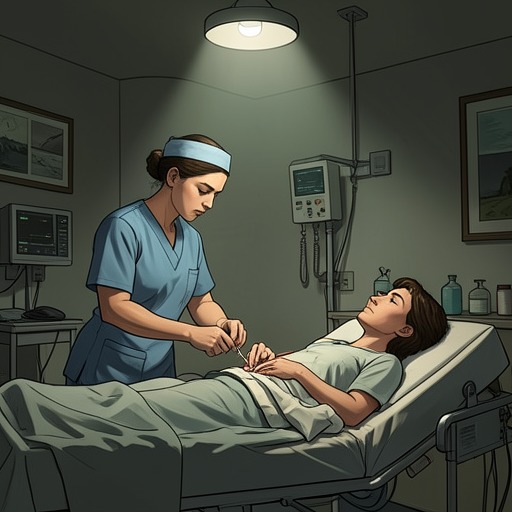
Saint Barnabas Medical Center insulin-poisoning incidents
The Good Nurse: A True Story of Medicine, Madness, and MurderThe Saint Barnabas Medical Center insulin-poisoning incidents were a series of unexplained insulin-induced collapses in 1991, eventually linked to heparin IV bags deliberately contaminated with insulin. The hospital found physical evidence of tampering and identified nurse Charles Cullen as a leading suspect, yet could not establish a case against him or persuade local police to take over. Its internal investigation tightened drug controls but did not catch the person responsible; the incidents stopped after Cullen ceased receiving shifts, leaving a stark pattern without a courtroom resolution in this account.
First Signs and the Patient Crises
On February 11, pharmacy nurse Pam Allen brought a suspicious IV bag to Karen Seiden, the risk manager at Saint Barnabas Medical Center. The bag’s port looked used, while the bag itself was filled so full it seemed about to leak. Seiden sought help from Thomas Arnold, the hospital’s assistant director of security and a former police officer. The bag was sent to the pathology lab. It was supposed to contain saline and heparin; testing found insulin as well.
Three days later, on Valentine’s Day, Critical Care Unit patient Anna Byers began receiving heparin through an IV. Within half an hour she was sweating, confused, nauseated, and shaking with weakness. A blood test found an extraordinarily high insulin level. Orange juice failed to correct the crash, so nurses administered dextrose directly into her bloodstream. That treatment kept her alive, but the excess insulin repeatedly overwhelmed it, and she remained unstable through the day and night.
Byers was due to undergo a procedure the next morning to place a catheter in her heart. Her physician ordered the heparin drip removed in case she was too unstable for surgery. Once the drip was disconnected, her insulin problems abated and she began to feel better. That change tied her crisis to the IV, though it did not yet explain how insulin had entered a bag intended to contain heparin.
A second patient, Fred Belf, experienced a similar collapse. His heparin began at 7 a.m.; by noon he was vomiting and could not keep down orange juice. Dextrose was added intravenously alongside the heparin, and the two drips continued through the day and night. By 7 p.m. the following evening, nurses connected the pattern of symptoms to the heparin bags. They unhooked Belf’s drip, and he quickly improved. Staff sealed his removed IV bag in sterile plastic and sent it for testing.
Evidence of Deliberate Tampering
The laboratory found insulin in Belf’s bag. A microscopic examination of its exterior revealed many tiny needle marks, including three along the bag’s edges. Needles could accidentally puncture saline bags where they were connected to a stopcock, but punctures around the perimeter were unusual. To Arnold and Seiden, the marks suggested that someone had repeatedly and intentionally tampered with IV bags in the hospital’s storage room.
The two contaminated bags gave the investigators physical evidence to set beside the Byers and Belf cases. They reviewed Critical Care Unit records and found that unexplained insulin crashes had occurred with regularity for months. Codes had become so frequent that nurses sometimes had to leave one emergency to attend another. The episodes were scattered across intensive care, critical care, and cardiac units and did not fall neatly within one shift or ward, making the pattern difficult to reconstruct from anecdotal accounts.
Laboratory results strengthened the suspicion: patients with these sudden crashes had exceptional insulin levels, and much of the insulin was foreign to their bodies rather than naturally produced. Investigators first considered ordinary clinical mistakes, such as a nurse misreading an order or a vial being mislabeled. But their review found no doctor’s prescription for insulin and no nursing notation that it had been administered. If the insulin had been given by mistake, its administration had also gone unrecorded; alternatively, the acts might not have been mistakes at all.
The Internal Investigation and Its Limits
Arnold brought his findings to Joe Barry, Saint Barnabas’s senior vice president in charge of security, a former thirty-year police veteran and New Jersey State Police major. After investigators ruled out patients’ visitors, they compared nursing schedules with the times of the patient codes. Only three nurses had worked every code under review; Cullen drew particular attention. During interviews, most nurses appeared anxious about their jobs, reputations, and patients. Cullen, by contrast, seemed unconcerned and defiant. He was difficult to schedule because he worked through a staffing service and took irregular shifts. When Arnold and Barry eventually brought him into a conference room, Cullen refused to answer questions.
The hospital’s case remained circumstantial. Cullen floated among units, often on last-minute call-ins, and the patients had complicated illnesses that could produce many symptoms. Investigators could not connect each insulin spike to one incident, Cullen’s actions, or a later death. Their timelines and mortality-rate work produced more questionable cases but no certainty sufficient to establish what had happened to each patient. They concluded that outside help was needed and approached the police.
On March 5, 1991, Barry and Arnold presented the matter over lunch to Livingston’s police chief. They had two suspicious bags, patients whose crises tracked the heparin drips, and a strong suspect among the hospital staff. The chief declined to take on the investigation, saying he did not think the evidence was enough to act and that the hospital should handle the matter internally. Arnold and Barry could not yet prove the case themselves, but the refusal left the unresolved criminal concern with the hospital.
They tried to catch the person responsible inside the institution. For several weeks, they installed stop-motion cameras in the medication-storage room, interviewed physicians, employees, and families, and introduced a sign-out protocol that subjected insulin stocks to tighter control, similar to the restrictions applied to drugs such as morphine. In October, two more patients in the Critical Care Unit suffered unexplained hypoglycemia and were found connected to insulin-tainted IV bags. The new cases deepened suspicion but still did not supply proof. Then Cullen stopped receiving shifts. The insulin spikes disappeared with him.
Suspicion, Departure, and Aftermath
The narrative also presents Cullen’s private understanding of the investigation. He believed the hospital had found the spiked bags and knew he had worked both shifts connected to the clearest cases. He recognized that he had not worn gloves and thought his fingerprints might be on the bags. He had, he reflected, spiked bags at random, sending them out without knowing which patients would receive them. These admissions give the reader a direct connection between the suspicious pattern and Cullen, even as the hospital investigators lacked proof they could use to resolve the case.
Cullen waited through the spring, fall, and winter for the hospital to act. He interpreted its failure to reach a conclusion as evidence that it was either afraid or inept, and saw its inaction as a kind of absolution. When Saint Barnabas finally stopped calling him for shifts, he was surprised. The change in his employment coincided with the disappearance of the insulin spikes, but the internal inquiry had not established a public, case-by-case account of responsibility or harm.
The episode also had a continuing effect on nursing practice. At Saint Barnabas, insulin was no longer simply kept in a small refrigerator: nurses were asked to sign an insulin adjustment form and estimate how much remained in each vial. Amy Loughren objected that the estimate was unreliable and that staff were being asked to accept accountability without being told why insulin had become a specially controlled drug. Her refusal and questions register the consequences of the incidents inside routine work: a poisoning investigation could alter bedside procedures while the people expected to follow those procedures remained uninformed.
The story’s central contrast is between a pattern strong enough to alarm experienced investigators and evidence too fragmented to prove who caused each crisis. The punctured bags, foreign insulin, patients’ improvement after their drips were removed, and the recurrence of incidents on Cullen’s shifts converged into a compelling suspicion. Yet the hospital’s internal handling and the police chief’s refusal left that convergence short of a completed criminal investigation. The episodes stopped when Cullen’s shifts stopped, but the account closes on disappearance rather than a formal resolution.