Slow code
The Good Nurse: A True Story of Medicine, Madness, and MurderSlow code is the burn-ward name for a Code Blue in slow motion: not a sudden collapse, but a drawn-out crisis in which a patient is critically injured, death appears overwhelmingly likely, and treatment continues. Through Matthew Mattern’s case at Lehigh Valley Hospital, the expression describes both a clinical predicament and a prolonged exposure to suffering that shapes how the ward’s staff understand his prospects.
Meaning and Clinical Context
The term is presented as nurses’ language for a patient’s slow-moving Code Blue, not as a formal protocol. Mattern’s condition makes the phrase concrete: he was twenty-two, had been trapped in a burning wreck, and arrived with burns covering 70 percent of his body. The Rule of Nines led staff to calculate that he was 92 percent likely to die. Survival remained possible, but death seemed far more probable.
A slow code held two futures in tension. Mattern might survive if the transplants took, yet the likely consequences of survival were devastating: he would be an amputee, encased in scar tissue and confined to a pressure suit. His extremities had been charred through to the bone and were gone; surgeons amputated him piece by piece. Nurses privately thought of the operations as butchering him, while many prayed for the death they regarded as inevitable.
Matthew Mattern’s Case
Mattern’s youth made his suffering unusually difficult for the ward to keep at a professional distance. His presence stirred emotion among the nurses: older staff thought of sons or grandsons, and younger ones of friends, lovers, or themselves. His case also drew an uncharacteristic stream of distraught young visitors. The slow code was therefore not only a medical course but a shared, prolonged confrontation with the difference between possible survival and a life profoundly altered by injury.
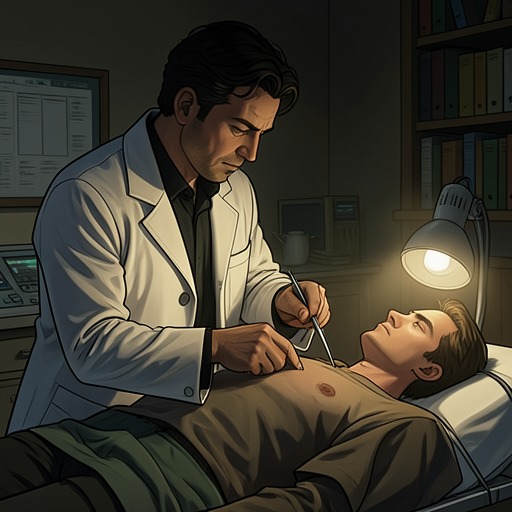
On August 31, 1999, Charles Cullen loaded Mattern’s intravenous line with a bolus dose of digoxin. The slow code ended before sunrise, and some nurses thanked God for what they understood as divine intervention; Cullen went back to the parking garage. The sequence gives the phrase an especially grim edge: a ward already watching a young patient move toward an expected death becomes the setting for Cullen’s deliberate intervention.
Narrative Significance
The account sets the nurses’ helplessness beside Cullen’s sense of agency. He regarded the staff at Lehigh Valley Hospital as cold and unempathetic, and felt treated as an inexperienced outsider despite his earlier work at Saint Barnabas Medical Center. In the book’s description, intervening in patients’ courses became a compulsion with little to do with the patients themselves: each act of control brought him temporary relief. Mattern’s slow code thus joins an extended pattern in which Cullen turns a setting of professional powerlessness, as he experiences it, into an opportunity to control an outcome.
The expression also compresses a disturbing contradiction. The staff continue to treat a patient whose prospects are bleak and whose likely survival would entail catastrophic injury; Cullen’s dose brings that already anticipated death about. By naming the drawn-out crisis before revealing the injection, the narrative makes the slow code both a description of Mattern’s condition and the frame for the act that ends it.