Somerset County Prosecutor’s Office
The Good Nurse: A True Story of Medicine, Madness, and MurderThe Somerset County Prosecutor’s Office is the investigative hub through which the suspected poisonings at Somerset Medical Center become a widening homicide inquiry. At first, the office has neither a clear case nor the medical records needed to build one. Its work grows into a collaboration among investigators, prosecutors, clinical expertise, and other agencies; the office later becomes the place where Charles Cullen is questioned and where the public response to his arrest first gathers force.
From a Routine Call to a Wider Investigation
On October 3, 2003, Wayne Forrest called Tim Braun about a death at Somerset Medical Center. Braun initially suspected that the call might reflect the influence of a politically connected person, and regarded the police response as the sort of local demand that came with the job. That first reaction makes the office’s subsequent transformation more striking: a call Braun was inclined to treat as routine became the starting point for an inquiry into possible patient murders.
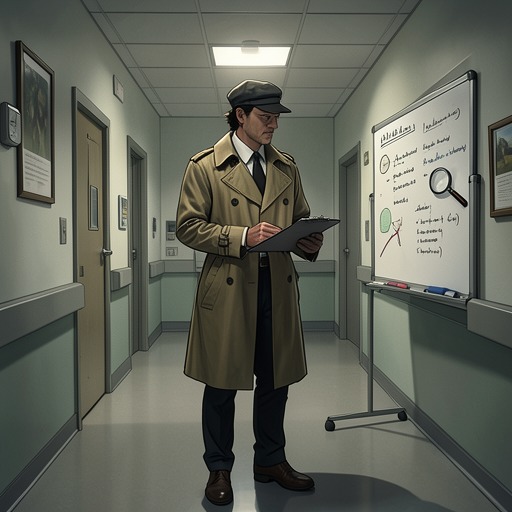
As the investigation widened, the Somerset County Prosecutor’s Office had to look beyond a single hospital and a single jurisdiction. Tim Braun briefed the larger team on Danny Baldwin’s work, which had generated red flags in several counties and identified Charles Cullen as a person of interest. The inquiry was expanding across hospitals and state lines, but suspicion was not yet a case: investigators had no hard evidence and needed to gather information across jurisdictions before they could establish a pattern. Braun therefore proposed a task force as the quickest way to coordinate the work.
The office’s role was not confined to its own building. In Bethlehem, Somerset County Prosecutor’s Office detectives and an assistant prosecutor joined personnel from the Northampton County District Attorney’s Office to search Cullen’s home and car under a warrant, chiefly looking for controlled substances he might have taken from a hospital. The joint search illustrates the geographical reach of the inquiry and the practical need to work with other agencies. The office was the organizing center, but the evidence had to be pursued wherever the investigation led.
Evidence, Gaps, and the Problem of Proof
The prosecutors’ task was made harder by the difference between evidence of suspicious access and proof of murder. The Somerset Medical Center patients were understood to have been poisoned with drugs, yet the hospital’s five-month internal investigation had produced only four pieces of paper and no answers useful to the detectives. Mary Lund could not provide the Pyxis records, Paul Nittoly could not provide interviews or background, and the investigators had no physical evidence. With the hospital’s experts unable to supply what the police needed, the team was running out of places to look.
After Reverend Florian Gall’s body was exhumed, toxicology gave the inquiry a firmer foundation. A Saturday-morning report found digoxin in several sampled tissues, including 23.4 micrograms per liter in the vitreous fluid and 104 micrograms per kilogram in the kidney. Nobby C. Mambo could then amend the report to classify the cause of death as digoxin toxicity and the manner as homicide. The investigation now had both a murder victim and a murder weapon, but still lacked a sure way to convict the murderer.
The Somerset County Prosecutor’s Office met twice daily as the case concentrated on records that might connect Cullen to the drug. Pyxis reports and Cerner printouts were its largest body of evidence tying him to the drugs that killed Gall, but their significance had a limit: they could show that Cullen might have obtained the drugs, not that he had administered them to kill Gall. He could claim that the Tylenol orders were legitimate; his cancellations could be mistakes; and his movements through the ward in Cerner could be explained as strange but harmless. The office faced a difficult evidentiary distinction: a pattern could direct the investigation without yet establishing an individual crime in court.
Amy Loughren and the Search for a Confession
That gap made Amy Loughren’s clinical knowledge and access to records important to the office’s work. Having recognized that Cullen’s routine use of the portable Cerner computer placed him near the doors through which drugs arrived, Loughren continued gathering records. She waited until her next shift to print more of them, then brought the paperwork to the second floor of the prosecutor’s office that morning to share what she had found with the detectives. Her discovery supplied a new line of inquiry, though the underlying records still required interpretation and did not by themselves prove murder.
The prosecutors concluded that records alone were unlikely to resolve the case. Cullen was no longer working at the hospital, so catching him in the act was not a viable route unless investigators risked another patient’s life. To avoid leaving Gall’s death unresolved like the earlier case of Ethel Duryea, Tim Braun would need Loughren to approach Cullen again and try to elicit a confession to at least one crime. The office’s dependence on her was therefore not incidental: the evidentiary problem had turned an employee with knowledge of the ward into a crucial investigative partner.
The office also pursued information beyond the local hospital. From Norristown, Braun dialed directory assistance and was connected through Montgomery Hospital’s switchboard and administration to Vice President Barbara Hannon. The account places this contact within the wider effort to follow Cullen’s employment and history across institutions, rather than suggesting that the investigation could be contained within Somerset. In parallel, the office used legal process to preserve the secrecy of its work: Danny Baldwin consulted Tim Van Hise on the language of a sworn affidavit, then brought the paperwork to a Superior Court judge and asked that both the order and affidavit be sealed. Quiet handling mattered because the investigation still depended on developing evidence without alerting its subject.
Arrest, Interview, and Public Consequences
After Cullen’s arrest, officers drove him to the Somerset County Prosecutor’s Office at 40 North Bridge Street. There, he was secured to a handcuff cable bolted to the floor of an upstairs interview room before Braun and Baldwin entered. The office thus changed from a place where investigators assembled incomplete records and planned their next steps into the controlled setting for direct questioning of their suspect.
News of the arrest for patient murders at Somerset Medical Center brought an immediate public response. Within less than a minute, calls began reaching the prosecutor’s office switchboard; more than 175 inquiries and potential-victim reports eventually flooded in from tipsters and concerned family members. The volume was so great that Braun and Baldwin could not break away until late afternoon, leaving Detectives Brownlie and Magos to handle callers while they crossed to the county jail. The office was both the center of the investigation and, suddenly, a point of contact for people who feared that Cullen might have harmed someone close to them.
Institutional and Narrative Significance
The office’s investigative progress is measured not by a single early revelation but by the conversion of scattered warnings into a case that could withstand scrutiny. Its personnel confront the absence of hospital records, the ambiguity of medication-system data, and the difference between identifying a possible means and proving a killing. Twice-daily meetings and a proposed task force mark an effort to impose coordination on an inquiry that had outgrown the boundaries of one hospital and one county.
The office also embodies the procedural tension at the center of the investigation: suspicion presses for swift action, while proof requires patient reconstruction and corroboration. Its eventual use of a sealed affidavit, cross-agency searches, Loughren’s assistance, and the interview room shows how the inquiry moved from a seemingly routine death call toward a formal murder investigation. The flood of calls after Cullen’s arrest gives that change a human scale: the office’s work was no longer only a problem of records and jurisdiction, but a public effort to determine who else might have been affected.