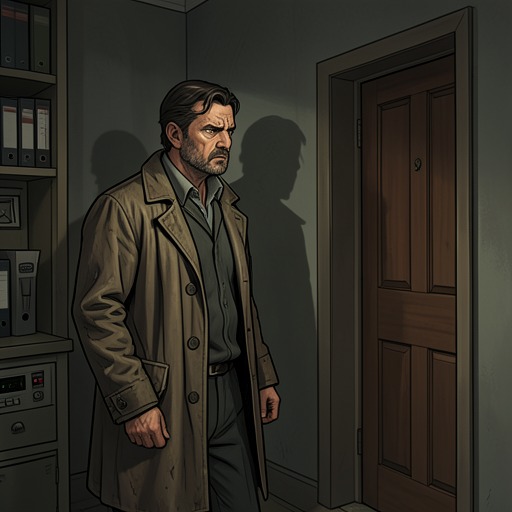
Somerset County Prosecutor’s Office Opens the Cullen Investigation
The Good Nurse: A True Story of Medicine, Madness, and MurderSomerset County Prosecutor’s Office Opens the Cullen Investigation marks the shift from unexplained deaths inside Somerset Medical Center to a criminal inquiry into possible deliberate poisoning. The investigation begins without a confirmed crime, a physical crime scene, or a clear explanation of the medical evidence. Its first task is therefore not simply to identify a suspect, but to determine whether the hospital’s scattered patient emergencies belong to one pattern—and why the hospital spent months investigating them internally before calling the police.
A Death That Does Not Yet Look Like a Crime
The inquiry formally begins with a call on Friday, October 3, 2003, from Somerset County Prosecutor Wayne Forrest to Tim Braun. Braun, a detective sergeant responsible for assigning and supervising Major Crimes cases, initially suspects that the call concerns a politically connected patient whose death has prompted officials to make the police respond. He assigns the case to Danny Baldwin, a younger detective he trusts from their work together in Newark. Baldwin has been at the prosecutor’s office for only six months, and this will be his first homicide investigation in Somerville.
Baldwin’s first step is to attend the autopsy of McKinley Crews, an older man who appears to have no visible injury. The state coroner, Nobby C. Mambo, considers the death natural, and the laboratory tests are clean. Baldwin reports that the examination seems like a waste of time; Braun, still unsure why the case has attracted the prosecutor’s attention, asks whether Crews looked like someone important. Nothing in the autopsy provides an obvious victim, weapon, or crime. The first piece of the investigation thus confirms how little the detectives know, rather than giving them a conventional homicide to pursue.
Four days later, Forrest sends Braun and Baldwin to Somerset Medical Center. They enter a conference room expecting an explanation of the death they have already investigated and instead find hospital leaders and counsel assembled. Paul Nittoly, the hospital’s lawyer, explains that the hospital is not reporting a homicide exactly. During the preceding five months, the Critical Care Unit has experienced five unexplainable patient incidents; Crews’s death is a sixth. Only after his death did the hospital notify the prosecutor’s office.
The hospital’s senior vice president, William Cors, reads out the patients’ names: Joseph Lehman, Frances Kane, Jin Kyung Han, Florian Gall, Francis Agoada, and McKinley Crews. All six had abnormal laboratory results and life-threatening symptoms; five had died. Cors does not say whether the incidents are connected. He explains that the hospital has already conducted an internal investigation lasting five months, without identifying their source, and summarizes the patients’ medical histories in technical terms. The distinction between a reported homicide and a cluster of unexplained medical incidents leaves the detectives with a grave possibility but no established crime.
An Investigation Without a Visible Crime Scene
Braun and Baldwin encounter unfamiliar medical evidence where they expect the ordinary materials of homicide investigation. The charts contain numbers and laboratory values neither detective can readily interpret; even professional laboratory personnel have not explained them. Insulin, glucose, and Digoxin appear among the medical terms, but the records offer no visible wounds, weapon, fingerprints, or witnesses. The patients might have died naturally, and the hospital has already examined their records without finding a cause. Braun wonders whether they have a crime at all, while Baldwin reduces the suspicion to its plainest form: the hospital may believe someone is deliberately poisoning patients.
The uncertainty is sharpened by the setting. Somerset Medical Center is one of the county’s largest employers and a powerful local institution, with influence extending into politics. Braun privately resents being handed a technically obscure case that the hospital has already investigated, and initially suspects that some corporate official has an agenda. But the scale of the meeting and the six-patient list change the assignment’s proportions. Baldwin, the lead detective, must make sense of the material the hospital has provided and decide whether it can support a criminal case. The investigation begins at the boundary between medical and police authority: the hospital has had the information for months, but neither it nor the detectives can yet turn abnormal results into proof of intentional harm.
That problem is particularly difficult in light of how Charles Cullen had acted at Saint Luke’s Hospital. There, he could inject Digoxin through an ordinary IV port, an action that could pass for routine line-flushing, then place the vial and used needle in the sharps box before taking part in the resuscitation. On another shift, he handled medicines in a supply room, prepared altered IV bags among normal work, and appeared helpful to colleagues. These earlier episodes do not establish what happened to the Somerset patients, but they show why the suspected means of harm could be concealed within legitimate nursing tasks. At Saint Luke’s, even colleagues watching the medication room did not immediately recognize what Cullen’s presence there meant.
From Local Assignment to a Wider Search
The first investigative checks yield no quick solution. Braun searches Edward Allatt, a phlebotomist connected to the inquiry, through motor-vehicle, criminal-history, and court databases, trying alternate spellings and nicknames. The checks produce no useful record. With a suspected case burning on his desk and no clear lead to follow, Braun searches for Charles Cullen as well. Cullen’s record is largely quiet: an old criminal-trespass charge in Pennsylvania and a drunk-driving charge in South Carolina, but no recent offenses or obvious warning in his background. The absence of a conventional criminal history does not resolve the question of what happened in the hospital.
As the work expands, investigators find warning signs across multiple counties and identify Cullen as a strong person of interest, but still lack hard evidence or a complete case. Braun tells Forrest that the prosecutor’s office has neither the experience nor the staffing for an investigation of this scope. Its ordinary workload continues, while the Somerset inquiry threatens to overwhelm the small office. A task force could combine investigators and resources from other counties, connect records across jurisdictions, and use Rapid Start, FBI software designed to consolidate and search large collections of data. The proposal promises a more systematic way to find a pattern than exchanging notebooks and isolated findings, but it also means sharing the investigation with other offices rather than retaining sole control of it.
Amy Loughren’s Evidence and Reversal
The inquiry also changes how hospital staff understand one another. Somerset Medical Center introduces an insulin adjustment form requiring nurses to electronically sign their estimates of how much insulin remains in a vial. Amy Loughren refuses to sign. She considers the estimate unreliable and objects that she is being asked to stake her nursing license on an inaccurate guess. Her manager, Val, orders her to sign but does not explain why insulin is suddenly being treated with heightened controls. Amy’s refusal is therefore both a challenge to a procedure she considers unsafe and an attempt to learn what may have happened to patients on her unit.
As police interviews and rumors spread, nurses worry that the investigation may implicate them. Amy is known as Cullen’s friend and as the nurse who resisted the insulin form. Some colleagues avoid her; even she fears that a medication mistake or her own use of antianxiety medication could have drawn suspicion. When Danny shows her a Pyxis printout from the night Florian Gall died, Amy recognizes Cullen’s activity. She has defended him against accusations before, but the record makes it possible for her to imagine that he did something terrible. What she cannot readily reconcile is the evidence with the person she believed her friend to be.
The printout does not settle the matter for Amy; it breaks open a conflict. She knows what happened to Gall and has seen the drug orders, yet doubts whether she can risk her job, deceive Cullen, and mislead her employer for investigators who might be wrong. Her decision to assist cannot be reduced to a clean choice between loyalty and betrayal. The investigation asks her to act against a friendship she trusts, while the institution employing her has withheld the reason for its new insulin controls and leaves her feeling exposed.
Amy’s later review of the paperwork supplies a further investigative lead. Recalling Cullen’s habit of working near the corridor doors and collecting the pharmacy runner’s delivery tote, she realizes that he could obtain drugs without using the Pyxis automated medication dispensing system. What had looked like helpfulness—taking the tote and stocking the unit—could also explain why the system’s records did not tell the whole story. Amy shares her understanding with Braun and Baldwin, brings them records, and identifies Cerner PowerChart patient records as another source investigators should obtain intact. Her knowledge of routine hospital work becomes a way to interpret gaps in the electronic trail, not merely to read the records already in police hands.
Significance and Limits of the Opening
The investigation’s opening is defined by a reversal in scale. A death initially judged natural leads to a hospital disclosure of six abnormal patient incidents; those incidents expand a local assignment into a multijurisdictional search, while records and clinical routines gradually make Charles Cullen a credible focus. The detectives do not begin with a confirmed murder or a complete explanation. They begin with a reluctant autopsy, a hospital’s delayed account of its internal inquiry, and medical data that resist straightforward interpretation.
The same uncertainty draws Amy Loughren from resistance and fear toward investigative cooperation. Her knowledge exposes how apparently ordinary medication work may conceal access not recorded by Pyxis, while her friendship with Cullen makes the evidence personally difficult to accept. The inquiry’s first achievement is not a final verdict: it is the recognition that the hospital’s incidents, Cullen’s opportunities, and Amy’s observations must be examined together. Its central problem remains how to turn a pattern hidden inside routine care into evidence strong enough to establish what happened.