The Jesus Prayer
The Good Nurse: A True Story of Medicine, Madness, and MurderThe Jesus Prayer is a repeated Christian prayer that becomes part of Charles Cullen’s religious practice in jail. Taught by Reverend Kathleen Roney as one of the meditation techniques she introduces to him, it appears at moments when he seeks steadiness: during sentencing and later, in transit to prison.
Instruction and Practice
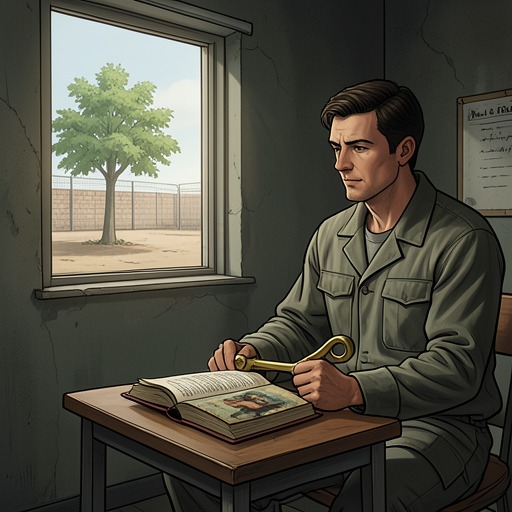
Reverend Kathleen Roney begins ministering to Cullen after he arrives at the Somerset jail in 2003. She teaches him techniques associated with the Desert Fathers, early Christian mystics who sustained their faith through years of ascetic isolation. Roney sees these practices as potentially useful to someone facing life in a confined cell. Cullen’s knowledge of Christianity has been limited to memories of Catholic grade school and religious films, so the prayer belongs to a devotional practice he is learning in jail rather than to a faith the book presents as long-established in his life.
The prayer is not reproduced in the account; its significance is conveyed through when Cullen recites it. He uses it during his Somerset sentencing, making it a practice carried into a public encounter with punishment as well as one taught in the relative privacy of pastoral instruction.
Use in Transit to Prison
After his final sentencing at the Lehigh County Courthouse, Cullen is shackled and transported in a windowless van toward the New Jersey State Prison. Nausea overtakes him during the journey. He tries to use another technique Roney has taught him, visualizing Jesus in a halo of fire in the darkness, but the image becomes nauseating too. He abandons the visualization and returns to the Jesus Prayer.
The sequence gives the prayer a practical role without suggesting that it resolves Cullen’s distress. An image he tries to hold in his mind fails under the physical strain of the ride; the recited prayer remains available as a familiar action. The shift from visualization back to recitation makes the practice less a declaration of certainty than a means of continuing through a moment he cannot control.
Narrative Significance
The Jesus Prayer connects Roney’s pastoral care to Cullen’s passage from county custody into state prison. Its recurrence at sentencing and during transport shows a religious practice accompanying him across distinct stages of confinement. Yet the account sets spiritual ritual beside the material facts of imprisonment: restraints, nausea, and the darkness of the van. The prayer offers Cullen a focus within those conditions, but the narrative does not present it as absolution or as an answer to the harm he has caused.