
The Fencing Duel Beneath the Sea
The Good ShepherdThis flow traces how George Krause’s fencing experience shapes his understanding of pursuit, anticipation, and reversal in submarine combat.
increasing Bearing strength in each event
 decreasing
Bearing strength in each eventdecreasingThe Foil and the Contact
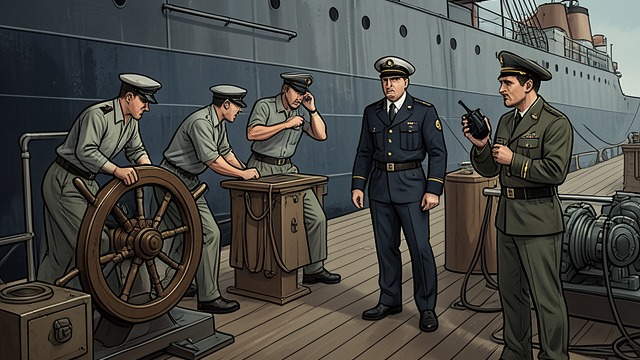
The Foil and the Contact
A familiar contest
George Krause remembers competitive fencing while trying to infer the submarine’s course from changing sonar reports. Both contests require reading an opponent whose intentions are not directly available.
A reaction in time
A fencer’s parry can become a riposte almost instantly. George Krause’s naval decisions likewise sometimes emerge before he can consciously explain the reasoning behind them.
Skill beneath calculation
The comparison shows that trained judgment is neither pure instinct nor step-by-step analysis. Years of practice prepare a person to recognize a pattern and act before the window closes.
Reversing the Pursuit
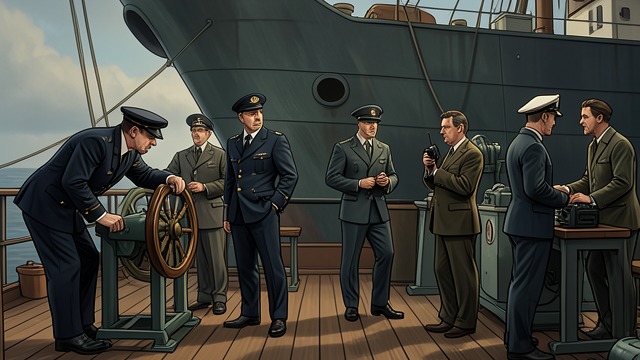
Reversing the Pursuit
A recurring circle
Keeling and the submarine circle one another, with the destroyer receiving delayed reports of the enemy’s movements. The submarine can change direction faster, but that advantage also makes its action more predictable when repeated.
Anticipation as riposte
George Krause turns before the expected reversal, risking the loss of contact if the submarine continues its course. The submarine instead turns into the approach he has prepared.
Risk within the maneuver
The successful turn depends on judgment under uncertainty, not on certainty about the enemy. The fencing image clarifies how a decisive move can be both a calculated risk and a nearly instantaneous response.
The Final Crossing
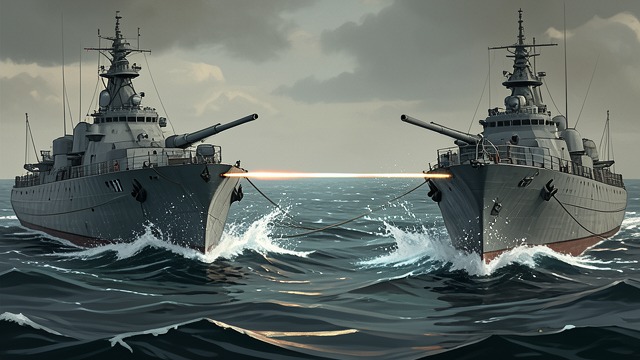
The Final Crossing
Combat becomes physical
The final U-boat engagement breaks out of the invisible sonar contest. The submarine surfaces close to Keeling and Dodge, placing the ships within direct gun range.
A changing line of attack
George Krause watches Dodge turn and finds an opening for Keeling’s guns. The tactical encounter resembles a blade crossing another blade: position shifts rapidly, and the advantage exists only briefly.
The cost of a touch
Keeling’s gunfire destroys the submarine, but the return fire damages the destroyer and kills sailors. The fencing metaphor reaches its limit because this contest has no harmless touch and no return to the starting line.
Wednesday morning as the submarine dives
Wednesday afternoon during the circling sonar fight
Thursday afternoon when the U-boat surfaces beside Keeling
