
The Enemy’s Deceptions
The Good ShepherdThis flow follows the submarines’ use of concealment and decoys, and the escorts’ efforts to distinguish genuine contact from deception.
increasing Bearing strength in each event
 decreasing
Bearing strength in each eventdecreasingRadar Contact in the Murk

Radar Contact in the Murk
A weak instrument
Keeling’s Sugar Charlie radar detects a small target at range, but its screen is fuzzy and unreliable. George Krause must decide whether the pip represents a submarine and whether to fire without seeing the target.
The enemy disappears
As Keeling closes, the radar pip fades. The submarine has dived, or the instrument has lost it; either way the destroyer must shift from visual attack to sonar search.
Detection is not certainty
The episode establishes the gap between having an indication and knowing what it means. Instruments extend the commander’s senses but cannot remove the need for judgment.
The Bubble Decoy

The Bubble Decoy
A false contact
Keeling follows a sonar echo whose range closes until it disappears. George Krause initially interprets the movement as a submarine’s evasive action.
The deception revealed
The submarine has released a Pillenwerfer, a bubble-producing device that can imitate an underwater target. The contact fades without the expected evidence of a destroyer passing over its prey.
A lesson in restraint
George Krause recognizes that the decoy nearly drew Keeling into wasting depth charges on a phantom. The encounter teaches him to question a promising contact as carefully as a doubtful one.
Layered Water and False Echoes
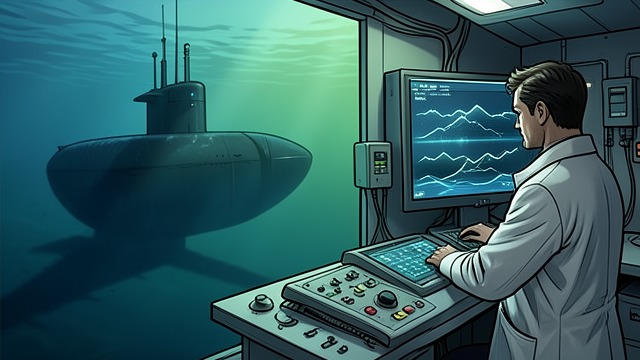
Layered Water and False Echoes
Natural interference
Keeling and Viktor receive echoes from cold layers in the water. These conditions can confuse sonar and obscure a submarine that may be moving or lying still at depth.
A hidden adversary
George Krause considers whether the submarine is exploiting temperature layers or has slipped beyond the destroyers’ search circles. The same weak signals can support several incompatible explanations.
Uncertainty remains
The hunt ends without a definitive contact or destruction. The absence of a result is not proof that the submarine is gone; it is a reminder that underwater detection remains limited by both equipment and environment.
Wednesday late morning before the first submarine dive
Wednesday evening after Keeling’s first pursuit through the convoy
Thursday morning during the prolonged pursuit with Viktor
