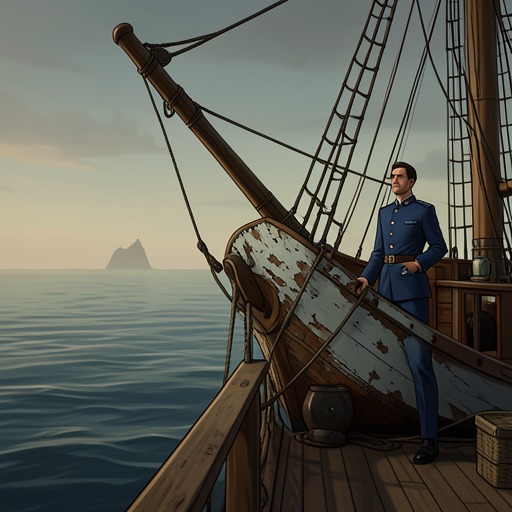
Abandonment and Sinking of Viktor
The Good ShepherdViktor’s abandonment and sinking end Krause’s effort to preserve a damaged but valuable ship. As its flooding defeats the measures taken to save it, he must authorize its crew to leave; Keeling remains nearby to protect Viktor and Cadena, while the ship’s loss is framed against its long survival and the home it had provided its exiled crew.
Guarding the Disabled Ships
With the light gone, Keeling circles the two dark shapes of Viktor and Cadena on its starboard beam, searching below with sonar and scanning the surface with radar. Krause works out what the circuit can and cannot protect: a circle a mile in diameter is more than three miles around, taking Keeling twenty minutes to complete. A U-boat two miles away and beyond sonar range could cover that distance at six knots, then launch a spread from half a mile before Keeling returned. His calculation makes the danger specific. He is not merely standing by two damaged vessels; he is trying to close a predictable interval in which an attacker could approach.
Krause judges that his duty is to cover Viktor and Cadena, leaving the rest of the convoy to two corvettes. Both ships carry value beyond their immediate condition. If Viktor can reach port, it could be made ready for sea again in a tenth of the time required to build a replacement, retaining equipment that could not be replaced. Cadena, meanwhile, is carrying men and has already saved many lives on the voyage. Tugs of its ocean-going type are scarce and nearly as valuable as destroyers. These reasons give the protective choice both a material and a human dimension: saving the ship may preserve irreplaceable equipment, while guarding the tug also protects people and a scarce rescue vessel.
Flooding and the Order to Abandon Ship
Viktor initially makes way under tow, reporting three knots and an intention to work up to five. Its captain is concerned about the bulkheads if the speed increases, and the ship can steer only imperfectly. The attempt to keep it moving therefore remains conditional: progress is possible, but the ship’s structural limits are already part of the decision.
The later report makes clear that the damage cannot be contained. The collision mats are too small, and the hand-billy pump is not powerful enough; water has been gaining steadily and is entering faster. The worsening is not described as a single sudden failure. As the hull sinks lower, more holes pass below the surface, increasing the pressure that forces water in. Viktor has a fifteen-degree list, and the main deck is underwater aft of the bridge. The cumulative mechanics of the flooding turn continued rescue into an untenable prospect.
Krause asks whether there is any choice left. Told that there is not, he grants permission to abandon ship. His reply also acknowledges the effort made aboard Viktor: he tells the reporting officer to assure the captain that Krause has no doubt he did everything in his power to save the vessel, and to convey his regret at the bad luck. The narration emphasizes the strain of finding the right words to an ally while his tired brain continues to work. The order is operationally decisive, but it does not reduce the loss to a procedure; it recognizes the captain’s effort and the shared position of the two crews.
The Ship Breaks Up
After the abandonment decision, a sonar report of loud breaking-up noises confirms that Viktor is coming apart. The sound is treated as the ship’s requiem, marking a change from a vessel that might still be towed toward port to one that is gone. Cadena sounds four blasts, identified as “F” for Fox, the signal that rescue is complete. The rescue signal and the breaking-up report place two outcomes beside each other: the people have been taken off, but the ship cannot be saved.
Krause’s earlier decision to stay with Viktor and Cadena gives this ending its immediate tactical context. Keeling continues its protective circuit even though the convoy has been entrusted to the two corvettes. The scene does not present the loss as a reason to abandon that duty; rather, the danger of a U-boat’s approach makes the continued watch intelligible even as Viktor’s own survival becomes impossible. The ship’s destruction and the successful completion of rescue are distinct results of the same emergency.
A Ship’s History and Its Loss
The account measures Viktor’s end against two and a half years of survival. It had escaped from Gdynia in defiance of the Luftwaffe and got out of the Baltic despite the Nazi Navy. Through those years of fighting, it had been the only home left to its exiled crew. The history makes the sinking more than the loss of a useful hull: the ship had also been the place that held a displaced crew together.
That history sharpens the contrast between the practical reasons Krause has for trying to save Viktor and the finality of its destruction. The ship’s equipment could not readily be replaced, and restoring it would take far less time than building another destroyer; nevertheless, the flooding makes those calculations powerless. The narrative calls Viktor a brave ship, then records its breaking up and the completion of rescue without treating either as a reversal of the other. Its crew can be saved, while the vessel that had served as their home is lost. The abandonment is therefore both a necessary command decision and the end of a long passage through exile and danger.