Cadena
The Good ShepherdCadena is the convoy’s designated rescue ship: a scarce oceangoing tug whose work repeatedly pulls her away from the formation and into danger. She recovers survivors from stricken ships, then takes the disabled Viktor in tow and brings her crew to safety. Her role links rescue to escort duty: the convoy needs Cadena to save lives, but every rescue leaves both the tug and the ships she is helping exposed to attack.
Role and Position in the Convoy
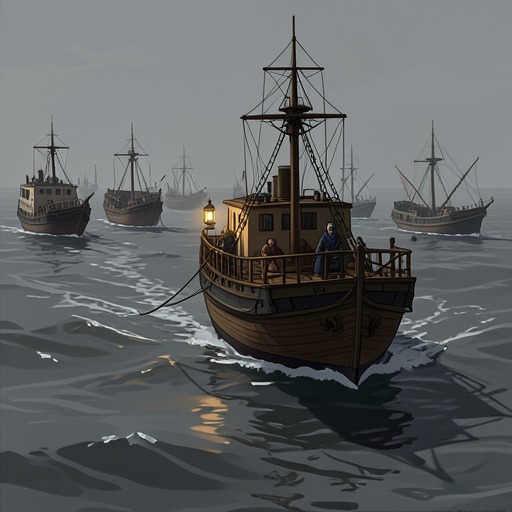
Cadena is seen astern of the convoy, where her position allows her to attend damaged ships without holding the merchant formation back. When Keeling passes the convoy’s line of ships, Krause recognizes Cadena by her smokestack and foremast, some distance off the starboard bow. Two boats are visible near her. Beyond them, a badly damaged ship lies nearly bottom up, three-quarters rolled over and almost entirely submerged, but still afloat. The arrangement makes the rescue work plain even before the men aboard Cadena can be distinguished: the tug has put herself beside the wreck and is taking survivors aboard.
Cadena rolls in the trough to give the boats a lee and lowers scramble nets against her dark side. From Keeling, Krause can make out small figures climbing up the hull. It is a practical, exposed operation, conducted alongside a vessel that is still afloat but close to disappearing beneath the sea. The nets and the tug’s sheltering position provide a way out of the water; the convoy’s rescue capacity depends on Cadena being able to remain at the wreck long enough for people to climb aboard.
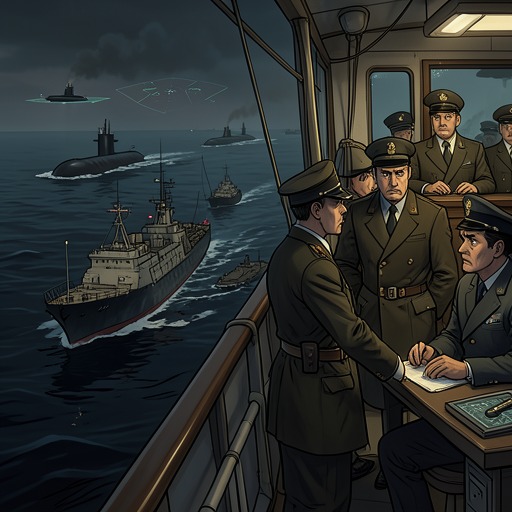
Her position also makes her a moving point of coordination. With a U-boat still unlocated, Krause must watch the convoy, the rescue ship, and the suspected threat while controlling Keeling. He orders Cadena to rejoin at best speed using a modified zigzag, and directs that the message be sent slowly enough for an unpractised merchant seaman to read. The instruction balances urgency against the need to deliver a usable order: Cadena must return to the convoy, but the message itself cannot be rushed past its recipient.
Repeated Rescue Work
Cadena’s duties do not end with the first recovery. After an explosion lights a burning ship, Keeling heads toward the wreck while depth charges detonate behind her. The blast produces a flash and a shock wave, then leaves the bridge momentarily dark and silent. A ship reported ahead is identified as Cadena, again engaged in rescue work. The tug has only just resumed her place in the convoy before being called away for this new mission, illustrating the recurring cost of her assignment: whenever another vessel is in distress, the rescue ship must fall behind again.
The account preserves an unresolved discrepancy in the report of survivors. Keeling signals Cadena that four survivors have been recovered; Cadena answers that she has not recovered any. The exchange does not clarify whether the ships are reporting on different groups or circumstances. It does show how quickly rescue information must pass between vessels, and how incomplete or conflicting reports can complicate the coordination of an operation. Krause nevertheless directs Cadena to head after the convoy and look out for stragglers ahead.
The scale of Cadena’s contribution becomes explicit later: she is carrying many men and has saved many lives on the voyage. Those aboard are not only the immediate object of rescue; they also make the tug a crowded vessel whose safety matters in its own right. A further rescue assignment therefore places a ship already carrying survivors back into a dangerous working position, rather than allowing her simply to resume an uneventful passage with the convoy.
Taking Viktor in Tow
Cadena’s most consequential task begins when a signal reports that Viktor has been hit. Krause initially tries to reach Viktor by radio-telephone but receives no answer. When contact is restored, Viktor reports that the torpedo has struck the engine room, flooding it and destroying all power. Cadena is standing by and has taken Viktor in tow. The crew has rigged a jury-battery circuit to restore the radio-telephone, allowing the damaged ship to report her condition despite the loss of power.
The tow is a rescue operation under continuing threat, not a completed retreat to safety. Krause orders Keeling to circle the two ships at half a mile while her sonar searches the depths and her radar scans the surface. He calculates that a U-boat could use the interval between Keeling’s passes to close in and fire, so he maintains a moving guard around the tug and her tow. The geometry of the circle becomes part of the defense: Keeling must cover both ships closely enough to protect them, while continuing to search for a submarine that might still be within striking distance.
Cadena’s towing work proceeds slowly. Viktor reports making three knots and hoping to work up to five, while concern remains about the condition of her bulkheads. The subsequent plan requires Keeling to make ellipses around Cadena as the tug struggles onward at four knots, each circuit bringing the group only slightly nearer safety. The small gain in each pass underscores how far the damaged ships remain from secure waters and how long the escort may have to remain with them.
For Krause, abandoning the convoy to cover Cadena and Viktor is a consequential allocation of protection. The two corvettes are left with the rest of the convoy, while Keeling guards the tow. Krause also considers the value of bringing Viktor into port: she could be made ready for sea again far more quickly than a replacement could be built, and her equipment is valuable and irreplaceable. Cadena herself is scarce, nearly as valuable as a destroyer, and full of people she has already saved. The choice to protect the tow thus preserves not merely one damaged warship but a rescue ship, her passengers, and the possibility of restoring Viktor.
Abandonment and the Return to the Convoy
The tow cannot keep Viktor afloat. Her crew reports that the collision mats are too small and the hand-operated billy pump inadequate; water continues to gain faster than they can control it. Viktor asks to abandon ship. Krause checks whether there is any alternative, then learns that the flooding cannot be kept under. Cadena’s presence gives the evacuation a nearby refuge, but the tug must bring all of Viktor’s people aboard while remaining at sea with the damaged ship.
Krause asks whether everyone has been saved, and Cadena confirms that they have. The confirmation relieves him of the immediate fear that someone might be lost between the grinding hulls. The rescue is complete, but it leaves Cadena responsible for the people she has taken aboard and for the wrecked vessel she has been towing. Keeling continues to screen the group as the convoy draws farther ahead, and the question of fuel and eventual assistance becomes more pressing.
Once the crew is safe, Krause directs Cadena to make her best speed to rejoin the convoy, with Keeling screening ahead and instructions to use a modified zigzag plan. The order returns the tug to her assigned place in the convoy’s defense without erasing the cost of her repeated diversions. Cadena’s significance lies in this cycle: she is sent back toward the formation, called away by another casualty, and relied upon again when Viktor must be rescued. Her work makes her indispensable, while the time spent doing it continually exposes how fragile the convoy’s protection is.