Carling
The Good ShepherdCarling is a bridge officer aboard Keeling whose development is measured through decisions made under pressure rather than through any account of his background. George Krause first sees him poised to sound the general alarm, later has to correct his handling of the ship during a submarine pursuit, and eventually observes him exercising independent authority and executing a course order correctly. The change is modest but consequential: Carling moves from uncertainty toward the practical responsibility his position requires, while remaining subject to the risks and demands of command at sea.
Position and Initial Test
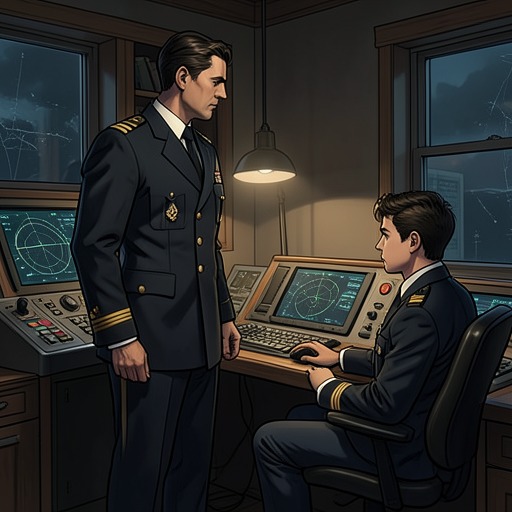
During an uncertain contact report, Carling has his hand on the lever for the general alarm and looks to Krause for a decision. Krause refuses to call General Quarters: James is pursuing a contact at a distance, with Viktor assisting, and that circumstance alone does not justify bringing the whole ship to battle stations. The refusal reflects the strain that prolonged readiness would place on the crew and the need to preserve their battle reserve. Carling’s part in the moment is brief but revealing of his station: he is ready to act, yet awaits the captain’s authority before sounding an alarm that would interrupt the ship’s routine.
Carling is also occupied with getting Keeling to a new station while the convoy proceeds. As he concentrates on that task, Krause inspects the lookouts himself, concerned that their regular, uninterrupted search is essential to detecting a briefly exposed periscope. The contrast establishes the pressures distributed across the bridge: Carling must handle the ship’s movement, while Krause keeps watch over the wider tactical picture and the crew’s performance. It does not make Carling’s assigned task unimportant; it shows that even routine station-keeping takes attention at a moment when a small sign might alter the danger to the convoy.
Tactical Briefing and Loss of the Conn
As the submarine situation develops, Krause gives Carling a concise account of the presumed enemy position and course, together with the plan to intercept again. The briefing is practical preparation for a possible handover: Krause might have to attend to competing demands, collapse, or be hit by stray fire, in which case Carling could temporarily take control. Carling answers that he understands, but Krause hears no confidence in his tone and no eagerness for the encounter. He considers whether Carling may be regretting his choice of profession. The narration does not establish what Carling privately thinks; it presents Krause’s reading of a subdued response at a moment when clear comprehension may be needed without warning.
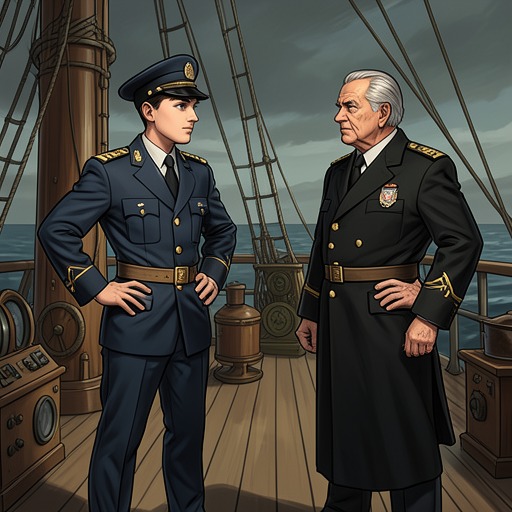
That concern becomes more concrete when Krause leaves Carling with the conn. After returning, Krause finds that Keeling is on course zero-eight-zero and orders a sharp turn to course one-seven-zero, directing Carling to bring the ship toward the target again. He concludes that Carling has spent the intervening time keeping Keeling on a course almost certainly diverging from the submarine’s. The failure is tactical, not merely a matter of tone: the ship’s movement has lost time that mattered to the interception. Krause’s judgment is blunt, and he reproaches himself as well, recognizing that he should not have gone below while leaving Carling in control.
Nervousness Under Pressure
Krause’s doubts sharpen when he explains that he intends to approach the submarine from behind. Carling’s hesitant reply accompanies a failure to grasp a situation that Krause considers straightforward for someone who has been on the bridge through the preceding half-hour. Krause concludes that the problem is not complexity but nerves: Carling is too excited, agitated, or possibly frightened to think clearly. The judgment is serious, but it is not framed as proof of cowardice or permanent incapacity. Krause remembers his own buck-fever earlier that day, when excitement made his hand tremble and contributed to omissions. That comparison places Carling’s difficulty within the human vulnerabilities of combat rather than outside them.
The episode also shows why a bridge officer’s competence cannot be measured only by knowing an order or repeating a tactical explanation. Carling has received the relevant information, yet under the pressure of the pursuit he does not use it effectively. Krause’s response is to correct the ship’s course and retain close oversight. Carling remains in the working relationship, however: Krause continues to issue him commands and later entrusts him with the conn again. The text therefore records a genuine lapse without turning it into a final verdict on his ability.
Initiative and Evidence of Learning
A later decision supplies a contrast. While Keeling patrols back across the front of the convoy and Dodge is visible on station beyond its starboard flank, Carling gives permission to shift the steering cables without first consulting Krause. He explains what he has authorized. Krause recognizes that standing orders leave the decision to the officer of the deck, so Carling has acted within his authority. There remains a tactical qualification: if a submarine were just beyond radar range, the timing might be poor. But no contact is present, and the change must be made daily. Krause credits Carling for accepting responsibility and considers that he may have learned something during the preceding twenty-four hours.
Carling then gives the order that places Keeling on course zero-six-zero for the return patrol across the convoy’s front. Krause regards this as a limited test, not a complex feat, but Carling performs it quickly and correctly. The success answers, in part, the earlier evidence of hesitation and confusion. Krause imagines that the Navy’s expected expansion could put Carling in command of a destroyer in battle within six months, if he survives. The possibility is conditional, not a promise: Carling’s prospects depend both on the Navy’s needs and on the danger of the work. The moment nevertheless indicates that Krause can see a future in which Carling bears greater responsibility.
Trust During the Periscope Encounter
The measure of that trust comes when a periscope is reported several miles away. Krause initially orders a turn, then immediately cancels it and demands that the bearing be confirmed. He wants to avoid showing the submarine that Keeling has detected it. After watching for a further appearance, he gives Carling the conn and orders course one-seven-zero. Carling repeats the course and acknowledges the order. Krause’s maneuver is intended to preserve the submarine’s belief that it has passed unnoticed through the gap between Keeling and Dodge and can proceed toward a firing position near the convoy.
Carling’s role here is not to originate the deception but to carry out the shiphandling on which it depends. The transfer of the conn places him inside a live tactical maneuver after his earlier mishandling of the pursuit. This does not erase that mistake or establish that his nerves have disappeared; the evidence gives no final assessment of his performance after the transfer. It does, however, show Krause continuing to use him in consequential work, and it makes Carling’s development a matter of observed conduct: an uncertain officer is corrected, tested in routine decisions, and again entrusted with the ship as the threat comes into view.