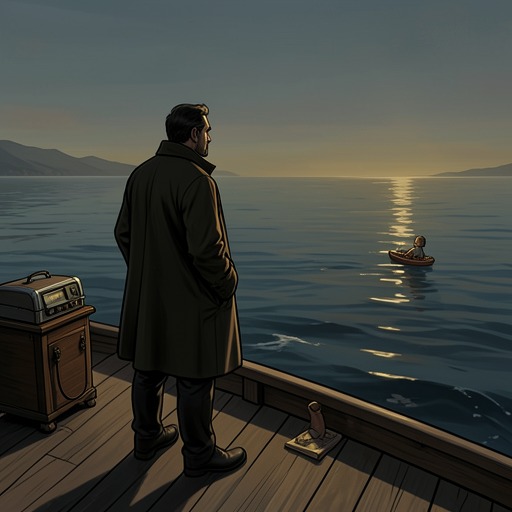
Carquinez Straits
The Good ShepherdCarquinez Straits is a remembered childhood landscape whose transformation gives physical form to George Krause’s estrangement from his past. In memory, it belongs to fishing trips with his father; when naval service brings him back, a steel bridge and relentless traffic make the familiar place seem irretrievable.
Childhood Fishing Ground
Krause recalls traveling by train with his father to Carquinez Straits to fish for bass. The journey was one of the happy occasions that shaped his childhood: the sun brightened their excitement, and the place became inseparable from the father who had loved him enough for two after his mother’s death. The straits are not merely scenery in this recollection but a setting for a rare, intimate form of family life.
Those memories belong to a wider pattern of excursions from the Bay. On a few memorable occasions, father and son crossed by ferry and took a boat through the Golden Gate into the open ocean. Against that remembered world of fishing, ferries, and shared journeys, Carquinez Straits holds the emotional scale of a home that Krause once knew through companionship.
Return to a Changed Landscape
Years later, the chances of naval service bring Krause back to the scenes of his childhood, but the return does not restore them. Carquinez Straits is crossed by a vast steel bridge, crowded with traffic whose noise and movement sharply contrast with the remembered fishing trips. The transformation is part of a larger change: Oakland has become noisy and different, and the Berkeley hills have been built over.
The landscape’s new infrastructure gives visible form to the distance between Krause’s past and present. The ferries on the Bay are soon replaced by other bridges over which traffic hurtles with a pitiless single-mindedness unlike anything in his memories. What had been a place of sunlight and shared leisure is now encountered within a changed world that offers no return to the childhood he recalls.
Significance in Krause’s Life
Carquinez Straits marks the difference between remembering a home and being able to inhabit it again. Krause’s return reveals not a recovered past but a severance: the altered surroundings leave him feeling that the child who lived there was someone else, and that he has no roots. The straits therefore connect a specific lost bond with his broader sense of displacement, while their changed crossing makes that loss concrete in the landscape itself.