Command under physical and mental exhaustion
The Good ShepherdCommand under physical and mental exhaustion is shown through George Krause’s effort to keep Keeling and her crew effective through prolonged submarine threats, dwindling supplies, and the accumulating costs of cold, hunger, pain, and lost sleep. The novel treats command not as invulnerability but as the repeated work of making decisions while the decision-maker and the ship’s company are being worn down. Krause’s discipline sustains action, yet the narrative also makes clear that bodies have limits, and that sound command sometimes means conserving strength or ending a pursuit.
Judgment Under Uncertainty
Krause’s mental burden begins before the most extreme physical strain. When James reports a distant contact and requests permission to attack, he must weigh a possible opportunity against the danger of weakening the convoy screen. The report offers no certainty that a U-boat is present. Detaching James could leave gaps in the escort, while a high-speed search and return would consume fuel from the small reserve Krause wants to preserve for a later crisis. Yet leaving a submarine free could expose the convoy’s position and allow it to summon other boats. The decision is therefore not a simple choice between action and caution: every option risks spending a resource the convoy may soon need.
The character of the available information changes, but uncertainty does not disappear. A Huff-Duff report of a foreign transmission bearing toward the convoy gives Krause stronger grounds to suspect a U-boat, and he orders that it be run down. Later, he considers several explanations for a submarine’s disappearance, including a dive to evade detection, a possible new radar capability, a routine maneuver, or even the crew’s need to prepare a meal in rough seas. He does not mistake one plausible explanation for established fact. Instead, he keeps alternative possibilities in view while deciding how to close the distance and search. His judgment is presented as a practiced capacity to act without pretending that incomplete reports have become certainty.
That practice includes knowing when not to escalate. Keeling is already in Condition Two, with battle stations largely manned and watertight integrity maintained, but Krause refuses to sound General Quarters merely because James is pursuing a distant contact with Viktor. Calling the entire crew to battle stations would interrupt sleep and meals, stop routine maintenance, and impose a more exhausting state that could be sustained only for hours. Repeated alarms without clear cause might also make men slack in their duties. Krause’s restraint protects the crew’s readiness as well as their immediate comfort: a reserve of attention and endurance is part of the ship’s fighting capacity.
Crew Endurance and the Ship’s Routine
The novel locates fatigue in the organization of the crew, not only in Krause’s personal resolve. New weapons and instruments have brought additional personnel aboard Keeling, straining living space without providing enough trained ratings to form three full watches under Condition Two. Krause divides the company into four sections and adopts a watch-and-watch routine. His officers generally work four hours on and eight off, while the watch below is to receive a full four hours’ rest unless an emergency intervenes. He cancels a routine call to General Quarters before dawn because the ship is already prepared for action and another unnecessary interruption would diminish the rest still available.
These arrangements do not remove the strain: Condition Two itself is hard on the crew and on the ship. They do, however, show Krause treating endurance as a finite operational resource rather than demanding unlimited effort as proof of loyalty. The same logic shapes his concern about fuel and ammunition. Decisions made in one encounter affect what Keeling can do in the next, and the burden of a prolonged fight cannot be measured only by whether the latest attack succeeds.
The strain also exposes vulnerabilities in the ship’s actual capacity. Tom Ellis, Keeling’s sonar operator, has served since the outbreak of war and received instruction at the Key West Sound School, but the narrative emphasizes that he has never since heard a submarine echo in combat. The gap between classroom exercises and live tracking leaves open whether he will recognize an echo or draw the necessary deductions quickly enough. Underwater warfare can turn a small delay into a large difference: a depth-charge dropped within ten yards may produce a likely victory, while one dropped twenty yards away means certain failure. The scene makes the operator’s burden concrete without treating nervousness as cowardice; performance depends on training, experience, and the pressure of knowing that the attack may rest on a delicate reading of sound.
The Commander’s Body in the Pursuit
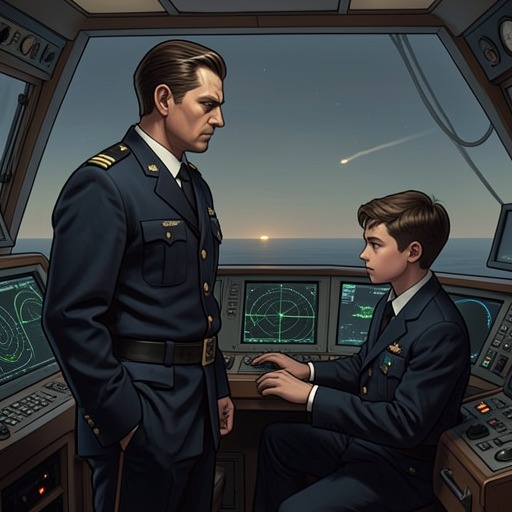
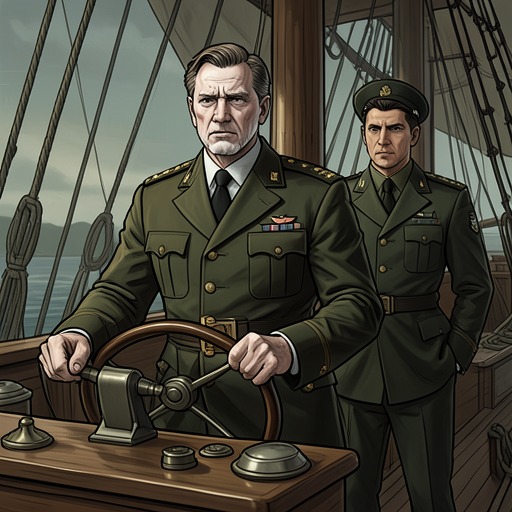
Krause’s own body becomes increasingly difficult to set aside as the chase continues. During one approach he has stood exposed on the bridge in the freezing wind and spray, without a sweater, gloves, or scarf. The sheepskin coat sent for him has itself been chilled by the wind; when he puts it on, he shudders uncontrollably and has to master his chattering teeth. Meanwhile, the tactical problem continues to demand attention. Keeling must close within sonar range, and the submarine’s possible movement expands the search area with every passing minute. Physical discomfort does not pause the calculations.
After the midnight watch, four hours of concentration and misery have left Krause’s legs aching and his muscles taut. He sits on the captain’s stool, although he has long held that a captain should not sit at sea, and the relief is mixed with an immediate need to use the head and a powerful desire for hot coffee. He suppresses those needs because Keeling is closing on a contact. Later, as the range breaks off, he pushes his weary brain to estimate the submarine captain’s next move. When orders for another attack are given, hunger, thirst, painful joints, and bodily urgency remain present; disciplined command means continuing to think accurately while those demands press for attention.
That persistence is tested over hours rather than a single dramatic instant. Krause estimates that the hunt has lasted about seven hours before he gives it up. During the pursuit he has to judge not only his own ability to continue but the wider tactical cost of keeping Keeling away from the convoy. The convoy has straggled after a torpedo attack; Viktor must cover its vulnerable flank and help bring the scattered ships back into formation, while Dodge and James have their own demands. Krause’s decision to abandon the search brings regret and self-doubt. He asks whether fatigue is weakening his resolve, but concludes that ending the hunt may be the correct judgment, not a failure of character. The distinction matters: duty is not synonymous with continuing every action until exhaustion makes continuation impossible.
Depletion, Reassessment, and Handover
The material limits of the fight reinforce the human ones. During the day Keeling has expended thirty-four depth-charges in a pattern that brings the reported total to thirty-eight; in the previous twenty-four hours she has used more than seven tons of high explosive and has only six charges left. Krause must stop firing patterns. A smaller pattern would sharply reduce the chance of a hit, but even one explosion near a U-boat could have a deterrent effect and force evasive action. The remaining weapons therefore have both a direct tactical value and a psychological one. Their scarcity makes each further attack a choice about what capacity to leave for whatever follows.
On another approach, Krause recognizes that a single depth-charge cannot account for the submarine’s evasive movement as a full pattern might. He responds by making the attack’s timing and course more exact, and by changing Keeling’s route so that the U-boat may not anticipate the familiar method. The tactical adjustment takes place while his mind and body are close to their limits. Persistence is not merely repetition: it requires him to keep adapting even when exhaustion makes clear thought harder.
The boundary is exposed when Krause nearly falls from his stool after actually falling asleep for a moment. He is shocked by the lapse and resolves not to let it happen again. Yet the episode also demonstrates that command cannot abolish the body’s need for sleep. Rather than treating the lapse as proof that he has become incapable, Krause attempts to remain upright, even refusing the thought of changing into slippers because he believes the captain must set an example. His self-command is formidable, but the scene makes its cost—and its vulnerability—visible.
The narrative offers practical forms of support alongside this severe inward discipline. Charlie Cole is on the bridge while Carling has the conn, and Cole arranges food for Krause. When coffee arrives, Krause drinks it urgently, his numb hands trembling as he pours, and asks for another pot. A handover allows command duties to be shared without erasing Krause’s responsibility for the situation. Such moments do not undo the accumulated exhaustion; they show how food, rest, and trusted shipmates help a commander remain functional within it.
Victory Without Recovery
After Keeling and Dodge destroy a U-boat, Krause must address the crew despite the battle’s immediate aftermath. The ship has been hit, shipmates have been lost or badly wounded, and a stretcher carries Storekeeper Third Class Meyer past the shattered deck. Krause’s announcement is difficult for him to compose. He is in the reaction that follows extreme tension, cold inside his clothes and sweating, and his fatigue intensifies the shock. A small mirror reveals a face he initially fails to recognize: red-rimmed staring eyes, stubble, and traces of mayonnaise and egg still on his face. His appearance registers how far battle conditions have displaced ordinary care and self-recognition.
The announcement does not end the work. Krause returns to the pilot-house, sits down, and takes command of the next demand while the sonar continues to ping and the Atlantic remains dangerous. The book’s portrayal of exhaustion therefore resists both a heroic fantasy of limitless endurance and an account in which fatigue automatically cancels agency. Krause remains responsible, but his effectiveness depends on reserves, crew routines, changing tactics, assistance, and the willingness to reassess an action. Command under exhaustion is the difficult practice of carrying on without confusing self-punishment with duty, or victory in one encounter with the end of the danger.