Depth charges
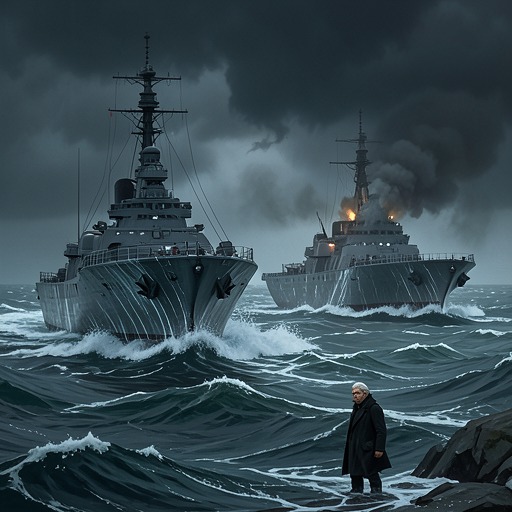
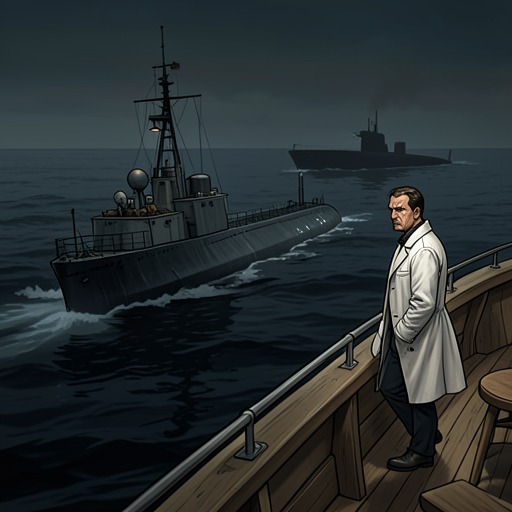
The Good ShepherdDepth charges are the weapons through which Keeling turns an uncertain underwater contact into a direct attack, but their use is never portrayed as a simple matter of releasing explosives. A successful pattern depends on sonar contact, estimates of the submarine’s position and depth, and timing the charges’ fall and detonation. The sea hides the target while magnifying the consequences of error: an early attack leaves no visible proof of a hit, whereas a later, coordinated attack is followed by Viktor’s report that the submarine has been destroyed.
Design and Method
The charges are released in patterns intended to cover the submarine’s possible position rather than strike a target visible to the crew. When the U-boat may be passing close beneath Keeling, Krause cannot know whether it is directly under the destroyer, still ahead, or as much as a hundred yards to either side. Charges dropped from the stern might therefore explode behind it; the K-guns extend the pattern by firing charges out to either side. The attack is a calculated response to uncertainty, not a precise shot at a visible vessel.
The text makes the narrow margin for accuracy explicit. A charge falling within ten yards of a target could mean a probable victory, while one twenty yards away meant certain failure. At the same time, the operator’s sonar contact could disappear at close range: around three hundred yards was the smallest distance at which sonar could function. That limitation makes the moment of attack especially dependent on estimates made before contact is lost.
The charges’ descent also governs the timing of an attack. In one engagement, Krause calculates from a separation of about three hundred yards and a combined speed of roughly eighteen knots, allowing thirty seconds; he then subtracts fifteen seconds for a charge to sink to medium depth and allows a ten-second spread around the estimate. Later, the charges are set deeper. Their longer descent delays the explosions, while their somewhat random downward fall makes the spread less regular. Krause wishes that streamlined charges were available, but they are only in production; the weapons at hand are described as clumsy cylinders.
The First Pattern
During Keeling’s first attack, a sudden change in the contact’s bearing suggests that the submarine has turned towards the destroyer, possibly trying to pass on the opposite course. At the closest range, Krause has to reckon with the possibility that it is already passing beneath his feet. The K-guns fire on either side as charges go over, creating a pattern intended to catch a target whose exact position remains unknown.
Krause steps onto the bridge wing as a charge leaves the K-gun at the fantail. He sees it fall astern, followed by successive columns of water from the underwater explosions. The disturbed sea gives no confirmation of success: no hull appears, and no other sign shows that a charge has struck the submarine. The apparent scale of the explosions cannot resolve the uncertainty. The narration estimates that the odds of a single pattern scoring a hit are at least ten to one against, and the first pattern may not have succeeded.
The moment also exposes a human lapse in the weapon’s use. Krause realizes that he should not have left his post to watch the explosions: five seconds have passed since the last detonation, enough time for the submarine to travel a hundred yards. He recognizes the lapse as buck-fever and neglect of duty. The charges can cover the sea around a calculated position, but they cannot compensate for a commander’s lost attention at the moment when seconds matter.
Coordinated Attacks
In a later engagement, Keeling and Viktor attack in coordination. After Viktor reports that its charges are away, Keeling turns and the explosions rise in Viktor’s wake. Sonar then reports the contact obscured. The loss of a clear return does not establish what the pattern has done, and Krause continues to judge the engagement through timing, bearing, and the expected movements of the submarine rather than direct observation.
As the attack develops, the submarine is expected to dive after being forced to surface, and the next charges are set deeper. Their delayed detonation gives it more time to reach extreme depth; their irregular fall makes the placement less predictable. Krause knows the limitations of the available weapons and contrasts the current cylinders with streamlined charges that are not yet available. The attack thus combines a practical adjustment to the target’s likely response with awareness that equipment design constrains what the crew can do.
Viktor eventually reports that the submarine has been caught and that its crew heard it break apart under pressure. Krause remains silent over the T.B.S. The account connects that success to the deaths of fifty men aboard the submarine, placing the weapon’s operational result beside its human cost. The charges have achieved what the first pattern could not confirm, but victory does not arrive as an uncomplicated technical triumph.
Operational Cost and Significance
The ship’s ability to use depth charges depends on a wider system of readiness. Keeling is already in Condition Two, with battle stations largely manned, and Krause avoids calling general quarters without an emergency because battle stations cannot be sustained indefinitely without exhausting the crew. The men must retain their capacity to act when the decisive moment comes. The discipline to conserve that readiness parallels the discipline required to time an attack: both depend on recognizing that effort and attention are limited resources.
The weapon also exposes how unevenly responsibility is distributed. Sonar operators must interpret faint echoes, officers must convert reports into firing decisions, and the crew must release charges at the calculated moment. Yet no single person can see the underwater target or guarantee a hit. The difference between an effective pattern and failure may be a small error in range, timing, or response. Depth charges therefore function in the narrative as both a material weapon and a measure of command under incomplete information: their explosions can destroy a submarine, but the sea leaves success uncertain until a report from another ship gives it voice.