Dodge
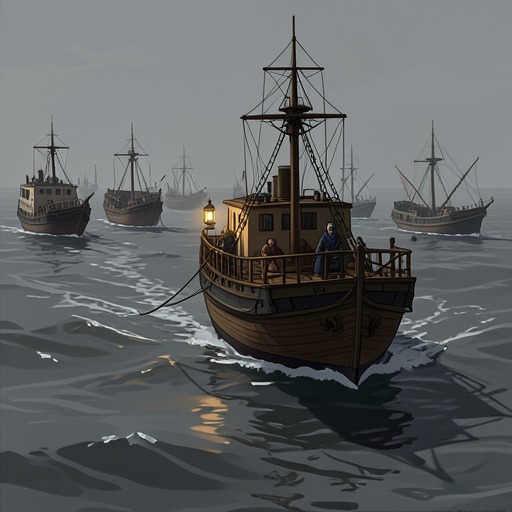
The Good ShepherdDodge is a Canadian corvette and one of the escort ships protecting the convoy. In the ship-to-ship calls, Krause addresses her as Dicky; she answers promptly, reports contacts, and acts on orders to shield the merchant ships as the threat develops. Her part in the action brings the cost of escort duty into sharp focus: after engaging a surfaced submarine at close range, Dodge loses her four-inch gun, suffers seven dead and some wounded, and must continue with her remaining capabilities sharply reduced.
Identity and Place in the Escort
When Krause decides to detach James and Viktor to investigate a possible U-boat, Keeling and Dodge are left to screen thirty-seven convoy ships. The convoy’s spread covers three square miles, and the sea from which torpedoes might be fired forms a vast arc. Two escorts cannot cover that danger as effectively as the original force; Krause must position them as well as he can rather than leave the convoy without protection. Dodge is therefore not simply a ship available for pursuit. Her station is part of the reduced defensive screen, and moving her to meet one threat creates a corresponding risk elsewhere.
Krause first orders Dodge to take station three miles ahead of the leading ship in the convoy’s starboard column. This places her forward of the ships she is charged with protecting. Later, he orders her to leave that station and ride herd on the convoy’s starboard side, look to the Commodore for instructions, and bring stragglers back into line. The change makes her work both tactical and protective: she must help guard the formation while attending to ships that have fallen out of position.
Signals, Contacts, and Repositioning
Dodge is alert to the possibility of enemy contact. When she breaks into the communications circuit, she reports a radar pip bearing 098 at a range of fourteen miles, which appears to be a submarine. The report expands the picture beyond the contact already being investigated by James and Viktor. It also demonstrates how the convoy’s defense depends on several ships independently watching and reporting rather than on a single escort having a complete view of the threat.
The later calls place Dodge in a close, rapidly changing contest. She reports a contact bearing 064 at a range of one thousand, and Krause tells her to come in. The image of the submarine escaping one destroyer only to run toward another captures the value of having more than one escort in the hunt; but the ships are also at risk of converging on one another while trying to maintain contact. Krause must maneuver Keeling with Dodge’s attack in mind, prepared to take up the chase if her attack fails.
Dodge’s communications remain important as danger closes. Her voice warns Krause that torpedoes have been fired at him and notes that he has turned. The call conveys both the urgency of the attack and the coordination between the ships: Dodge’s report gives Krause another ship’s view of the threat while he maneuvers Keeling. After Dodge fires, Krause turns in to join the action. A single shot produces a pillar of water in her wake, but it also deafens her sonar, a reminder that even an attack can interrupt the sensing needed to locate the submarine.
Close Engagement and Losses
The escorts’ attack is constrained by dwindling supplies. Keeling has only six depth charges remaining after a day of fighting, and Krause resists firing a full pattern because every charge spent reduces the options left for later encounters. During the pursuit, Keeling and Dodge each drop a charge, an attack the narration presents as a weak one. The subsequent report of a submarine astern turns the situation abruptly: Krause sees a grey shape a quarter of a mile away, with its bridge and hull visible, and guns open fire.
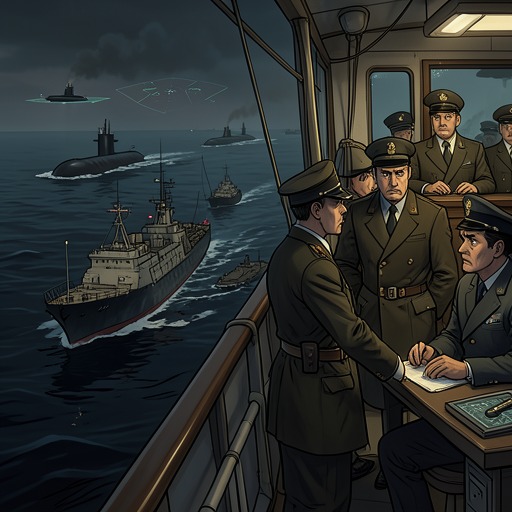
Dodge and the surfaced submarine then circle at close quarters, each turning after the other. From Keeling, the encounter is visible as a dangerous, confused duel: Dodge turns rapidly, her guns fire, and the submarine remains beside her as the ships circle. Dodge fires her four-inch gun at extreme depression. The scene shows how far the action has moved from the distant, uncertain sonar contact that began the hunt; the enemy is now alongside in plain view, and the destroyer’s weapons are being used at an angle that underscores the immediacy of the encounter.
The cost is reported afterward. Dodge has lost her four-inch gun, which was struck on its mount; seven men are dead and some are wounded. Krause asks about other damage, and Dodge reports that nothing else is serious, since most of the submarine’s shells passed through without exploding. The report is starkly specific: the gun is gone and the crew has suffered fatal losses, but the ship has not been rendered wholly incapable of continuing. The later account describes serious damage forward as adequately patched. Dodge’s survival as a functioning escort does not erase the human cost or restore the weapon she has lost.
Remaining Capacity and the Voyage’s End
By the time her condition is reported near the end of the convoy’s passage, Dodge has no depth charges and fuel for thirty-seven hours. Her gun is out of action, and her forward damage has been patched. These figures define what remains of her fighting capacity more clearly than a general statement that she is damaged: she can continue with the convoy, but she has lost a principal gun and all her depth charges, and her remaining fuel is finite. James reports three depth charges and fuel for thirty-one hours, so the two escorts’ depleted stores differ even as both face a tight journey to Londonderry.
Krause orders Dodge and James to form column astern of Keeling, at thirteen knots on course 087. The order marks a transition from the independent and hazardous movements of the hunt to a final, coordinated passage toward England. When Krause signals the convoy commander to say goodbye and thank him for the cooperation, he also gives the escort ships their departure formation. Dodge is among the ships he has guarded for so long, and the separation weighs on him even as he completes his assigned duty.
Narrative Significance
Dodge’s role is defined by a recurring tension between coverage and concentration. She is needed to keep station and shepherd stragglers, yet she must also respond when the submarine threat presses close. Her reports, changing station, and movement into the attack make the escort screen an active system of shared attention, not a static line around the convoy. The system can detect and answer danger, but every maneuver places demands on limited ships, weapons, fuel, and crew.
Her damage makes that limitation concrete. Dodge remains in the formation after losing her gun and suffering casualties, but the final inventory shows how much the prolonged engagement has taken from the escorts: she has no depth charges, while James has only three, and both have limited fuel. Dodge’s contribution is therefore not represented as a clean victory or an uncomplicated rescue. It is the costly continuation of convoy protection by a ship whose capacity has been diminished, yet which still takes its place astern of Keeling for the passage onward.