Five-Inch Naval Guns
The Good ShepherdFive-Inch Naval Guns are Keeling’s principal weapons in its close engagement with a U-boat, turning a sudden opening in the maneuvering fight into a decisive attack. Their firing destroys the submarine, but the brief triumph is inseparable from the damage and deaths inflicted on Keeling in return.
Position and Firing Opportunity
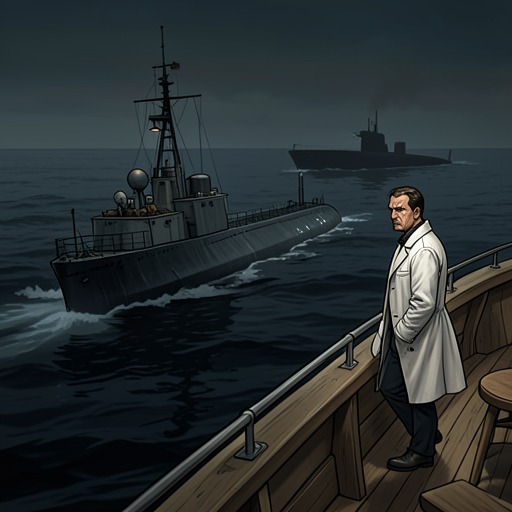
The guns enter the decisive action through a rapid change in relative position. As Krause prepares Keeling for a run-in, he sees Dodge cease turning to port; Compton-Clowes is putting its helm over. Krause orders Keeling to turn to starboard and tells gunnery control to stand by for a target on the port beam. The turn presents Keeling’s port side to Dodge, while the U-boat, momentarily caught by Dodge’s abrupt alteration, moves away from it. Clear water opens between the ships, giving Keeling’s five guns a fleeting chance to fire before the submarine can turn back toward Dodge.
The account stresses how narrow that opportunity is: the gap grows from ten yards to twenty and then fifty. As Keeling turns, all five guns train around, and they open fire while the enemy is exposed. The weapons’ effectiveness here depends not only on their number but on the coordinated sequence of observation, helm orders, target direction, and gunnery readiness. The guns act at the end of that chain, in the short interval created by the other ships’ movements.
The Engagement and Its Immediate Effects
The five-inch fire falls around the U-boat in close, repeated bursts. The water seems to rise around its grey bridge, which remains dimly visible amid the splashes; shells burst within that disturbance. Then the guns stop abruptly. For a moment Krause fears that Keeling’s main armament has been disabled, but when he looks again the submarine is gone from sight. The water is foaming, and two large bubbles break the surface in succession. The sequence gives the guns a starkly visible result without showing the submarine’s destruction directly: fire, a sudden silence, and the vanished target.
The cessation of fire also marks a reversal in the scene. The guns have achieved their purpose, but Keeling has been struck during the exchange. Krause hears a rending crash and feels a violent shock that makes people on the bridge stagger. Looking aft, he sees that the port-side 20-mm. gun tub is gone and the deck beneath it has been torn and twisted. The account thus distinguishes the weapon that has just fired from the damage elsewhere on the ship, while making clear that the engagement’s outcome is not one-sided.
Reports, Results, and Cost
After the battle, Krause tells the ship’s company that Keeling got the U-boat and that Dodge has picked up a survivor. He reports that Keeling hit it a dozen times with the five-inch guns, then acknowledges that the enemy hit Keeling and that shipmates have been lost or badly hurt. The guns’ success is therefore presented alongside the human cost, not as a clean or consequence-free victory.
The later gunnery report gives a more qualified count. Fippler has recorded seven distinct hits among the fifty-odd rounds fired. Krause thinks the number may have been higher; Fippler allows that there may have been additional hits the crew did not see. The difference between the captain’s public report of a dozen hits and the gunnery officer’s count of seven distinct ones remains unresolved in the account. It reflects the limits of what could be observed during a brief, violent exchange, rather than supplying a single definitive tally. Krause nevertheless commends the shooting as good work.
Place in Keeling’s Fighting System
The guns’ moment of action stands against the sustained readiness required elsewhere aboard Keeling. The ship is already in Condition Two, a demanding state that keeps battle stations largely manned while disrupting ordinary routines. Krause resists calling general quarters without need because a full battle-station call would consume the crew’s rest and leave routine maintenance undone; he treats that readiness as a reserve to preserve for the crucial moment. The guns are thus part of a fighting system whose effectiveness depends on conserving the people required to operate it, not simply on having weapons available.
That system also relies on information gathered before a target can be engaged. Lookouts must search continuously for the brief appearance of a periscope, while sonar operators listen for an enemy beneath the surface. The text emphasizes the vulnerability of those tasks: an unpractised sonar operator might fail to interpret an echo quickly enough, and a momentary glimpse at sea can matter to the convoy’s fate. Against this background, the five guns represent the force brought to bear once maneuver and detection create an opportunity. Their sudden thunder, abrupt silence, and uncertain hit count make them both instruments of victory and evidence of the strain, danger, and incomplete knowledge under which that victory is achieved.