General Quarters
The Good ShepherdGeneral Quarters is the order that brings everyone aboard to action stations, transforming a ship’s ordinary routine into an all-hands battle posture. For Krause, it is not simply a louder version of Condition Two: it is a far more demanding commitment of people and time, to be called when the threat warrants it and released when the immediate need has passed. The order’s costs make its timing part of command, not merely a response to danger.
What the order requires
General Quarters sends every member of the ship’s company to a duty post. Once sounded, ordinary work gives way to battle readiness: sleep and meals are interrupted, routine maintenance is deferred, and the crew must sustain a level of effort that cannot be kept up indefinitely. The strain is practical as well as physical. Jobs needed to maintain the ship accumulate while the people who would ordinarily do them remain at their stations; fatigue and hunger build as the alarm continues.
The novel distinguishes this state from Condition Two, which already keeps battle stations largely manned and the ship’s watertight integrity strictly maintained. Condition Two places a real strain on the crew and interferes with normal work, but it can be endured for days; General Quarters is measured in hours. The distinction gives Krause a middle course between routine readiness and a shipwide emergency response. He can preserve a high level of preparedness without requiring the whole crew to remain at full battle stations whenever an uncertain report comes in.
That distinction also concerns how people respond to repeated orders. Krause knows that if special demands are made continually without an evident reason, some sailors may become slack in carrying them out. A call to action therefore spends more than the hours it occupies: used too readily, it can weaken the attention and urgency on which a later response depends. His command judgment must account for the fallibility of a tired crew as well as the location of a possible enemy.
The decision to hold the alarm
When the British destroyer James is pursuing a distant, uncertain contact with assistance from Viktor, Krause declines to sound General Quarters. The contact may indicate a U-boat, but its presence is not established. Detaching ships to investigate also leaves gaps in the convoy’s four-ship screen, while a prolonged search and the return journey would consume fuel from a reserve that Krause wants to preserve. The possibility of an enemy is serious, but it does not by itself make a full-ship alarm the right response.
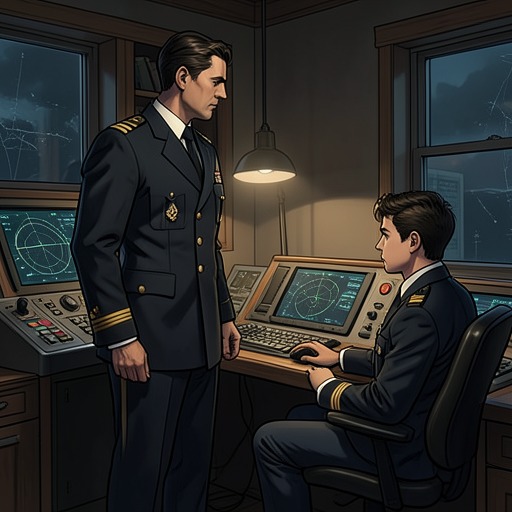
Carling stands ready at the alarm lever, awaiting Krause’s decision. Krause says no, and the refusal takes only seconds. The speed of the answer reflects long professional habit: he has already considered the competing demands of escort coverage, fuel, readiness, and the likelihood that further contacts may be reported. The moment also reveals the importance of delegated initiative. Carling is prepared to sound the alarm, but Krause retains responsibility for deciding whether this particular situation justifies imposing its costs on everyone aboard.
The decision changes when a more definite warning arrives. A high-frequency direction-finding report gives a bearing for a foreign transmission fifteen to twenty miles away, which Krause treats as a much stronger indication of a U-boat than James’s possible contact. He orders full speed and General Quarters. Carling operates the alarm, and warning horns sound through Keeling as men leave bunks, abandon unfinished letters, seize their equipment, and hurry to their posts. The ship’s response is immediate and material: the engine room reports flank speed as Keeling turns toward the threat.
Readiness, fatigue, and release
The order’s urgency does not make its duration limitless. After the fighting, Krause directs Charlie Cole to secure from General Quarters and return the ship to Condition Two, with hot food arranged for the men off watch. The release lets half the crew eat, rest, and warm themselves. Looking at the clock, Krause realizes that it is past thirteen hundred, more than four hours since he was called from his cabin and nearly three hours since the ship went to General Quarters. He regrets that he had brought the men to battle stations at all, but recognizes that the time already spent cannot be recovered.
The passage also shows that the commander is subject to the bodily conditions imposed by the alarm and the battle. Krause has been exposed to severe cold on the bridge, and after the engagement his fingers are numb enough that a pencil falls from his hand when he tries to write. The crew’s exhaustion is not an abstract cost: it is reflected in the cold, missed rest, and disrupted meals of the ship’s company. Securing from General Quarters is therefore a return to a less punishing state of readiness, not an abandonment of vigilance.
Later, while Keeling remains in contact with the enemy, Krause expressly cancels the routine General Quarters that would otherwise be sounded before dawn. He has learned that the ship can meet danger without keeping every sailor at action stations continuously; Condition Two and the existing readiness of the crew make an automatic call unnecessary. His standing instruction is that General Quarters should be sounded only for a real emergency, while the watch below receives a full four hours of rest unless circumstances intervene.
The watch system and the meaning of restraint
Krause’s policy is shaped by the limits of Keeling’s personnel as well as by the intensity of the fighting. The ship has received new weapons and instruments, but the additional men needed to operate them have strained its living space, and there are not enough trained ratings to provide three full watches in Condition Two. Even if more watch sections were available, Krause questions where the men could sleep or how they could be fed. He divides the company into four sections and uses a watch-and-watch routine in Condition Two to avoid adding unnecessary demands. Most officers work four hours on and eight off, but Krause also tries to spare them an avoidable alarm.
The policy is tested repeatedly rather than settled once. When a new watch comes on, Krause tells its sailors that a periscope was sighted ten minutes earlier and that Keeling is pursuing it, urging them to remain alert. Yet he does not treat this information as a reason to abandon the distinction between ongoing readiness and full General Quarters. Later, when asked whether the routine dawn alarm should be sounded, he again says no unless the real thing occurs, and orders the decision announced over the loudspeaker. The rule is thus not a fixed preference for quiet or for alarm, but a threshold that must be reassessed as evidence and operational conditions change.
General Quarters embodies a central tension in Krause’s command: the ship must be ready to fight, but readiness itself consumes the people and resources that make effective fighting possible. Sounding the alarm too late risks leaving the crew unprepared; sounding it too often risks fatigue, neglected work, and diminished responsiveness. By distinguishing it from Condition Two, refusing an alarm for a doubtful contact, and releasing the crew when the immediate crisis passes, Krause treats the order as a finite operational resource. Its force depends in part on his willingness not to use it routinely.